Neapolitan MastiffCharacteristics, history, training and care
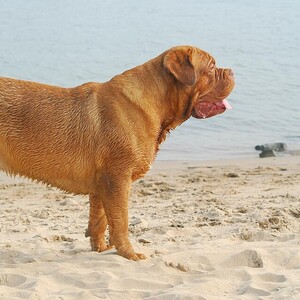
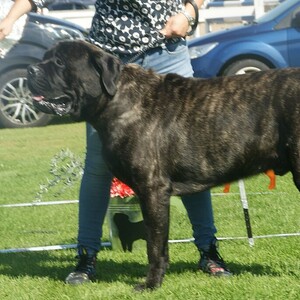
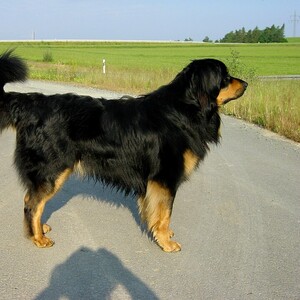
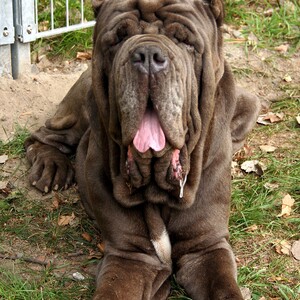
Neapolitan Mastiff. · przykuta / Wikimedia Commons, CC BY-SA 2.5. Cropped and resized.
The Neapolitan Mastiff is a giant, heavy and massive Italian molosser, with loose skin full of wrinkles and folds. It is the descendant of the great Roman mastiff and survived for centuries in the villages at the foot of Vesuvius. The standard describes it as steady and loyal, not at all aggressive, an ever-alert guardian, intelligent, noble and majestic.
Quick facts
| Common name | Neapolitan Mastiff (Mastino Napoletano) |
| Scientific name | Canis lupus familiaris |
| Country of origin | Italy |
| Official recognition | FCI, definitively since 8 March 1956 (group 2, molossoid breeds, mastiff type; standard no. 197); also recognised by the AKC |
| Lifespan | 7–9 years, according to the AKC |
| Size (males) | 65–75 cm at the withers; 60–70 kg |
| Size (females) | 60–68 cm at the withers; 50–60 kg |
| Coat type | Short, hard, dense, no longer than 1.5 cm |
| Common colours | Grey, lead grey, black, mahogany, fawn, stag red; all may be brindled |
| Energy level | Low in adults |
| Suited to an apartment? | No |
| Temperament | Steady, loyal, alert, intelligent, noble |
| Tendency to aggression | Low; a serious guardian |
| Good with children | Average; with supervision |
| Good with other animals | Average |
| Genetic predispositions | Hip and elbow dysplasia, “cherry eye”, heart disease, bloat |
- Primary category:Dog breeds
- Explore this animal's categories:
History and origin
The FCI standard says the Neapolitan Mastiff is the descendant of the great Roman mastiff described by Columella in the 1st century AD in “De re rustica”. Spread throughout Europe by the Roman legions, alongside which it fought, it is the ancestor of many mastiff breeds in other countries.
The breed survived for centuries in the villages at the foot of Vesuvius and, more generally, in the Naples area. From 1947 it was selected again, thanks to a group of breed enthusiasts. Wikipedia says it was recognised in Italy in 1949 and is closely related to the Cane Corso.
How the breed developed
- 1st century AD – Columella describes the Roman mastiff.
- Centuries – The breed survives around Vesuvius and the city of Naples.
- 1947 – The new selection of the breed begins.
- 1949 – The Italian Kennel Club recognises the breed.
- 8 March 1956 – The FCI recognises the breed.
Breed rating
| Feature | Stars |
|---|---|
| Training and intelligence | ★★★☆☆ |
| Easy to train | ★★★☆☆ |
| Intelligence | ★★★★☆ |
| Independence | ★★★★☆ |
| Stubbornness | ★★★★☆ |
| Behaviour and temperament | ★★★☆☆ |
| Affectionate with family | ★★★★★ |
| Friendly with children | ★★★☆☆ |
| Good with other dogs | ★★★☆☆ |
| Good with cats and other animals | ★★★☆☆ |
| Loyalty | ★★★★★ |
| Tendency to be aggressive | ★★☆☆☆ |
| Tendency to bark | ★☆☆☆☆ |
| Needs and care | ★★★☆☆ |
| Shedding | ★★☆☆☆ |
| Needs frequent grooming | ★★☆☆☆ |
| Activity and lifestyle | ★★☆☆☆ |
| Energy level | ★★☆☆☆ |
| Daily exercise needs | ★★★☆☆ |
| Suited to apartment life | ★☆☆☆☆ |
| Health and longevity | ★☆☆☆☆ |
| Life expectancy | ★★★☆☆ |
| Predisposition to genetic diseases | ★★★☆☆ |
| Working abilities and uses | ★★★★★ |
| Good guard dog | ★★★★★ |
| Good companion dog | ★★★☆☆ |
Indicative rating: 5 stars means the highest level. It is based on the ratings the American Kennel Club gives the breed and on the FCI standard.
Physical characteristics
The standard describes it as a large, heavy, massive dog of bulky appearance. The body is 15% longer than the height at the withers. The AKC says that unless you have been to “Jurassic Park”, you have never seen anything like a Mastino.
General appearance
The head is short and massive, with loose skin full of wrinkles and folds; the most typical fold runs from the outer corner of the eye down to the corner of the lips. The coat is short and hard, dense, of the same length all over the body, no longer than 1.5 cm.
| Feature | Neapolitan Mastiff |
|---|---|
| Size | Very large |
| Height at the withers | males: 65–75 cm; females: 60–68 cm |
| Weight | males: 60–70 kg; females: 50–60 kg |
| Coat | Short, hard, no more than 1.5 cm |
| Head | Short, massive, wrinkled |
| Drooling | Very heavy |
The preferred colours are grey, lead grey and black, but mahogany, fawn and deep fawn (stag red) are also accepted. All of them may be brindled. A small white patch on the chest or on the tips of the toes is allowed.
Training and socialisation
The standard describes it as steady and loyal, not at all aggressive, a guardian of the property and of those who live there, always alert, intelligent, noble and majestic.
The AKC says most adults are calm and sleep a lot, but puppies are active and curious, and adolescents can be energetic and strong. That is why the Mastino must be trained from an early age, so that it can be controlled when it becomes a strong, stubborn adolescent.
Tips for effective training
- Start training early. The adolescent will be strong and stubborn.
- Socialise it thoroughly. It is a serious guardian.
- Be calm and consistent. It is loyal, but stubborn.
- Keep a towel to hand. The AKC says it drools a lot.
Activity needs and lifestyle
The AKC says every dog needs to run and play often, but with the Mastino, running and sudden turns should be avoided, because its joints are easily damaged. Being big and heavy, it overheats quickly, so care is needed in hot weather.
| Activity | How often | Why it matters |
|---|---|---|
| Quiet walks | daily | Moderate exercise |
| Gentle play | daily | No jumping or sudden turns |
| Time in the shade | in summer | It overheats easily |
Tips for a balanced life
- It is not suited to beginners.
- In summer, walk it only in the morning and evening.
- Stop puppies' play before they get tired.
Care and health
Coat and skin care
The AKC says the short coat needs only an occasional bath. The eyes and ears should be checked and gently cleaned with a damp cloth, and the face and lips wiped after eating and drinking.
Common health problems
The AKC says it is generally healthy and that, although it has many wrinkles and loose skin, most dogs have no skin problems. Problems that may occur:
| Condition | Description | Common symptoms |
|---|---|---|
| Hip dysplasia | The hip joint forms incorrectly and, over time, arthritis develops | Limping, difficulty getting up or jumping, hip pain |
| Elbow dysplasia | The elbow joint develops incorrectly and arthritis appears | Limping on the front legs, especially after exercise |
| “Cherry eye” | The gland in the corner of the eye becomes inflamed and protrudes | Red swelling in the corner of the eye |
| Heart disease | Disorders of the heart | Tires quickly, laboured breathing |
| Gastric dilatation-volvulus (bloat) | The stomach fills with gas and may twist; this is a veterinary emergency | Swollen belly, trying to vomit without success, drooling, restlessness |
Other care
- Clean the skin folds regularly.
- Wipe its face after meals.
- Trim the nails regularly.
Diet and nutrition
The AKC says experienced breeders recommend a diet somewhat higher in fat and lower in protein, especially while the dog is growing.
Tips for a healthy diet
The table gives a starting estimate, calculated with the formula from the Merck Veterinary Manual. The first two calorie columns show the calories per day for a healthy adult dog. The last column shows what this means in dry food with 3,500–4,000 kcal per kilogram.
| Dog's weight | Calories per day (neutered) | Calories per day (not neutered) | Dry food per day (approximate) |
|---|---|---|---|
| 50 kg | 2,110 kcal | 2,370 kcal | 530–680 g |
| 60 kg | 2,410 kcal | 2,720 kcal | 600–780 g |
| 70 kg | 2,710 kcal | 3,050 kcal | 680–870 g |
- Split the food into two meals a day to reduce the risk of bloat.
- Do not let it run right after a meal.
- Puppies need growth food suited to very large breeds.
Foods to avoid
Some human foods are dangerous for dogs: chocolate, coffee, grapes and raisins, onions, garlic, xylitol (a sweetener used in chewing gum), macadamia nuts and alcohol.
Reproduction and development
Physical and emotional maturity
In dogs, sexual maturity usually comes between 6 and 12 months, but in large breeds it can be delayed until about two years. Very large breeds become adults only at around 2 years.
Mating and pregnancy
Pregnancy lasts about 63 days, counted from ovulation. Mating a female on her first heat is not recommended. The FCI standard requires that only healthy dogs of typical breed appearance are used for breeding.
Caring for the puppies
In large breeds, a litter has around 7 puppies on average. The puppies grow very fast, so they need growth food suited to large breeds. Socialisation starts in the first weeks.
Interesting facts
- A descendant of the Roman mastiff. Columella described it as early as the 1st century.
- It fought with the legions. The standard says it fought alongside the Roman legions.
- It drools a lot. The AKC gives it top marks for drooling.
- Related to the Cane Corso. Wikipedia says the two are closely related.
- It sleeps a lot. The AKC says adults are calm and sleep a lot.
Frequently asked questions
How big does it get?
Males measure 65–75 cm and weigh 60–70 kg; females measure 60–68 cm and weigh 50–60 kg.
Is it aggressive?
The standard says it is not aggressive, but it is a serious guardian.
Does it drool a lot?
Yes. The AKC gives it top marks for drooling.
How long does it live?
The AKC gives 7–9 years.