Chow ChowCharacteristics, history, training and care
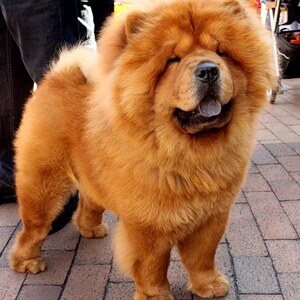
Chow Chow. · Prayitno / Wikimedia Commons, CC BY 2.0. Cropped and resized.
The Chow Chow is a powerful, compact Chinese dog with a lion-like ruff and a blue-black tongue. It has been known in China for more than 2,000 years, where it was a guard dog and hunting dog. It is dignified, calm, very clean, loyal to its family and reserved with strangers.
Quick facts
| Common name | Chow Chow |
| Scientific name | Canis lupus familiaris |
| Country of origin | China; patronage: Great Britain |
| Official recognition | FCI, definitively since 10 December 1957 (group 5, Asian spitz and related breeds; standard no. 205); also recognised by the AKC |
| Lifespan | 8–12 years |
| Size (males) | 48–56 cm at the withers |
| Size (females) | 46–51 cm at the withers |
| Weight | about 20–32 kg |
| Coat type | Rough (long, dense, with a ruff) or smooth (short, plush); woolly undercoat |
| Common colours | Black, red, blue, fawn, cream or white, in a single colour |
| Energy level | Moderate |
| Suited to an apartment? | Yes, with frequent walks |
| Temperament | Independent, loyal, calm, dignified |
| Tendency to aggression | Average; reserved with strangers and protective |
| Good with children | Average |
| Good with other animals | Poor to average with other dogs |
| Genetic predispositions | Hip and elbow dysplasia, eye diseases (including entropion) |
- Primary category:Dog breeds
- Explore this animal's categories:
History and origin
The Chow Chow's ancestors come from China, where it was used as a guard dog and for hunting. The FCI standard says it has been known there for more than 2,000 years and that it is related to the northern spitz breeds, but also has something of the mastiff.
Because of China's policy of isolation from the rest of the world, the Chow Chow only began to appear in other countries around 1800. Wikipedia notes that a genetic study concluded that the breed descends from local dogs in central China, from about 8,300 years ago.
How the breed developed
- More than 2,000 years ago – The breed is known in China as a guard dog and hunting dog.
- Around 1800 – The first Chow Chows reach countries outside China.
- 10 December 1957 – The FCI recognises the breed.
- 8 September 2026 – The newest FCI standard is published.
Breed rating
| Feature | Stars |
|---|---|
| Training and intelligence | ★★★☆☆ |
| Easy to train | ★★★☆☆ |
| Intelligence | ★★★★☆ |
| Independence | ★★★★★ |
| Stubbornness | ★★★★☆ |
| Behaviour and temperament | ★★★★☆ |
| Affectionate with family | ★★★★☆ |
| Friendly with children | ★★★☆☆ |
| Good with other dogs | ★★☆☆☆ |
| Good with cats and other animals | ★★☆☆☆ |
| Loyalty | ★★★★★ |
| Tendency to be aggressive | ★★★☆☆ |
| Tendency to bark | ★☆☆☆☆ |
| Needs and care | ★★★☆☆ |
| Shedding | ★★★☆☆ |
| Needs frequent grooming | ★★☆☆☆ |
| Activity and lifestyle | ★★★☆☆ |
| Energy level | ★★★☆☆ |
| Daily exercise needs | ★★★☆☆ |
| Suited to apartment life | ★★★☆☆ |
| Health and longevity | ★★★☆☆ |
| Life expectancy | ★★★☆☆ |
| Predisposition to genetic diseases | ★★★☆☆ |
| Working abilities and uses | ★★★★☆ |
| Good guard dog | ★★★★☆ |
| Good companion dog | ★★★★☆ |
Indicative rating: 5 stars means the highest level. It is based on the ratings the American Kennel Club gives the breed and on the FCI standard.
Physical characteristics
It is a powerful, compact, square dog, with a lion-like ruff around the head and over the shoulders. It walks with rather stiff legs, a gait typical of the breed.
General appearance
The small, thick ears stand erect, tilted forward, and give it the “scowling” expression typical of the breed. The oval eyes are dark. The tail is carried over the back. The tongue is blue-black.
| Feature | Chow Chow |
|---|---|
| Size | Medium |
| Height at the withers | males: 48–56 cm; females: 46–51 cm |
| Weight | about 20–32 kg |
| Coat | Rough or smooth, very dense, with undercoat |
| Tongue | Blue-black |
| Tail | Carried over the back |
The Chow Chow is a single colour: black, red, blue, fawn, cream or white, often shaded, but without patches. The area under the tail and the back of the thighs are often lighter.
Training and socialisation
The AKC says it is very intelligent, but can be stubborn. Patience, praise and regular practice are the best tools. Harsh methods should be avoided so that a relationship of trust can form.
Early socialisation and puppy classes help it become a well-balanced companion. A well-socialised Chow is never fierce, but refined and dignified.
Tips for effective training
- Socialise it early. It is reserved with strangers and with other dogs.
- Be patient and positive. Harshness damages its trust.
- Be consistent. It can be stubborn.
- Practise little and often. Short, regular sessions work best.
Activity needs and lifestyle
The AKC says it needs moderate exercise: moderately paced walks, four or more times a day, and calm play with toys, with no rough play or intense exertion.
| Activity | How often | Why it matters |
|---|---|---|
| Moderately paced walks | 4 or more times a day | The right kind of exercise for it |
| Calm play with toys | daily | Keeps it active |
| Activities together | weekly | Strengthen the bond with its owner |
Tips for a balanced life
- Avoid exertion during the hottest hours: it does not tolerate heat and humidity well.
- It does not need intense exertion or rough play.
- It is clean and easy to house-train.
Care and health
Coat and skin care
Both coat types are double and abundant. The AKC recommends thorough brushing at least twice a week and a bath once a month. After a bath it should be dried well, with a dryer on a cool setting. The coat of puppies and the hair around the head tangle easily.
Common health problems
The AKC says the breed is generally healthy, but a few problems can occur:
| Condition | Description | Common symptoms |
|---|---|---|
| Hip dysplasia | The hip joint forms incorrectly and, over time, arthritis develops | Limping, difficulty getting up or jumping, hip pain |
| Elbow dysplasia | The elbow joint develops incorrectly and arthritis appears | Limping on the front legs, especially after exercise |
| Entropion and other eye diseases | The eyelid turns inwards and irritates the eye | Watery eyes, frequent blinking, red eyes |
Other care
- Check the eyes and ears at every brushing.
- Trim the nails regularly.
- Check the coat for fleas and ticks.
Diet and nutrition
Choose a good-quality food suited to its age. Watch its weight so it does not get fat.
Tips for a healthy diet
The table gives a starting estimate, calculated with the formula from the Merck Veterinary Manual. The first two calorie columns show the calories per day for a healthy adult dog. The last column shows what this means in dry food with 3,500–4,000 kcal per kilogram.
| Dog's weight | Calories per day (neutered) | Calories per day (not neutered) | Dry food per day (approximate) |
|---|---|---|---|
| 20 kg | 1,060 kcal | 1,190 kcal | 260–340 g |
| 26 kg | 1,290 kcal | 1,450 kcal | 320–410 g |
| 32 kg | 1,510 kcal | 1,700 kcal | 380–490 g |
- Give it its food in two meals a day.
- Fresh water should always be available, especially in summer.
- A dog is at the right weight when you can feel its ribs under the coat without pressing hard.
Foods to avoid
Some human foods are dangerous for dogs: chocolate, coffee, grapes and raisins, onions, garlic, xylitol (a sweetener used in chewing gum), macadamia nuts and alcohol.
Reproduction and development
Physical and emotional maturity
In dogs, sexual maturity usually comes between 6 and 12 months. Most breeds become adults at around 13–15 months.
Mating and pregnancy
Pregnancy lasts about 63 days, counted from ovulation. Mating a female on her first heat is not recommended. The FCI standard requires that only healthy dogs of typical breed appearance are used for breeding.
Caring for the puppies
In dogs, a litter has 5–6 puppies on average, and the number rises with the size of the breed. Socialisation starts in the first weeks: gentle handling, everyday noises and new people.
Interesting facts
- A blue-black tongue. Its blue-black tongue is one of the best-known features of the breed.
- As clean as a cat. The AKC says owners consider it one of the cleanest dogs, with very little odour.
- A scowling expression. The forward-tilted ears give it the “scowling” expression required by the standard.
- A stiff gait. Walking on rather straight legs is typical of the breed.
- A very old breed. Wikipedia says it has been identified as a “basal” breed, older than the modern breeds.
Frequently asked questions
Why does the Chow Chow have a blue tongue?
The blue-black tongue is a characteristic feature of the breed.
How big does it get?
Males measure 48–56 cm, females 46–51 cm; they weigh about 20–32 kg.
Is it a good family dog?
Yes, it is loyal and devoted, but reserved with strangers and needs socialisation.
Does it cope with heat?
Not really. It must be kept from exertion during the hottest hours.
How long does it live?
Its life expectancy is 8–12 years.