BeeInteresting facts and information
Bees are a diverse group of pollinating insects. This profile focuses mainly on honey bees (Apis), which form colonies and produce honey and wax. Many other bees are solitary and do not live in honey-bee hives.
Bees support flowering plants by transferring pollen. Habitat loss, pesticides, parasites and disease affect different species in different ways; the status of managed honey-bee colonies should not be used as a measure of all wild bees.
Quick facts
| Common name | Bees |
| Scientific name | Apis (honey bees); bees as a whole include many other genera |
| Typical lifespan | About 4-6 weeks (summer worker) up to about 3-5 years (queen) |
| Maximum speed | About 25 km/h (honey bee) |
| Height | Approximately 1-2 cm |
| Length | About 1-1.5 cm (worker honey bee), up to about 2 cm (queen) |
| Weight | About 0.1 g (worker honey bee), about 0.2 g (queen) |
| Diet type | Nectar and pollen |
| Main predators | Birds, wasps and hornets, spiders, insect-eating mammals |
| Conservation status | Varies by species; managed colonies and wild-bee conservation are different issues |
| Number of species | More than 20,000 bee species worldwide; only a few are honey bees in the genus Apis |
| Type of flight | Honey-bee wings beat about 200-230 times per second |
| Visual system | 5 eyes: 2 compound eyes + 3 simple eyes (ocelli) |
| Communication system | Pheromones and dances |
| Dominant color | Colour varies greatly among bee species |
| Ecological role | Pollination, biodiversity maintenance |
| Production of honey | Honey yield depends on species, colony condition, weather and management |
| Optimal hive temperature | Honey bees keep their brood at about 34-35 °C |
| Geographical area | On all continents except Antarctica |
- Primary category:Insects
- Explore this animal's categories:
Interesting facts
- Bees can recognise human faces - Experiments have shown that honey bees can learn to recognise faces, even though their brains are smaller than a grain of rice; they learn patterns and shapes very quickly.
- Bees carry electric charge - As bees fly, they build up a small positive electric charge, while flowers usually have a negative charge; this helps pollen stick to the bee, and bees can even sense whether a flower has recently been visited.
- The queen can lay up to about 2,000 eggs a day - In the busiest season, a honey-bee queen lays huge numbers of eggs, keeping the colony going.
- The waggle dance - Honey bees perform a "waggle dance", often described as a figure-of-eight dance, that tells other bees the direction and distance of good food sources.
- Bees and the weather - Bees rarely fly in rain or strong wind and often stay close to the hive when bad weather is coming.
- A worker honey bee dies after stinging - Its sting is barbed and stays in the skin, tearing away part of the bee's abdomen. Wasps, which have smooth stings, can sting several times, and so can the queen bee. Wasp.
- Honey storage – Low water content helps properly stored honey resist microbial growth, but claims that any ancient honey is safe to eat are misleading.
Records and remarkable features
- The largest bee - Wallace's giant bee (Megachile pluto) from Indonesia is the largest known bee: females are about 4 cm long, with a wingspan of over 6 cm.
- Flight speed - A honey bee (Apis mellifera) can fly at about 25 km/h.
- The biggest combs - In the Himalayas, the Himalayan giant honey bee (Apis laboriosa) builds huge open combs on steep cliffs, sometimes about 1.5 metres across.
- The longest-lived bee in the colony - A queen can live up to about 3-5 years, much longer than the workers, which live only a few weeks in summer.
- Honey production - A strong colony can produce tens of kilograms of honey in a good season, depending on flowers and weather.
Characteristics
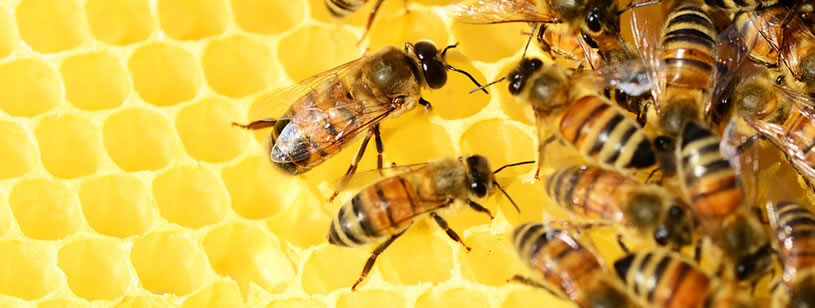
Bees are flying insects of the order Hymenoptera. Their body is divided into three main parts: head, thorax and abdomen. Most bees are covered with fine, branched hairs that collect pollen.
- Head - It has two large compound eyes, which give a wide field of view, and three simple eyes (ocelli) on top, which detect light and help with orientation. The very sensitive antennae are used for smell, touch and sensing vibrations.
- Thorax - The two pairs of wings and the three pairs of legs are attached here.
- Abdomen - In females, it contains the venom gland and the sting, used for defence. Worker honey bees have a barbed sting, while the queen's sting is smooth, so she can sting several times.
Survival adaptations
- Hairy bodies - Fine hairs trap pollen and make bees excellent pollinators.
- Pollen baskets - Honey bees and bumblebees have "pollen baskets" on their back legs, where they carry the pollen they collect.
- Linked wings - Tiny hooks join the front and back wings in flight, so they work together.
- The sting - Used for defence; its venom causes pain and swelling.
Habits and behaviour
Honey bees are highly social insects that live in well-organised colonies. A colony has three castes: the queen, the workers and the drones. Most other bee species, however, live alone.
Structure of a colony
- The queen - The only fully fertile female, which lays the eggs. Early in life, she mates with many drones on one or a few mating flights and stores their sperm to lay eggs for years.
- Workers - Females that normally do not breed. They do all the other work: feeding the larvae, cleaning the hive, building comb, collecting pollen and nectar and defending the colony.
- Drones - The males of the colony, whose main role is to mate with young queens from other colonies. A drone dies after mating, and in autumn the workers push the remaining drones out of the hive.
Communication methods
Bees communicate with scents called pheromones and with dances. The best known is the "waggle dance", which tells other bees the direction and distance of food.
Territorial marking and defence
When the hive is threatened, guard bees release an alarm pheromone that smells a little like bananas and calls other bees to help. When a worker stings, it releases more of this scent, which marks the target for other bees.
Hibernation and adaptation to seasons
Honey bees do not hibernate. In winter, they form a tight cluster inside the hive and shiver their flight muscles to keep warm, living on the honey they stored in summer.
Browse more animals: Animals beginning with A.
Habitat and geographic distribution
Bees live on every continent except Antarctica. They are found in forests, grasslands, mountains, deserts and even cities, wherever there are flowers for nectar and pollen. Animals of Antarctica.
| Region | Population information |
|---|---|
| Europe | Many wild bee species are declining; the honey bee is native here |
| North America | Honey bees were brought by Europeans; beekeepers often lose many colonies each winter |
| Asia | Home to several honey-bee species, including the giant and dwarf honey bees |
| Africa | Many bee species, including African honey bees |
| Australia | About 2,000 native bee species, plus introduced honey bees |
Factors affecting distribution
- Flowers - Bees do best where many different plants flower through the year.
- Climate - Most bees are active only when it is warm enough to fly.
- Pesticides - In many farming areas, pesticides harm bees.
- Parasites and disease – The mite Varroa destructor and several pathogens can harm managed honey-bee colonies.
Impact of climate change
Climate change can make plants flower at different times from when bees are active, and extreme heat and drought reduce food. Some wild bees, such as bumblebees, are losing parts of their range.
Diet
Bees feed almost entirely on food from flowers. Nectar, a sweet liquid, gives them energy, while pollen provides protein and fat needed by the growing larvae.
| Food type | Main function |
|---|---|
| Nectar | Energy for flight; turned into honey |
| Pollen | Main source of protein, especially for larvae |
| Water | Cooling the hive and diluting honey |
| Honey | Energy store for winter and bad weather |
Methods of food collection
Bees suck up nectar with their long, tongue-like proboscis. Pollen sticks to their hairy bodies; they brush it into the pollen baskets on their back legs and carry it home.
Production of honey
Honey is made in several steps:
- Collecting nectar - Worker bees visit flowers and suck up nectar with their proboscis.
- Processing - The nectar is carried in the bee's honey stomach (crop), where enzymes begin to change it.
- Drying - Back at the hive, the nectar is placed in the wax cells of the comb, and bees fan it with their wings to evaporate water.
- Sealing - When the honey is thick enough, the bees cover the cells with wax.
Seasonal dietary adjustments
In the warm months, bees collect as much nectar and pollen as they can. In winter, they live on stored honey. When there is not enough food, beekeepers may feed hives with sugar syrup.
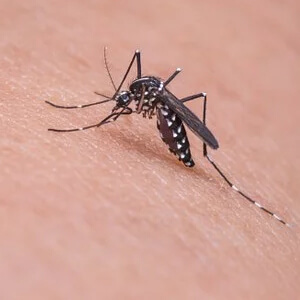
See also information about mosquitoes: Mosquito.
Reproduction and life cycle
In a honey-bee colony, reproduction is controlled by the colony, and each caste has its own role.
The Queen's mating
A young queen leaves the hive on one or a few mating flights and mates in the air with many drones. She stores their sperm and uses it to fertilise eggs for the rest of her life. New colonies are formed when the old queen leaves with a large group of workers in a "swarm".
Bees development
Honey bees go through four stages: egg, larva, pupa and adult. Development takes a different time for each caste:
| Stage | Duration (worker) | Duration (queen) | Duration (drone) |
|---|---|---|---|
| Egg | 3 days | 3 days | 3 days |
| Larva | About 6 days | About 5 days | About 6-7 days |
| Pupa | About 12 days | About 8 days | About 14 days |
| Adult | About 4-6 weeks in summer, several months in winter | Up to about 3-5 years | A few weeks to a few months |
The role of pheromones in reproduction
Pheromones produced by the queen keep the colony working together and stop most workers from laying eggs.
Care of the juveniles
For the first few days, all larvae are fed royal jelly, a rich food made by young worker bees. Worker larvae are then switched to a mix of pollen and honey, while larvae chosen to become queens are fed royal jelly all the time, which makes them develop into queens.
Name and history
Origin of the name
The English word "bee" comes from Old English bēo, a word shared with other Germanic languages. The Latin word for bee, apis, is used as the scientific name of the honey-bee genus. In other languages, bees are called:
- French: abeille
- German: Biene
- Italian: ape
- Spanish: abeja
- Russian: пчела (pchela)
Taxonomic classification
Bees belong to the order Hymenoptera, together with wasps and ants. Honey bees belong to the family Apidae. The best-known species is the western honey bee, Apis mellifera, but there are more than 20,000 species of bees in the world. Ant.
| Classification | Name |
|---|---|
| Kingdom | Animalia |
| Phylum | Arthropoda |
| Class | Insecta |
| Order | Hymenoptera |
| Family | Apidae |
| Genus | Apis |
| Species | Apis mellifera (best known) |
The first documentation on bees
- The oldest known bee fossil, preserved in amber from Myanmar, is about 100 million years old, from the Cretaceous period.
- Ancient Egyptians kept bees in hives by about 2400 BC, and the bee was a royal symbol.
- Aristotle (384-322 BC) wrote some of the first detailed descriptions of bee colonies.
- Until sugar became common, honey was the main sweetener in Europe, and beeswax was used to make candles.
Cultural significance and mythology
In many cultures, bees have been linked with gods, hard work, wealth and good order.
Ancient Egypt
- The bee was a symbol of the kings of Lower Egypt.
- The Egyptians believed that bees were born from the tears of the sun god Ra.
- Beekeeping was important, and honey was used as an offering to the gods and as medicine.
Greek and Roman mythology
- According to myth, the infant Zeus was fed honey by the nymph Melissa, whose name means "bee".
- The priestesses of the goddess Demeter were called Melissae, "bees".
- The Romans saw honey as a gift of the gods and used it in religious rituals.
Christianity and the Middle Ages
- The bee was a symbol of virtue, hard work and good order.
- Saint Ambrose, the patron saint of beekeepers, is often shown with a beehive; legend says bees settled on his face when he was a baby.
- In heraldry, the bee symbolised hard work and prosperity; Napoleon later chose the bee as an emblem of his empire.
Asia and the Middle East
- In Hindu mythology, Kamadeva, the god of love, carries a bow whose string is made of honey bees.
- In the Quran, a whole chapter, Surah An-Nahl ("The Bee"), is named after the bee.
Conservation status and threats
In recent decades, many wild bees and managed honey-bee colonies have suffered heavy losses. Because bees pollinate many crops and wild plants, their decline is a serious problem.
Main threats
| Factor | Impact on bees |
|---|---|
| Pesticides (such as neonicotinoids) | Affect the nervous system, causing disorientation and death |
| Climate change | Changes flowering times and reduces food |
| Habitat loss | Loss of meadows and large single-crop fields reduce the variety of flowers |
| Diseases and parasites | The Varroa destructor mite and the viruses it spreads weaken honey-bee colonies |
| Pollution | Can affect bees' food and their ability to find their way |
Conservation efforts
Governments, scientists, farmers and conservation groups help bees by:
- Restricting harmful pesticides.
- Planting wildflower strips and hedges on farmland.
- Researching bee health and supporting sustainable beekeeping.
- Teaching people how important bees are and how to help them in gardens.
In 2018, the European Union banned the outdoor use of three neonicotinoid pesticides to protect bees.
In popular culture
Bees often appear in books, films, cartoons and modern symbols.
In literature
- Winnie-the-Pooh (1926) - A. A. Milne's famous bear is always looking for honey.
- The Adventures of Maya the Bee (1912) - Waldemar Bonsels's story, later made famous by cartoons.
- The History of Bees (2015) - Maja Lunde's novel imagines a world where bees have disappeared.
In films and animations
- Bee Movie (2007) - An animated film starring Jerry Seinfeld that highlights the importance of bees for pollination.
- Transformers - Bumblebee, one of the most popular robots in the series, is named after the bumblebee and shares its yellow-and-black colours.
- The Swarm (1978) - A disaster film about a massive attack by killer bees.
In modern symbolism
- The worker bee is a symbol of the city of Manchester, standing for its hard-working spirit.
- The bee is often used in environmental campaigns, including campaigns against harmful pesticides.
Did you know? About bee
- Besides honey bees, stingless bees also make honey that people eat.
- Bees must visit about two million flowers to make about half a kilogram of honey.
- A honey bee visits about 50-100 flowers on each foraging trip.
- A honey-bee colony usually has about 20,000-60,000 bees and one queen.
- A honey-bee queen usually lays most of a colony’s eggs. Worker bees can sometimes lay unfertilised eggs; egg-laying rate varies with colony and season.
- The buzzing of bees is the sound of their wings, which beat about 11,400 times a minute.
- A honey-bee colony usually includes a queen, female workers and male drones.
- A worker bee can carry a load of nectar or pollen weighing up to about 80% of its own body weight.
- Bees have periods of sleep and rest; they are not continuously awake.
- A worker honey bee dies after it stings, but a queen can sting and survive.
- Each bee colony has its own smell, so its members can recognise each other.
- A honey bee has a crop for carrying nectar as well as a digestive tract. Calling this “two stomachs” is an oversimplification.
- Bees use the sun as a compass, and on cloudy days they use polarised light to find their way.
- Honey bees develop through four stages: egg, larva, pupa and adult.
- Honey bees have two pairs of wings. Small hooks help link the forewing and hindwing during flight.
- Older worker bees collect nectar, pollen, water and a sticky plant resin called propolis.
- Male honey bees are called drones; their main role is to mate with queens.
- Bees cannot see red, but they can see ultraviolet light.
- Female honey bees can sting. A sting can be serious, especially with allergy; a fixed “fatal number” cannot safely describe the risk.
- Honey bees tell each other where food is by dancing.
- In winter, honey bees form a tight cluster in the hive to keep the queen and themselves warm, feeding on stored honey.
- Most bee species are solitary; the social honey-bee colony is only one way that bees live.
- In a project at Los Alamos National Laboratory, scientists trained bees to detect explosives.
- Bees can learn to recognise human faces.
- When a colony raises new queens, they may fight; the colony can also divide by swarming.
- Honey bees build their combs from beeswax.
- Over millions of years, flowers and bees evolved together.
- Bees especially like blue and purple flowers, such as lavender and rosemary.
- Bee sizes vary greatly between species; tiny stingless bees are much smaller than familiar honey bees.
- Wallace's giant bee from Indonesia is the largest known bee, about 4 cm long.
- Beeswax is made by glands on the underside of a worker bee's abdomen.