Italian Short-haired SegugioCharacteristics, history, training and care
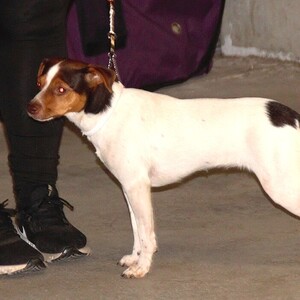
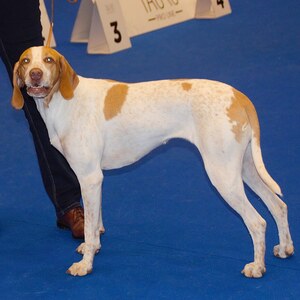
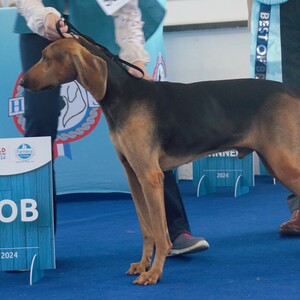
Italian Short-haired Segugio. · Canarian / Wikimedia Commons, CC BY 4.0. Cropped and resized.
The Italian Short-haired Segugio (Segugio Italiano a pelo raso) is a medium-sized Italian hound, used mainly to hunt hare and wild boar. Wikipedia says it is one of the two forms of the Segugio Italiano, the other being the rough-haired one, which is almost identical apart from the coat and slightly larger. The FCI standard describes it as hardy, fast and very keen, with a balanced but not very demonstrative temperament, a gentle expression and a resonant, very pleasant voice.
Quick facts
| Common name | Italian Short-haired Segugio (Segugio Italiano a pelo raso) |
| Scientific name | Canis lupus familiaris |
| Country of origin | Italy |
| Official recognition | FCI, definitively since 11 May 1993 (group 6, scent hounds; standard no. 337); in the AKC Foundation Stock Service programme since 2018 |
| Lifespan | 11–13 years, according to the AKC |
| Size (males) | 52–58 cm at the withers; 18–28 kg |
| Size (females) | 48–56 cm at the withers; 18–28 kg |
| Coat type | Short, dense, smooth, with a horsehair texture |
| Common colours | Solid fawn, from deep red to washed-out fawn, black and tan |
| Energy level | High |
| Suited to an apartment? | Only with plenty of exercise |
| Temperament | Keen, balanced, gentle, sensitive |
| Tendency to aggression | Low; the AKC says it is neither aggressive nor shy |
| Good with children | Very good, according to the AKC |
| Good with other animals | Very good with other dogs; poor with small animals |
| Genetic predispositions | No known breed-specific diseases; the long ears need attention |
- Primary category:Dog breeds
- Explore this animal's categories:
History and origin
The FCI standard says the origin of the Segugio is very old: these dogs are said to descend from the primitive hounds of ancient Egypt, brought to the Mediterranean coasts by Phoenician merchants. Dogs of the same type appear beside the statues of Diana the huntress in the Naples Museum and the Vatican Museums.
Wikipedia says these dogs were widely used in the great hunts of the Italian Renaissance. In 1886, in Milan, dogs with short and rough coats were shown, with no clear separation between breeds. The club founded in 1920 in Lodi was dissolved in 1939, and in 1947, when only 69 dogs were still registered, the Società Italiana Pro Segugio was founded. The FCI fully accepted the short-haired variety in 1993.
How the breed developed
- Antiquity – Similar dogs beside the statues of Diana.
- The Renaissance – It is used in the great hunts.
- 1886 – It is shown in Milan.
- 1947 – The Società Italiana Pro Segugio club.
- 11 May 1993 – The FCI recognises the short-haired variety.
- 2018 – The AKC adds it to the Foundation Stock Service.
Breed rating
| Feature | Stars |
|---|---|
| Training and intelligence | ★★★★☆ |
| Easy to train | ★★★☆☆ |
| Intelligence | ★★★★★ |
| Independence | ★★★☆☆ |
| Stubbornness | ★★★☆☆ |
| Behaviour and temperament | ★★★★★ |
| Affectionate with family | ★★★★★ |
| Friendly with children | ★★★★★ |
| Good with other dogs | ★★★☆☆ |
| Good with cats and other animals | ★☆☆☆☆ |
| Loyalty | ★★★★★ |
| Tendency to be aggressive | ★☆☆☆☆ |
| Tendency to bark | ★★★★★ |
| Needs and care | ★★★☆☆ |
| Shedding | ★★☆☆☆ |
| Needs frequent grooming | ★★★☆☆ |
| Activity and lifestyle | ★★★★☆ |
| Energy level | ★★★★★ |
| Daily exercise needs | ★★★★★ |
| Suited to apartment life | ★★★☆☆ |
| Health and longevity | ★★★☆☆ |
| Life expectancy | ★★★★☆ |
| Predisposition to genetic diseases | ★★☆☆☆ |
| Working abilities and uses | ★★★☆☆ |
| Good hunting dog | ★★★★★ |
| Good companion dog | ★★★★☆ |
Indicative rating: 5 stars means the highest level. It is based on the ratings the American Kennel Club gives the breed and on the FCI standard.
Physical characteristics
The AKC describes it as fleet-footed and elegant, a tenacious hunter with remarkable stamina. It is a medium-sized hound, adapted to the most varied terrain, with a “Roman nose” (a slightly convex profile).
General appearance
The hair is short all over the body, straight, dense, close-lying and smooth, with a texture like horsehair. A few harsher hairs on the body, muzzle or legs are not a fault.
| Feature | Italian Short-haired Segugio |
|---|---|
| Size | Medium |
| Height at the withers | males: 52–58 cm; females: 48–56 cm |
| Weight | 18–28 kg |
| Coat | Short, smooth |
| Ears | Long |
| Type | Hound |
The standard accepts solid fawn in all shades, from deep red to washed-out fawn, and black and tan, with the tan markings on the muzzle, eyebrows, chest and legs.
Training and socialisation
The AKC describes it as well-mannered and alert, a good watchdog for home and owner, neither aggressive nor shy. It is brave but not bold, rather cautious and curious. It is easy to train, but it is sensitive and needs gentle training: harshness can make it withdrawn.
According to the AKC, its kindly nature, intelligence and gentle, docile temperament make it a good companion for people of all ages. Like any hound, it needs a lot of patience with the recall.
Tips for effective training
- Be gentle. The AKC says harshness makes it withdrawn.
- Practise the recall. On a scent, it forgets about you.
- Keep it on a lead. Its hunting instinct is strong.
- Use rewards. It learns easily.
Activity needs and lifestyle
The AKC recommends a brisk 30–45-minute walk every day and 1–2 hours of free exercise. People living in flats need to take it to dog parks often. Games and dog sports keep it busy.
| Activity | How often | Why it matters |
|---|---|---|
| Brisk walk | 30–45 minutes daily | Physical fitness |
| Free exercise | 1–2 hours daily | Energy |
| Scent work | several times a week | Hound instinct |
Tips for a balanced life
- Clean and air the ears often.
- Keep it on a lead outside the yard.
- Give it activities for its nose.
Care and health
Coat and skin care
The AKC says brushing once or twice a week is enough. The long ears must be cleaned regularly, kept dry and turned back often to let air in and prevent infections. Trim the nails as needed.
Common health problems
There are no published health studies for the breed and no known breed-specific diseases. The AKC draws attention to the ears:
| Condition | Description | Common symptoms |
|---|---|---|
| Ear infections | Infections of the long ears | Head shaking, bad smell, red ears |
| Hip dysplasia | The hip joint forms incorrectly and, over time, arthritis develops | Limping, difficulty getting up or jumping, hip pain |
Other care
- Clean the ears regularly.
- Check the teeth for tartar.
- Check for ticks after outings.
Diet and nutrition
The AKC says that, for performance, it needs a high-protein, low-fat food made for working dogs. For less active dogs, ask your vet for advice.
Tips for a healthy diet
The table gives a starting estimate, calculated with the formula from the Merck Veterinary Manual. The first two calorie columns show the calories per day for a healthy adult dog. The last column shows what this means in dry food with 3,500–4,000 kcal per kilogram.
| Dog's weight | Calories per day (neutered) | Calories per day (not neutered) | Dry food per day (approximate) |
|---|---|---|---|
| 18 kg | 980 kcal | 1,100 kcal | 240–310 g |
| 23 kg | 1,180 kcal | 1,320 kcal | 300–380 g |
| 28 kg | 1,360 kcal | 1,530 kcal | 340–440 g |
- Fresh water should always be available.
- Do not let it run right after a meal.
- A dog is at the right weight when you can feel its ribs without pressing hard.
Foods to avoid
Some human foods are dangerous for dogs: chocolate, coffee, grapes and raisins, onions, garlic, xylitol (a sweetener used in chewing gum), macadamia nuts and alcohol.
Reproduction and development
Physical and emotional maturity
In dogs, sexual maturity usually comes between 6 and 12 months. Most breeds become adults at around 13–15 months.
Mating and pregnancy
Pregnancy lasts about 63 days, counted from ovulation. Mating a female on her first heat is not recommended. The FCI standard requires that only healthy dogs of typical breed appearance are used for breeding.
Caring for the puppies
In dogs, a litter has 5–6 puppies on average, and the number rises with the size of the breed. Socialisation starts in the first weeks: gentle handling, everyday noises and new people.
Interesting facts
- “SEGIT”. The AKC says the breed is also called SEGIT.
- A Roman nose. Its profile is slightly convex.
- Egyptian ancestors. The standard links it to the hounds of ancient Egypt.
- Two coat varieties. The rough-haired variety is almost genetically identical.
- An Italian plural. The plural is “Segugi Italiani”, the AKC says.
In popular culture
The statues of Diana the huntress
The FCI standard says a dog of the same type appears beside the statues of the goddess Diana in the Naples Museum and the Vatican Museums.
Frequently asked questions
How does it differ from the rough-haired Segugio?
Its short coat and slightly smaller size.
How big does it get?
Males measure 52–58 cm and females 48–56 cm; they weigh 18–28 kg.
Is it good with children?
The AKC gives it the top score for compatibility with young children.
How long does it live?
The AKC gives 11–13 years.