Common barbelBarbus barbus — habitat, diet and reproduction
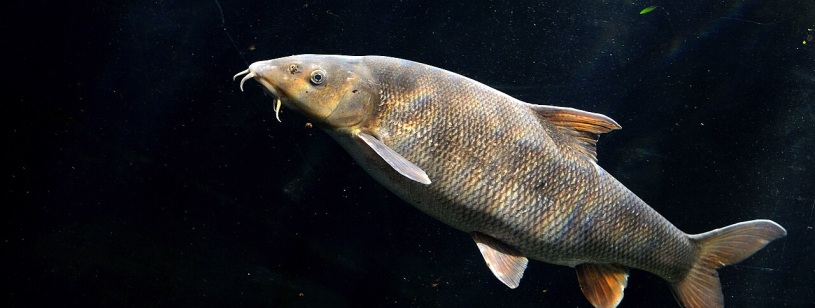
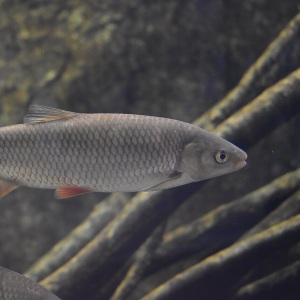
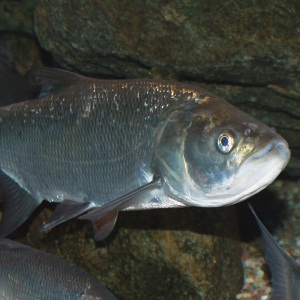
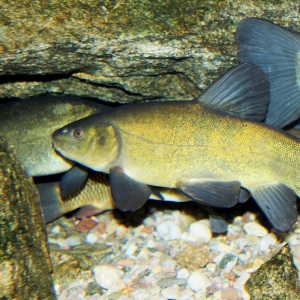
Common barbel (Barbus barbus) photographed underwater. · Linie29 / CC BY-SA 3.0 (https://creativecommons.org/licenses/by-sa/3.0). Cropped and resized.
The common barbel is a powerful fish that spends much of its life near the riverbed. A downward-facing mouth and four sensitive barbels help it locate food among stones. Its elongated body and fins suit flowing water, while quieter sections provide places to rest.
Quick facts
| Common name | Common barbel |
| Scientific name | Barbus barbus |
| Lifespan | Can reach around 15–20 years; varies between populations |
| Diet | Omnivore, mainly bottom-dwelling invertebrates |
| Predators | Pike, otters and fish-eating birds |
| Conservation status | Least Concern (LC), global assessment 2022 |
| Distribution | Europe, including the Danube basin |
| Habitat | Rivers with gravel and stone substrates |
| Length | Often a few tens of centimetres; large fish exceed 50 cm |
| Family | Cyprinidae |
| Distinctive feature | Four barbels around the mouth |
- Primary category:Fish
- Explore this animal's categories:
Interesting facts
- Four sensory barbels help locate food.
- The downward-facing mouth suits bottom feeding.
- Adults may move upstream before spawning.
- Juveniles also use shallow margins with weaker flow.
Characteristics
The elongated body has a greenish-brown or bronze back and a paler belly. A projecting snout partly covers the fleshy-lipped mouth.
Two pairs of barbels surround it, distinguishing barbel from some other small bottom fishes with only one pair. Fins may show orange or reddish-brown tones. Common barbel should not automatically be confused with smaller related species from upland streams.
Behaviour
Much feeding takes place close to the substrate, often around dawn or dusk. Bankside cover, submerged structures and deeper sections provide shelter.
During cold weather, fish can gather where the flow is weaker. A preference for rivers does not mean constant swimming in the fastest current. Varied depths and flows allow feeding, rest and movement towards breeding areas.
Habitat and distribution
The species is native to Europe, including the Danube basin. Romanian populations use numerous river sections with flowing water and suitable substrates.
Gravel and stones support invertebrates and provide spawning habitat. Good oxygen availability matters, especially in warm periods. Marginal areas also have a role because young fish cannot withstand the same currents as large adults.
Diet and feeding
Food includes insect larvae, worms, crustaceans and molluscs. Small fishes or plant material may also be consumed, but bottom animals are particularly important.
Barbels detect food close to the mouth, while fleshy lips and mouth position help take organisms from the substrate. This ties barbel to communities between stones. Fine sediment covering the riverbed can change the food available.
Reproduction and life cycle
Spawning occurs in late spring and summer, with regional variation. Adults may move upstream to shallow gravel runs.
Females lay in several batches. The eggs are described as non-adhesive and settle within the substrate, unlike those of fishes that attach eggs to plants. Larvae initially use yolk reserves, then begin feeding. Quieter marginal water is important during early life.
Name and history
The name Barbus barbus refers to the conspicuous barbels. The species belongs to Cyprinidae.
“Barbel zone” describes river stretches with characteristic flow and substrate conditions. It does not imply that only barbel live there or that fish communities have rigid boundaries. Common barbel also distinguishes this species from related fishes bearing similar names.
Conservation and threats
The global category is Least Concern. Local breeding success nevertheless depends on connected rivers and suitable substrates.
Barriers can restrict movements, and altered flows change depth and current. Fine sediment may cover feeding and spawning gravel. Conserving varied river habitats supports barbel alongside the other animals that share its freshwater ecosystem.
Frequently asked questions
How many barbels does it have?
Four, arranged in two pairs around the mouth.
Does it mainly feed at the surface?
No. Its downward-facing mouth and sensory barbels mainly serve bottom feeding.
Why does gravel matter?
It supports food organisms and provides suitable spawning habitat.
Are all barbels Barbus barbus?
No. Several related species exist; this article concerns common barbel.