French BulldogCharacteristics, history, training and care
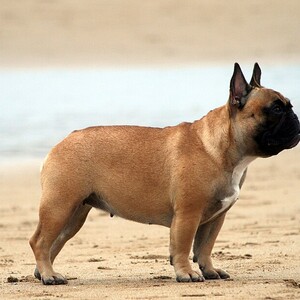
French Bulldog. · Cotebasque.es / Wikimedia Commons, CC BY-SA 4.0. Cropped and resized.
The French Bulldog is a small, compact and muscular companion dog with large, erect “bat ears”. It appeared in Paris in the 19th century and has become one of the most popular breeds in the world. It is sociable, lively, playful and very devoted to its owner, but its short face can cause breathing problems.
Quick facts
| Common name | French Bulldog (Bouledogue Français, Frenchie) |
| Scientific name | Canis lupus familiaris |
| Country of origin | France |
| Official recognition | FCI, definitively since 30 November 1954 (group 9, small molossian-type companion dogs; standard no. 101); also recognised by the AKC |
| Lifespan | 10–12 years, according to the AKC |
| Size (males) | 27–35 cm at the withers; 9–14 kg |
| Size (females) | 24–32 cm at the withers; 8–13 kg |
| Coat type | Short, close-lying, glossy and soft, without undercoat |
| Common colours | Fawn, brindled or not, with or without white patches |
| Energy level | Moderate |
| Suited to an apartment? | Yes |
| Temperament | Sociable, lively, playful, possessive, very devoted to its owner |
| Tendency to aggression | Low |
| Good with children | Very good |
| Good with other animals | Good |
| Genetic predispositions | Brachycephalic syndrome (breathing problems), spinal problems, eye diseases, heat sensitivity |
- Primary category:Dog breeds
- Explore this animal's categories:
History and origin
The FCI standard says the French Bulldog is related to the English Bulldog and to the small mastiffs of France. Today's breed is the result of crosses made by enthusiastic breeders in the working-class districts of Paris in the 1880s. It was the dog of market porters, butchers and coachmen, but it quickly won over high society and the world of artists.
Wikipedia says that lace workers from Nottingham who had lost their jobs moved to Normandy with their small bulldogs, which became very popular in France. The first breed club was founded in Paris in 1880, the first dog was shown in 1887, and in 1898 the French Kennel Club recognised the breed.
How the breed developed
- Mid-19th century – Small bulldogs from England reach France.
- 1880 – The first breed club is founded in Paris.
- 1885 – The first French Bulldog is registered.
- 1898 – The first standard; the French Kennel Club recognises the breed.
- 30 November 1954 – The FCI recognises the breed.
- 2023 – It becomes the most popular breed in the AKC rankings, ahead of the Labrador.
Breed rating
| Feature | Stars |
|---|---|
| Training and intelligence | ★★★★☆ |
| Easy to train | ★★★★☆ |
| Intelligence | ★★★★☆ |
| Independence | ★★★☆☆ |
| Stubbornness | ★★★★☆ |
| Behaviour and temperament | ★★★★☆ |
| Affectionate with family | ★★★★★ |
| Friendly with children | ★★★★★ |
| Good with other dogs | ★★★★☆ |
| Good with cats and other animals | ★★★☆☆ |
| Loyalty | ★★★★★ |
| Tendency to be aggressive | ★☆☆☆☆ |
| Tendency to bark | ★☆☆☆☆ |
| Needs and care | ★★★★☆ |
| Shedding | ★★★☆☆ |
| Needs frequent grooming | ★☆☆☆☆ |
| Activity and lifestyle | ★★★★☆ |
| Energy level | ★★★☆☆ |
| Daily exercise needs | ★★☆☆☆ |
| Suited to apartment life | ★★★★★ |
| Health and longevity | ★★★★☆ |
| Life expectancy | ★★☆☆☆ |
| Predisposition to genetic diseases | ★★★★★ |
| Working abilities and uses | ★★★☆☆ |
| Good watchdog | ★★★☆☆ |
| Good companion dog | ★★★★★ |
Indicative rating: 5 stars means the highest level. It is based on the ratings the American Kennel Club gives the breed and on the FCI standard.
Physical characteristics
The AKC says it looks like a miniature bulldog, except for its large, erect “bat ears”, the hallmark of the breed. The head is large and square, with wrinkles above the very short nose, and the body is compact and muscular.
General appearance
The standard calls for a strong, broad, square head, with symmetrical wrinkles, but without excess. The smooth, glossy coat has no undercoat.
| Feature | French Bulldog |
|---|---|
| Size | Small |
| Height at the withers | males: 27–35 cm; females: 24–32 cm |
| Weight | males: 9–14 kg; females: 8–13 kg |
| Coat | Short, glossy, no undercoat |
| Ears | Large, erect, “bat ears” |
| Nose | Very short |
The FCI standard accepts fawn, brindled or not, with or without white patches. Brindle has dark stripes on a fawn background, and a black mask may be present.
Training and socialisation
The standard describes it as a sociable, lively, playful, possessive and very devoted companion dog. The AKC says it is a clever, affectionate dog that barks little.
The AKC recommends early socialisation and puppy classes. French Bulldogs have strong personalities and need clear rules, but they learn well with rewards.
Tips for effective training
- Socialise it as a puppy. The AKC recommends puppy classes.
- Use rewards. It learns well with praise and play.
- Keep it away from water. The AKC says it cannot swim and must not be left unsupervised near a pool.
- Protect it from heat. It breathes with difficulty in hot, humid weather.
Activity needs and lifestyle
The AKC says a short walk or an outdoor play session every day keeps it in shape. It enjoys dog sports such as obedience, agility and rally, but it must never be allowed to exert itself in hot or humid weather.
| Activity | How often | Why it matters |
|---|---|---|
| Short walk | daily, morning or evening | Exercise without much effort |
| Play indoors | daily | It loves to play |
| Obedience or tricks | several times a week | Mental activity |
Tips for a balanced life
- In summer, keep it cool and avoid exertion.
- Do not leave it unsupervised near water.
- Go for walks in the morning and evening, when it is cool.
Care and health
Coat and skin care
The AKC says the short coat sheds little. Brushing once a week with a medium-bristle brush, a rubber grooming mitt or a hound glove is enough. The folds on the face must be kept clean and dry.
Common health problems
The AKC says that, as a short-faced (brachycephalic) breed, the French Bulldog can have a few specific problems:
| Condition | Description | Common symptoms |
|---|---|---|
| Brachycephalic syndrome | The airways are narrowed by the short muzzle | Noisy breathing, tires quickly, copes poorly with heat |
| Heat sensitivity | It breathes with difficulty and overheats quickly | Heavy panting, bluish tongue, fainting |
| Intervertebral disc disease | A disc between the vertebrae ruptures and presses on the spinal cord | Back or neck pain, unsteady walking on the hind legs; in severe cases, paralysis |
| Eye diseases | Cherry eye (gland prolapse), juvenile cataracts | A red swelling in the corner of the eye, cloudy eye |
Other care
- Clean and dry the wrinkles on the face.
- Brush its teeth regularly.
- Tell your vet that the breed is sensitive to anaesthesia.
Diet and nutrition
The AKC says French Bulldogs put on weight easily, and the extra weight affects their bodies and raises the risk of the breed's health problems. Calories must be watched carefully.
Tips for a healthy diet
The table gives a starting estimate, calculated with the formula from the Merck Veterinary Manual. The first two calorie columns show the calories per day for a healthy adult dog. The last column shows what this means in dry food with 3,500–4,000 kcal per kilogram.
| Dog's weight | Calories per day (neutered) | Calories per day (not neutered) | Dry food per day (approximate) |
|---|---|---|---|
| 8 kg | 530 kcal | 600 kcal | 130–170 g |
| 11 kg | 680 kcal | 760 kcal | 170–220 g |
| 14 kg | 810 kcal | 910 kcal | 200–260 g |
- Give treats in moderation.
- Give it its food in two meals a day.
- A dog is at the right weight when you can feel its ribs without pressing hard.
Foods to avoid
Some human foods are dangerous for dogs: chocolate, coffee, grapes and raisins, onions, garlic, xylitol (a sweetener used in chewing gum), macadamia nuts and alcohol.
Reproduction and development
Physical and emotional maturity
In dogs, sexual maturity usually comes between 6 and 12 months. Small breeds become adults faster than large ones, usually at around one year.
Mating and pregnancy
Pregnancy lasts about 63 days, counted from ovulation. Mating a female on her first heat is not recommended. The FCI standard requires that only healthy dogs of typical breed appearance are used for breeding.
Caring for the puppies
In small breeds, a litter has 3–4 puppies on average. The puppies are very small and fragile in the first weeks, so they must be kept warm and handled with care. Socialisation starts early: gentle handling, everyday noises and new people.
Interesting facts
- The most popular in the United States. In 2023 it overtook the Labrador in the AKC rankings, after 31 years.
- It cannot swim. Because its body is heavy at the front, the AKC says it cannot swim.
- The dog of the Paris porters. It was the dog of porters, butchers and coachmen before it won over high society.
- “Boule” and “dogue”. The French name can also be read as “boule” (ball) and “dogue” (mastiff).
- It barks little. The AKC gives it the lowest score for barking.
In popular culture
The dog of the Paris artists
The FCI standard says that, although it started out as the dog of porters, butchers and coachmen in Paris, the French Bulldog quickly won over high society and the world of artists, thanks to its distinctive looks and character.
Frequently asked questions
Does it have breathing problems?
It can, because of its short face. Avoid exertion in the heat and choose a breeder who tests their dogs.
How big does it get?
Males measure 27–35 cm and weigh 9–14 kg; females measure 24–32 cm and weigh 8–13 kg.
Can it live in a block of flats?
Yes, it is very well suited to flat life.
Can it swim?
No. The AKC says it should never be left unsupervised near water.
How long does it live?
The AKC gives 10–12 years.