Moscow WatchdogCharacteristics, history, training and care
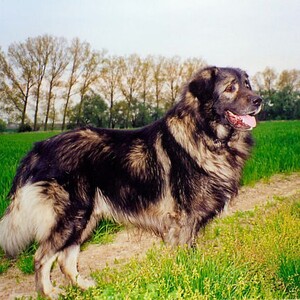
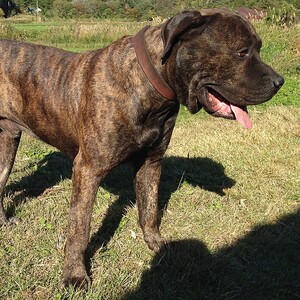
Moscow Watchdog. · Edmontcz / Wikimedia Commons, CC BY-SA 3.0. Cropped and resized.
The Moscow Watchdog (Moskovskaya Storozhevaya) is a giant guard dog, created in the Soviet Union by crossing the Saint Bernard, the Caucasian Shepherd Dog and the Russian Piebald Hound. Wikipedia describes it as self-confident and balanced, a “gentle giant” that defends its family when needed, but needs early training and socialisation. It is not recognised by the FCI.
Quick facts
| Common name | Moscow Watchdog (Moskovskaya Storozhevaya) |
| Scientific name | Canis lupus familiaris |
| Country of origin | Russia (former USSR) |
| Official recognition | Not recognised by the FCI; first standard in 1958 |
| Lifespan | No published data for the breed; giant breeds usually live 8–10 years |
| Size (males) | at least 68 cm (ideally 77–78 cm); at least 55 kg |
| Size (females) | at least 66 cm (ideally 72–73 cm); at least 45 kg |
| Coat type | Double and dense, resistant to extreme cold |
| Common colours | Red piebald, white with red patches, red and black, with a black mask |
| Energy level | Low to medium |
| Suited to an apartment? | No |
| Temperament | Self-confident, balanced, protective, gentle |
| Tendency to aggression | Moderate towards intruders |
| Good with children | Good, with supervision |
| Good with other animals | Moderate; needs socialisation |
| Genetic predispositions | No known breed-specific diseases; as in giant breeds, dysplasia and bloat |
- Primary category:Dog breeds
- Explore this animal's categories:
History and origin
Wikipedia says that after the Second World War, the loss of working dogs and rising crime created a need in the USSR for a guard dog able to withstand cold of −30 to −40 °C and to adapt to warehouses, railways, labour camps and other sites.
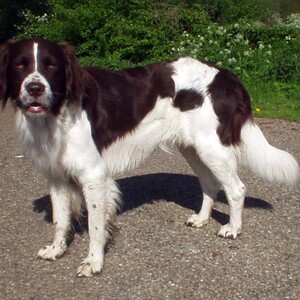
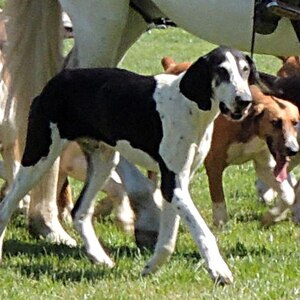
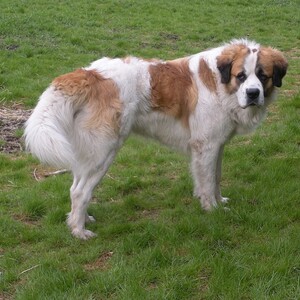
The Central School of Military Dog Breeding, part of the USSR Ministry of Defence, created the breed by crossing Caucasian Shepherd Dogs, Saint Bernards and Russian Piebald Hounds. The first standard was published in 1958.
How the breed developed
- After 1945 – The USSR needs a cold-resistant guard dog.
- 1958 – The first breed standard.
Breed rating
| Feature | Stars |
|---|---|
| Training and intelligence | ★★★☆☆ |
| Easy to train | ★★★★☆ |
| Intelligence | ★★★★☆ |
| Independence | ★★☆☆☆ |
| Stubbornness | ★★★☆☆ |
| Behaviour and temperament | ★★★☆☆ |
| Affectionate with family | ★★★☆☆ |
| Friendly with children | ★★★☆☆ |
| Good with other dogs | ★★★★★ |
| Good with cats and other animals | ★☆☆☆☆ |
| Loyalty | ★★★☆☆ |
| Tendency to be aggressive | ★★★☆☆ |
| Tendency to bark | ★★☆☆☆ |
| Needs and care | ★★★☆☆ |
| Shedding | ★★★☆☆ |
| Needs frequent grooming | ★★★☆☆ |
| Activity and lifestyle | ★★★☆☆ |
| Energy level | ★★★☆☆ |
| Daily exercise needs | ★★★☆☆ |
| Suited to apartment life | ★★★★★ |
| Health and longevity | ★★★☆☆ |
| Life expectancy | ★★★☆☆ |
| Predisposition to genetic diseases | ★★★★☆ |
| Working abilities and uses | ★★★☆☆ |
| Good guard dog | ★★★☆☆ |
| Good companion dog | ★★★★★ |
Indicative rating: 5 stars means the highest level. The breed is not recognised by the FCI or the AKC, so the rating is based on its description on Wikipedia.
Physical characteristics
Wikipedia says it is a large, powerful dog: males measure at least 68 cm (ideally 77–78 cm) and weigh at least 55 kg, females at least 66 cm and 45 kg. It has the size, looks and intelligence of the Saint Bernard and the alertness of the Caucasian Shepherd Dog.
General appearance
The coat is double and dense, able to withstand extreme cold. Puppies have a characteristic black mask on the face.
| Feature | Moscow Watchdog |
|---|---|
| Size | Giant |
| Height at the withers | males: min. 68 cm; females: min. 66 cm |
| Weight | males: min. 55 kg; females: min. 45 kg |
| Coat | Double, dense |
| Mask | Black |
| Type | Guard dog |
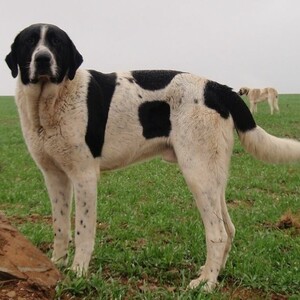
Wikipedia says the coat can be red piebald, white with red patches, red and black, black and red, or with sable patches, with a black mask on the head.
Training and socialisation
Wikipedia describes it as self-confident and balanced, but says it needs training and early socialisation, with both people and animals. Properly raised, it adapts easily to any environment and is a protective family dog.
As a companion, it is known as a “gentle giant”, determined and protective of its family when it is in danger.
Tips for effective training
- Socialise it early. With people and animals.
- Be calm and consistent. It is very strong.
- Start training in puppyhood. It will become a giant.
- Do not choose it as a first dog. It calls for experience.
Activity needs and lifestyle
It needs daily walks and space, but not intense exercise. It copes very well with cold.
| Activity | How often | Why it matters |
|---|---|---|
| Walks | daily | Fitness |
| Guarding the yard | daily | Instinct |
| Training | several times a week | Discipline |
Tips for a balanced life
- It needs a large yard.
- Keep it out of the heat.
- Do not let it run after a meal.
Care and health
Coat and skin care
The double coat is brushed once or twice a week, and more often during the shedding season.
Common health problems
There are no published health studies for the breed. As with any giant breed, it is worth watching for:
| Condition | Description | Common symptoms |
|---|---|---|
| Hip dysplasia | The hip joint forms incorrectly and, over time, arthritis develops | Limping, difficulty getting up or jumping, hip pain |
| Elbow dysplasia | The elbow joint develops incorrectly and arthritis appears | Limping on the front legs, especially after exercise |
| Gastric dilatation-volvulus (bloat) | The stomach fills with gas and may twist; this is a veterinary emergency | Swollen belly, trying to vomit without success, drooling, restlessness |
Other care
- Ask for the parents' hip tests.
- Learn the signs of bloat.
- Go for yearly check-ups.
Diet and nutrition
A giant dog needs good-quality food suited to its size; puppies need special food for large breeds.
Tips for a healthy diet
The table gives a starting estimate, calculated with the formula from the Merck Veterinary Manual. The first two calorie columns show the calories per day for a healthy adult dog. The last column shows what this means in dry food with 3,500–4,000 kcal per kilogram.
| Dog's weight | Calories per day (neutered) | Calories per day (not neutered) | Dry food per day (approximate) |
|---|---|---|---|
| 45 kg | 1,950 kcal | 2,190 kcal | 490–630 g |
| 55 kg | 2,260 kcal | 2,540 kcal | 560–730 g |
| 70 kg | 2,710 kcal | 3,050 kcal | 680–870 g |
- Split the food into two or three meals a day.
- Do not let it run right after a meal.
- A dog is at the right weight when you can feel its ribs under the coat without pressing hard.
Foods to avoid
Some human foods are dangerous for dogs: chocolate, coffee, grapes and raisins, onions, garlic, xylitol (a sweetener used in chewing gum), macadamia nuts and alcohol.
Reproduction and development
Physical and emotional maturity
In dogs, sexual maturity usually comes between 6 and 12 months, but in large breeds it can be delayed until about two years. Very large breeds become adults only at around 2 years.
Mating and pregnancy
Pregnancy lasts about 63 days, counted from ovulation. Mating a female on her first heat is not recommended. Only healthy dogs of typical breed appearance should be used for breeding.
Caring for the puppies
In large breeds, a litter has around 7 puppies on average. The puppies grow very fast, so they need growth food suited to large breeds. Socialisation starts in the first weeks.
Interesting facts
- Created by the army. The Central School of Military Dogs of the USSR.
- Built for −40 °C. That was the requirement.
- Three parent breeds. The Saint Bernard, the Caucasian Shepherd Dog and the Russian Piebald Hound.
- A “gentle giant”. That is how it is known as a companion.
- A black mask. A characteristic feature.
Frequently asked questions
Is it recognised by the FCI?
No.
How big does it get?
Males measure at least 68 cm and weigh at least 55 kg.
Which breeds does it come from?
The Saint Bernard, the Caucasian Shepherd Dog and the Russian Piebald Hound.
Is it suited to beginners?
No; it needs experience.