Saint BernardCharacteristics, history, training and care
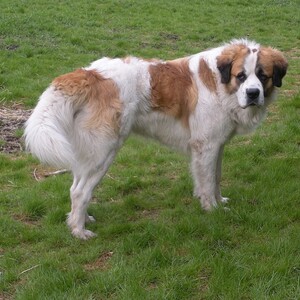
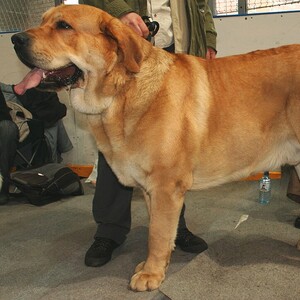
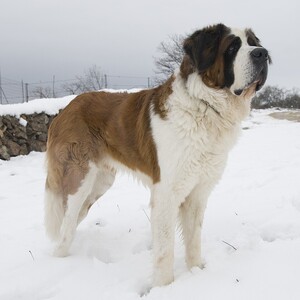
Saint Bernard. · Rafael Dominguez Rodriguez / Wikimedia Commons, CC BY-SA 4.0. Cropped and resized.
The Saint Bernard is a giant dog from the Swiss Alps, known for rescuing travellers lost in the snow at the hospice on the Great St Bernard Pass. It comes in short-haired and long-haired varieties. The FCI standard describes it as friendly by nature, with a temperament ranging from calm to lively, and watchful. Since 1887 it has been considered Switzerland's national dog.
Quick facts
| Common name | Saint Bernard (St Bernard) |
| Scientific name | Canis lupus familiaris |
| Country of origin | Switzerland |
| Official recognition | FCI, definitively since 28 August 1954 (group 2, mountain molossoid breeds; standard no. 61); also recognised by the AKC |
| Lifespan | 8–10 years, according to the AKC |
| Size (males) | 70–90 cm at the withers; 64–82 kg according to the AKC |
| Size (females) | 65–80 cm at the withers; 54–64 kg according to the AKC |
| Coat type | Short and dense, or medium length, with an abundant undercoat |
| Common colours | White with red patches or a red mantle, reddish brown |
| Energy level | Low to medium |
| Suited to an apartment? | No |
| Temperament | Friendly, calm, watchful, gentle |
| Tendency to aggression | Low |
| Good with children | Very good, according to the AKC |
| Good with other animals | Moderate |
| Genetic predispositions | Bloat, hip dysplasia, eye diseases |
- Primary category:Dog breeds
- Explore this animal's categories:
History and origin
The FCI standard says that at the Great St Bernard Pass, at an altitude of 2,469 metres, monks founded a hospice for travellers and pilgrims in the 11th century. Large mountain dogs were kept there from the middle of the 17th century for guarding and protection; they appear in a picture from 1695 and in a hospice document from 1707. They soon became rescue dogs for travellers lost in snow and fog.
The stories of people saved from the “white death” and the accounts of Bonaparte's soldiers, who crossed the pass in 1800, spread their fame throughout Europe; the legendary Barry became the symbol of the rescue dog. In 1884, the first dog entered in the Swiss stud book was a Saint Bernard, “Leon”, and on 2 June 1887 the breed was officially recognised as Swiss.
How the breed developed
- 11th century – The monks found the hospice.
- 1695 – The first picture of the hospice dogs.
- 1800 – Bonaparte's soldiers spread their fame.
- 1884 – “Leon” is the first dog in the Swiss stud book.
- 2 June 1887 – Officially recognised as a Swiss breed.
Breed rating
| Feature | Stars |
|---|---|
| Training and intelligence | ★★★★☆ |
| Easy to train | ★★★★★ |
| Intelligence | ★★★★★ |
| Independence | ★★☆☆☆ |
| Stubbornness | ★★★☆☆ |
| Behaviour and temperament | ★★★☆☆ |
| Affectionate with family | ★★★☆☆ |
| Friendly with children | ★★★☆☆ |
| Good with other dogs | ★★★★★ |
| Good with cats and other animals | ★☆☆☆☆ |
| Loyalty | ★★★☆☆ |
| Tendency to be aggressive | ★★★★★ |
| Tendency to bark | ★★☆☆☆ |
| Needs and care | ★★★☆☆ |
| Shedding | ★★★☆☆ |
| Needs frequent grooming | ★★★☆☆ |
| Activity and lifestyle | ★★★☆☆ |
| Energy level | ★★★☆☆ |
| Daily exercise needs | ★★★☆☆ |
| Suited to apartment life | ★★★★★ |
| Health and longevity | ★★★☆☆ |
| Life expectancy | ★★★☆☆ |
| Predisposition to genetic diseases | ★★★★☆ |
| Working abilities and uses | ★★★☆☆ |
| Good companion dog | ★★★☆☆ |
| Good companion dog | ★★★★★ |
Indicative rating: 5 stars means the highest level. It is based on the ratings the American Kennel Club gives the breed and on the FCI standard.
Physical characteristics
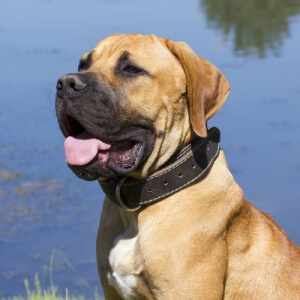
The Saint Bernard has a powerful, imposing and very expressive head. The AKC says the wrinkled brow, short muzzle and dark eyes give it the intelligent, friendly expression that was such a welcome sight to travellers lost in the Alps.
General appearance
The short-haired variety has a dense, smooth, harsh, close-lying topcoat with plenty of undercoat. The long-haired variety has a straight, medium-length topcoat with plenty of undercoat, feathering on the forelegs and a bushy tail.
| Feature | Saint Bernard |
|---|---|
| Size | Giant |
| Height at the withers | males: 70–90 cm; females: 65–80 cm |
| Weight | 54–82 kg (AKC) |
| Coat | Short or long |
| Colour | White with red |
| Type | Mountain molossoid |
The base colour is white, with smaller or larger red patches, up to a red mantle covering the back and flanks. White markings are required on the chest, feet, tail tip, muzzle, a blaze on the forehead and a patch on the nape. Dark shading on the head is desirable.
Training and socialisation
The standard describes it as friendly by nature, with a temperament ranging from calm to lively, and watchful. The AKC says it is good-natured and eager to please.
The AKC stresses that early socialisation and puppy classes are absolutely essential for such a big, powerful dog: it must learn not to jump up at people, not to knock over small children and not to steal food from the table.
Tips for effective training
- Start training in puppyhood. It will grow very large.
- Teach it not to jump up. It can knock people over.
- Use rewards. It wants to please.
- Always have a towel handy. It drools a lot.
Activity needs and lifestyle
The AKC says that, although it is big and strong, it needs only moderate exercise: a long walk or half an hour of play a day. It enjoys hiking and camping, and some happily pull small children in sledges or carts.
| Activity | How often | Why it matters |
|---|---|---|
| Long walk | daily | Fitness |
| Play | half an hour daily | Energy |
| Hiking | occasionally | Enjoyment |
Tips for a balanced life
- Keep it out of the heat.
- Do not let it run after a meal.
- Brush it daily when it sheds.
Care and health
Coat and skin care
The AKC says both coat types need the same care: weekly brushing, and daily brushing during the two shedding periods each year. In hot weather it copes if it has a cool place to rest and plenty of water.
Common health problems
The AKC says the Saint Bernard is generally healthy, but, as a large, deep-chested breed, it can suffer from bloat. Owners should know the signs. Watch for:
| Condition | Description | Common symptoms |
|---|---|---|
| Gastric dilatation-volvulus (bloat) | The stomach fills with gas and may twist; this is a veterinary emergency | Swollen belly, trying to vomit without success, drooling, restlessness |
| Hip dysplasia | The hip joint forms incorrectly and, over time, arthritis develops | Limping, difficulty getting up or jumping, hip pain |
| Eye diseases | Conditions of the eyelids and eyes | Watery, irritated eyes |
Other care
- Learn the signs of bloat.
- Keep it at the right weight.
- Clean its eyes and muzzle often.
Diet and nutrition
The AKC recommends good-quality food made for large breeds, suited to its age, and attention to its weight.
Tips for a healthy diet
The table gives a starting estimate, calculated with the formula from the Merck Veterinary Manual. The first two calorie columns show the calories per day for a healthy adult dog. The last column shows what this means in dry food with 3,500–4,000 kcal per kilogram.
| Dog's weight | Calories per day (neutered) | Calories per day (not neutered) | Dry food per day (approximate) |
|---|---|---|---|
| 54 kg | 2,230 kcal | 2,510 kcal | 560–720 g |
| 68 kg | 2,650 kcal | 2,980 kcal | 660–850 g |
| 82 kg | 3,050 kcal | 3,430 kcal | 760–980 g |
- Split the food into two or three meals a day.
- Giant-breed puppies need special food.
- A dog is at the right weight when you can feel its ribs without pressing hard.
Foods to avoid
Some human foods are dangerous for dogs: chocolate, coffee, grapes and raisins, onions, garlic, xylitol (a sweetener used in chewing gum), macadamia nuts and alcohol.
Reproduction and development
Physical and emotional maturity
In dogs, sexual maturity usually comes between 6 and 12 months, but in large breeds it can be delayed until about two years. Very large breeds become adults only at around 2 years.
Mating and pregnancy
Pregnancy lasts about 63 days, counted from ovulation. Mating a female on her first heat is not recommended. The FCI standard requires that only healthy dogs of typical breed appearance are used for breeding.
Caring for the puppies
In large breeds, a litter has around 7 puppies on average. The puppies grow very fast, so they need growth food suited to large breeds. Socialisation starts in the first weeks.
Interesting facts
- The Barry dog. That is what it was called in the 19th century.
- Switzerland's national dog. Since 1887.
- First in the stud book. “Leon” was the first dog entered, in 1884.
- The hospice at 2,469 m. The dogs have lived there since the 17th century.
- It drools a lot. The AKC gives it the top score for drooling.
In popular culture
Barry
The FCI standard says the legendary Barry became the symbol of the rescue dog, after the stories of lives saved from the “white death” at the Great St Bernard Pass.
Frequently asked questions
Did it really rescue people from the snow?
Yes; the standard says it rescued travellers lost in snow and fog.
How big does it get?
Males measure 70–90 cm at the withers.
Is it good with children?
Yes; the AKC gives it the top score, but it must be trained not to knock them over.
How long does it live?
The AKC gives 8–10 years.