Drentsche PatrijshondCharacteristics, history, training and care
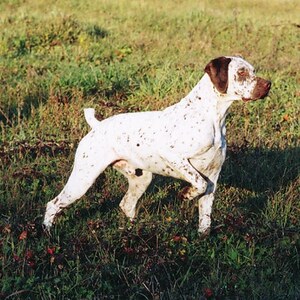
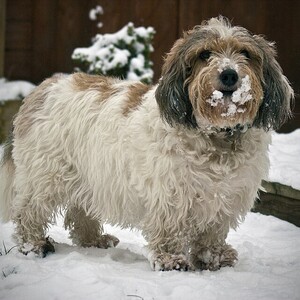
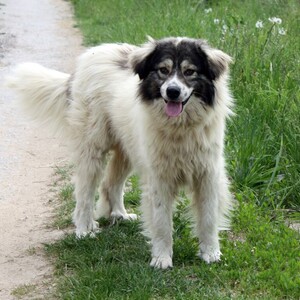
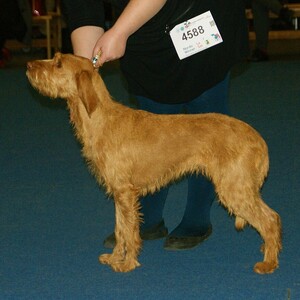
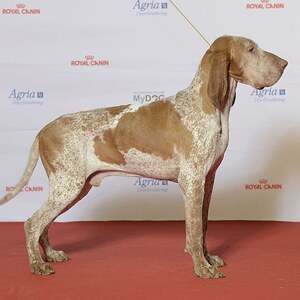
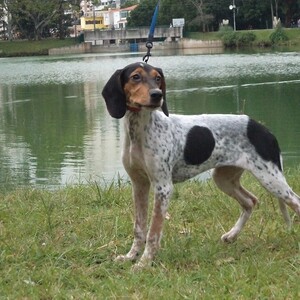
Drentsche Patrijshond. · Eric Broeksma / Wikimedia Commons, CC BY-SA 3.0. Cropped and resized.
The Drentsche Patrijshond, known as the Drent for short, is a versatile pointing dog from the Dutch province of Drenthe. It looks a little like a spaniel and a little like a setter, has a white coat with brown patches and works equally well in fields and marshes. It is friendly, attentive, quick and very easy to train.
Quick facts
| Common name | Drentsche Patrijshond (Drent) |
| Scientific name | Canis lupus familiaris |
| Country of origin | Netherlands (Drenthe) |
| Official recognition | FCI, definitively since 4 March 1960 (group 7, continental pointing dogs, spaniel type, with working trial; standard no. 224); also recognised by the AKC |
| Lifespan | 11–14 years, according to the AKC |
| Size (males) | 58–63 cm at the withers; 30–35 kg |
| Size (females) | 55–60 cm at the withers; 25–31 kg |
| Coat type | Dense, straight, medium-long, with a water-resistant undercoat; feathering on the ears, legs and tail |
| Common colours | White with brown patches, with or without ticking |
| Energy level | Moderate to high |
| Suited to an apartment? | Not really; it needs exercise |
| Temperament | Attentive, friendly, quick, attached to its owner |
| Tendency to aggression | Very low |
| Good with children | Very good |
| Good with other animals | Very good with dogs; hunting instinct towards birds |
| Genetic predispositions | Epilepsy, progressive retinal atrophy, eyelid disorders, hip and elbow dysplasia |
- Primary category:Dog breeds
- Explore this animal's categories:
History and origin
The FCI standard says the breed dates back to the 16th century, to dogs called “Spioenen” or “Spanjoelen”, which reached the Low Countries from Spain via France. In Dutch they were called “partridge dogs”. In the east of the country, especially in the province of Drenthe, the dogs were kept pure, without being mixed with foreign breeds.
Wikipedia says these dogs also appear in 17th-century Dutch painting, in the work of Gabriel Metsu. The breed was officially recognised in the Netherlands on 15 May 1943, with the support of Baroness Van Hardenbroek and Messrs Van Heek Jr. and Quartero. It is related to the Small Münsterländer and the Épagneul Français.
How the breed developed
- 16th century – The “Spioenen” dogs reach the Low Countries from Spain via France.
- 1658–1662 – Gabriel Metsu paints partridge dogs.
- 15 May 1943 – The breed is officially recognised in the Netherlands.
- 5 June 1948 – The Dutch breed club is founded.
- 4 March 1960 – The FCI recognises the breed.
- 4 April 2016 – The current FCI standard is published.
Breed rating
| Feature | Stars |
|---|---|
| Training and intelligence | ★★★★★ |
| Easy to train | ★★★★★ |
| Intelligence | ★★★★★ |
| Independence | ★★★☆☆ |
| Stubbornness | ★★☆☆☆ |
| Behaviour and temperament | ★★★★☆ |
| Affectionate with family | ★★★☆☆ |
| Friendly with children | ★★★★★ |
| Good with other dogs | ★★★★★ |
| Good with cats and other animals | ★★★☆☆ |
| Loyalty | ★★★★★ |
| Tendency to be aggressive | ★☆☆☆☆ |
| Tendency to bark | ★☆☆☆☆ |
| Needs and care | ★★★★☆ |
| Shedding | ★★★☆☆ |
| Needs frequent grooming | ★★★☆☆ |
| Activity and lifestyle | ★★★★☆ |
| Energy level | ★★★☆☆ |
| Daily exercise needs | ★★★★☆ |
| Suited to apartment life | ★★☆☆☆ |
| Health and longevity | ★★★★☆ |
| Life expectancy | ★★★★☆ |
| Predisposition to genetic diseases | ★★★☆☆ |
| Working abilities and uses | ★★★★☆ |
| Good hunting dog | ★★★★★ |
| Good companion dog | ★★★★☆ |
Indicative rating: 5 stars means the highest level. It is based on the ratings the American Kennel Club gives the breed and on the FCI standard.
Physical characteristics
The standard describes it as a well-proportioned dog with lean muscles and clean lines, showing strength as well as the speed a hunting dog needs. The head is a light wedge shape.
General appearance
The oval, wide-set eyes have a gentle, intelligent expression. The high-set ears hang close to the head and have long hair, wavy at the base. The tail reaches roughly to the hock and is richly feathered; it is never carried curled over the back.
| Feature | Drentsche Patrijshond |
|---|---|
| Size | Large |
| Height at the withers | males: 58–63 cm; females: 55–60 cm |
| Weight | males: 30–35 kg; females: 25–31 kg |
| Coat | Medium-long, straight, feathered |
| Eyes | Oval, with a gentle expression |
| Tail | Reaching the hock, richly feathered |
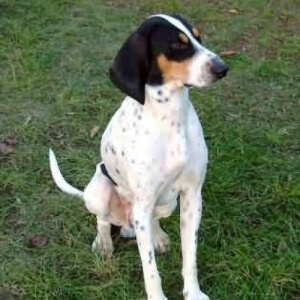
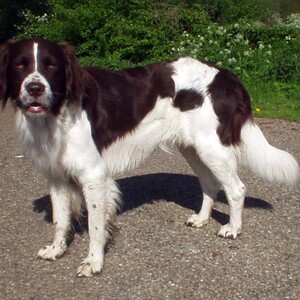
The coat is white with brown patches, with or without ticking. The ears and the hair around the eyes are brown. Roan (a mix of brown and white hairs all over the body) is not allowed, and a brown “mantle” on the back is less desirable. A white ear or white around the eyes disqualifies.
Training and socialisation
The standard describes it as an ideal dog for hunting on varied terrain, which works within gunshot range and always keeps in contact with the hunter. When searching for game, it wags its tail in a characteristic circular motion.
The AKC gives it top marks for trainability. However, it has a great need for mental activity, so constant, varied, reward-based work makes it happy.
Tips for effective training
- Give it work to do. The AKC gives it top marks for mental stimulation needs.
- Use rewards. It learns very quickly this way.
- Work on retrieving. It is also an excellent retriever.
- Do not rely on it as a guard dog. The AKC gives it the lowest score for watchdog ability.
Activity needs and lifestyle
It is a hardy hunting dog, suited to fields and marshes. It needs daily exercise and mental activity: long walks, retrieving, searching and, ideally, hunting or dog sports.
| Activity | How often | Why it matters |
|---|---|---|
| Long walks in nature | daily | Exercise and scents |
| Retrieving, including from water | several times a week | Retriever instinct |
| Fieldwork or searching | weekly | Mental activity |
Tips for a balanced life
- It suits an active family with a garden.
- Check it for ticks after outings in the fields.
- Watch out for insect stings: the AKC says it can have strong reactions.
Care and health
Coat and skin care
The AKC says the coat is medium-long, fine and not at all greasy, so brushing once a week is enough. It sheds twice a year. The ears are the hardest part: the hair on them must be thinned regularly.
Common health problems
The AKC says the breed has few hereditary diseases. Specialists consider epilepsy the biggest current problem. It is worth watching for:
| Condition | Description | Common symptoms |
|---|---|---|
| Epilepsy | Repeated neurological seizures; the exact type is not yet known | Trembling, convulsions, loss of consciousness |
| Progressive retinal atrophy | An inherited disease that gradually destroys the retina | Sees less and less well at night, then in the daytime too |
| Entropion and ectropion | Eyelids turned inwards or outwards | Watery, irritated eyes |
| Hip dysplasia | The hip joint forms incorrectly and, over time, arthritis develops | Limping, difficulty getting up or jumping, hip pain |
| Elbow dysplasia | The elbow joint develops incorrectly and arthritis appears | Limping on the front legs, especially after exercise |
Other care
- Clean and check the ears weekly.
- Trim the nails when they start to touch the floor.
- Brush its teeth regularly.
Diet and nutrition
The AKC says it does not need a special diet. Some dogs regulate their own food intake, while others eat as much as they can find, so the portion should be measured and increased only when activity increases.
Tips for a healthy diet
The table gives a starting estimate, calculated with the formula from the Merck Veterinary Manual. The first two calorie columns show the calories per day for a healthy adult dog. The last column shows what this means in dry food with 3,500–4,000 kcal per kilogram.
| Dog's weight | Calories per day (neutered) | Calories per day (not neutered) | Dry food per day (approximate) |
|---|---|---|---|
| 25 kg | 1,250 kcal | 1,410 kcal | 310–400 g |
| 30 kg | 1,440 kcal | 1,620 kcal | 360–460 g |
| 35 kg | 1,610 kcal | 1,810 kcal | 400–520 g |
- Split the food into two meals a day.
- Fresh water should always be available.
- A dog is at the right weight when you can feel its ribs without pressing hard.
Foods to avoid
Some human foods are dangerous for dogs: chocolate, coffee, grapes and raisins, onions, garlic, xylitol (a sweetener used in chewing gum), macadamia nuts and alcohol.
Reproduction and development
Physical and emotional maturity
In dogs, sexual maturity usually comes between 6 and 12 months, but in large breeds it can be delayed until about two years. The body also reaches its adult form later than in small breeds.
Mating and pregnancy
Pregnancy lasts about 63 days, counted from ovulation. Mating a female on her first heat is not recommended. The FCI standard requires that only healthy dogs of typical breed appearance are used for breeding.
Caring for the puppies
In large breeds, a litter has around 7 puppies on average. Socialisation starts in the first weeks: gentle handling, everyday noises and new people.
Interesting facts
- A circling tail. When it catches the scent of game, it wags its tail in a circle.
- In Dutch paintings. Gabriel Metsu painted partridge dogs in the 17th century.
- French and German relatives. It is related to the Épagneul Français and the Small Münsterländer.
- Kept pure in Drenthe. In the province of Drenthe, the dogs were not mixed with foreign breeds.
- About 5,000 dogs. Wikipedia says around 5,000 are registered in the Netherlands.
In popular culture
In the paintings of Gabriel Metsu
In “The Hunter's Gift” (about 1658–1660) by the Dutch painter Gabriel Metsu, a partridge dog leans against the hunter's knee. A similar, smaller dog also appears in “The Poultry Seller” (1662) by the same painter.
Frequently asked questions
What does “Drentsche Patrijshond” mean?
It means “partridge dog from Drenthe”, a province of the Netherlands.
How big does it get?
Males measure 58–63 cm and weigh 30–35 kg; females measure 55–60 cm and weigh 25–31 kg.
Is it easy to train?
Yes, the AKC gives it top marks for trainability.
Is it good with children?
Yes, very good.
How long does it live?
The AKC gives 11–14 years.