Spanish MastiffCharacteristics, history, training and care
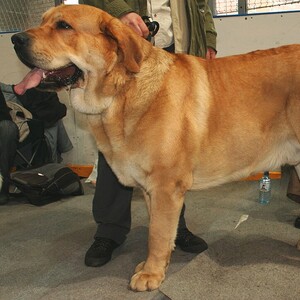
Spanish Mastiff. · Pleple2000 / Wikimedia Commons, CC BY-SA 4.0. Cropped and resized.
The Spanish Mastiff (Mastín español) is a giant dog from Spain, bred for centuries to guard Merino sheep from wolves and other predators. The FCI standard describes it as highly intelligent, rustic, affectionate, good-natured and noble, very determined when facing dangerous animals and strangers, a self-assured dog aware of its enormous strength.
Quick facts
| Common name | Spanish Mastiff (Mastín español) |
| Scientific name | Canis lupus familiaris |
| Country of origin | Spain |
| Official recognition | FCI, definitively since 13 November 1954 (group 2, molossoid breeds; standard no. 91); the AKC lists it in the Foundation Stock Service |
| Lifespan | 10–12 years, according to the AKC |
| Size (males) | at least 77 cm at the withers, preferably over 80 cm; 64–90 kg according to the AKC |
| Size (females) | at least 72 cm at the withers, preferably over 75 cm |
| Coat type | Dense, thick, of medium length, smooth |
| Common colours | Yellow, fawn, red, black, wolf colour, brindle |
| Energy level | Low to medium |
| Suited to an apartment? | No |
| Temperament | Intelligent, rustic, affectionate, noble, protective |
| Tendency to aggression | Moderate towards strangers and other dogs |
| Good with children | Moderate; with supervision |
| Good with other animals | Good with the animals it guards |
| Genetic predispositions | No known breed-specific diseases; as in giant breeds, hip dysplasia and bloat |
- Primary category:Dog breeds
- Explore this animal's categories:
History and origin
The FCI standard says the breed is closely linked to transhumance, especially to the Merino flocks, which it already accompanied in the days of the “Mesta”, the medieval association of transhumant flock owners, defending them from wolves along the way and on the pastures. Wikipedia says mastiffs were already working as flock guardians when the Romans arrived in the Iberian Peninsula, and they wore heavy spiked metal collars.
Wikipedia adds that the first breed standard was drawn up by the FCI in 1946, and in 1981 the Spanish Association of the Spanish Mastiff was founded, which started a breeding programme to bring back the large, powerful dog of the past. When it accompanies Merino sheep, it is also called “perro merinero”.
How the breed developed
- Antiquity – A flock guardian in the Iberian Peninsula.
- Middle Ages – It accompanies the flocks of the “Mesta”.
- 1946 – The first breed standard.
- 1981 – The Spanish breed association is founded.
Breed rating
| Feature | Stars |
|---|---|
| Training and intelligence | ★★★☆☆ |
| Easy to train | ★★★★★ |
| Intelligence | ★★★☆☆ |
| Independence | ★★☆☆☆ |
| Stubbornness | ★★★☆☆ |
| Behaviour and temperament | ★★☆☆☆ |
| Affectionate with family | ★★★☆☆ |
| Friendly with children | ★★★☆☆ |
| Good with other dogs | ★★★★★ |
| Good with cats and other animals | ★☆☆☆☆ |
| Loyalty | ★★★☆☆ |
| Tendency to be aggressive | ★★★★★ |
| Tendency to bark | ★★★☆☆ |
| Needs and care | ★★★☆☆ |
| Shedding | ★★☆☆☆ |
| Needs frequent grooming | ★★★☆☆ |
| Activity and lifestyle | ★★★☆☆ |
| Energy level | ★★★☆☆ |
| Daily exercise needs | ★★★☆☆ |
| Suited to apartment life | ★★★★★ |
| Health and longevity | ★★☆☆☆ |
| Life expectancy | ★★★☆☆ |
| Predisposition to genetic diseases | ★★★★☆ |
| Working abilities and uses | ★☆☆☆☆ |
| Good guard dog | ★★★☆☆ |
| Good companion dog | ★★★★★ |
Indicative rating: 5 stars means the highest level. It is based on the ratings the American Kennel Club gives the breed and on the FCI standard.
Physical characteristics
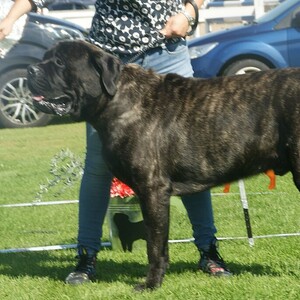
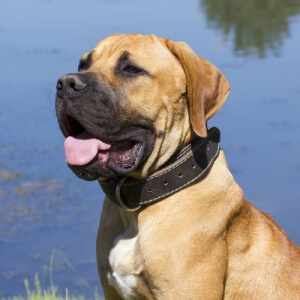
The AKC describes it as a very large, balanced, very powerful and muscular dog with a massive head. Its bark is hoarse, low and deep, very loud, heard from a great distance. The standard says there is no upper size limit: the biggest dogs are the most sought after, provided they are well proportioned.
General appearance
The coat is dense, thick, of medium length and smooth, covering the whole body down to between the toes. It is shorter on the legs and longer and silky on the tail.
| Feature | Spanish Mastiff |
|---|---|
| Size | Giant |
| Height at the withers | males: at least 77 cm; females: at least 72 cm |
| Weight | 64–90 kg (AKC) |
| Coat | Medium, dense |
| Bark | Deep, very loud |
| Type | Flock-guarding molossoid |
The standard says colour does not matter. The most valued are solid colours: yellow, fawn, red, black, wolf colour and deer colour, but also combinations, such as brindle or white with patches.
Training and socialisation
The standard describes it as highly intelligent, rustic, affectionate, good-natured and noble, very determined when facing dangerous animals and strangers, especially when it has farms or flocks to defend. It is self-assured, aware of its enormous strength.
Wikipedia says it is aloof, dignified, calm and devoted to its family, can be aggressive towards other dogs and gets bored easily, so training must be consistent and firm but gentle, and start early.
Tips for effective training
- Socialise it early. With people and other dogs.
- Be firm but gentle. That is what Wikipedia recommends.
- Use rewards. It is food-motivated.
- Think of the neighbours. Its bark carries a long way.
Activity needs and lifestyle
The AKC says that, although it is a fairly calm breed, it needs daily exercise: play in a fenced garden or walks several times a day. Wikipedia adds that it tends to lumber rather than gallop, but it can move fast when needed.
| Activity | How often | Why it matters |
|---|---|---|
| Long walk | daily | Fitness |
| Free movement in the garden | daily | Energy |
| Guarding | daily | Instinct |
Tips for a balanced life
- It needs a large fenced yard.
- Not suited to city life.
- Wipe its mouth often: it drools a lot.
Care and health
Coat and skin care
The AKC recommends weekly brushing and the occasional bath. The nails grow fast and are trimmed regularly, and the ears are checked often. The AKC gives it the top score for drooling.
Common health problems
The AKC says most Spanish Mastiffs are healthy. There are no known breed-specific diseases; as with any giant breed, it is worth watching for:
| Condition | Description | Common symptoms |
|---|---|---|
| Hip dysplasia | The hip joint forms incorrectly and, over time, arthritis develops | Limping, difficulty getting up or jumping, hip pain |
| Elbow dysplasia | The elbow joint develops incorrectly and arthritis appears | Limping on the front legs, especially after exercise |
| Gastric dilatation-volvulus (bloat) | The stomach fills with gas and may twist; this is a veterinary emergency | Swollen belly, trying to vomit without success, drooling, restlessness |
Other care
- Ask for the parents' hip tests.
- Do not let it run after a meal.
- Trim the nails regularly.
Diet and nutrition
The AKC recommends good-quality food suited to the dog's age, and attention to its weight.
Tips for a healthy diet
The table gives a starting estimate, calculated with the formula from the Merck Veterinary Manual. The first two calorie columns show the calories per day for a healthy adult dog. The last column shows what this means in dry food with 3,500–4,000 kcal per kilogram.
| Dog's weight | Calories per day (neutered) | Calories per day (not neutered) | Dry food per day (approximate) |
|---|---|---|---|
| 64 kg | 2,530 kcal | 2,850 kcal | 630–810 g |
| 77 kg | 2,910 kcal | 3,280 kcal | 730–940 g |
| 90 kg | 3,270 kcal | 3,680 kcal | 820–1050 g |
- Split the food into two or three meals a day.
- Giant-breed puppies need special food.
- A dog is at the right weight when you can feel its ribs without pressing hard.
Foods to avoid
Some human foods are dangerous for dogs: chocolate, coffee, grapes and raisins, onions, garlic, xylitol (a sweetener used in chewing gum), macadamia nuts and alcohol.
Reproduction and development
Physical and emotional maturity
In dogs, sexual maturity usually comes between 6 and 12 months, but in large breeds it can be delayed until about two years. Very large breeds become adults only at around 2 years.
Mating and pregnancy
Pregnancy lasts about 63 days, counted from ovulation. Mating a female on her first heat is not recommended. The FCI standard requires that only healthy dogs of typical breed appearance are used for breeding.
Caring for the puppies
In large breeds, a litter has around 7 puppies on average. The puppies grow very fast, so they need growth food suited to large breeds. Socialisation starts in the first weeks.
Interesting facts
- “Perro merinero”. That is what it is called when it guards Merino sheep.
- A spiked collar. It wore spiked metal collars against wolves.
- No size limit. The biggest dogs are the most sought after.
- A far-reaching bark. It can be heard from a great distance.
- Companion of the Mesta. It guarded the transhumant flocks from the Middle Ages.
Frequently asked questions
How big does it get?
Males measure at least 77 cm, preferably over 80 cm.
Is it suited to city life?
Not really; its size and bark make it hard to keep in a city.
Does it drool?
Yes, a lot.
How long does it live?
The AKC gives 10–12 years.