Bichon FriseCharacteristics, history, training and care
The Bichon Frise is a small companion dog with a white, curly coat. It needs social contact, training and regular grooming. No breed is guaranteed to be suitable for every person with an allergy.
Quick facts
| Common name | Bichon Frise |
| Scientific name | Canis lupus familiaris |
| Country of origin | France, Belgium (Mediterranean ancestry) |
| Official Recognition | Recognized by FCI and AKC |
| Typical lifespan | About 12-15 years |
| Dimensions (Male) | About 23-30 cm / 5-8 kg |
| Dimensions (Female) | About 23-28 cm / 5-7 kg |
| Coat type | Curly, soft, double layered |
| Common colours | White |
| Energy Level | Moderate |
| Suitable for an apartment? | Depends on exercise, training, health and the individual dog |
| Temperament | Friendly, playful, loving |
| Behaviour towards unfamiliar people and dogs | Individual behaviour varies; socialisation, training and management matter |
| Compatibility with children | Depends on the individual; adult supervision and suitable handling are essential |
| Compatibility with other animals | Depends on socialisation, prey drive and the animals involved |
| Health considerations | Dental problems, allergies, bladder stones, patellar luxation |
- Primary category:Dog breeds
- Explore this animal's categories:
History and Origin
The Bichon Frise belongs to the old Bichon family of small white dogs, together with the Maltese, the Bolognese and the Havanese. Dogs of this type were very popular with European nobility.
Evolution of the breed
- Mediterranean origins - Its ancestors are small white dogs from the Mediterranean; one type, the "Bichon Tenerife", is linked with the Canary Islands, from where sailors carried these dogs to Europe.
- A favourite at the French court — Bichon-type dogs were favoured at the courts of Francis I and Henry III during the 16th century.
- Decline and comeback - In the 19th century, bichons became street and circus dogs. After the First World War, French breeders worked to preserve them, and the breed got its name and standard in 1933.
- The Bichon Frise is recognised by major kennel organisations, including the American Kennel Club.
Breed Evaluation
The Bichon Frise is a sociable, cheerful and intelligent dog, excellent for families, single people and older people. These are general editorial ratings, not measured scores; individual dogs vary.
| Characteristic | Stars |
|---|---|
| Training and Intelligence | ★★★★☆ |
| Easy to train | ★★★★☆ |
| Intelligence | ★★★★★ |
| Level of independence | ★★★☆☆ |
| Level of stubbornness | ★★★☆☆ |
| Behavior and Temperament | ★★★★★ |
| Affectionate with family | ★★★★★ |
| Friendly with children | ★★★★★ |
| Compatible with other dogs | ★★★★★ |
| Compatible with cats and other animals | ★★★★★ |
| Degree of loyalty | ★★★★★ |
| Tendency to be aggressive | ★☆☆☆☆ |
| Tendency to bark | ★★★☆☆ |
| Needs and Care | ★★★★☆ |
| Shedding level | ★☆☆☆☆ |
| Requires frequent care | ★★★★★ |
| Activity and Lifestyle | ★★★★☆ |
| Energy level | ★★★★☆ |
| Daily exercise requirement | ★★★☆☆ |
| Suitable for apartment living | ★★★★★ |
| Health and Longevity | ★★★★☆ |
| Life expectancy | ★★★★★ |
| Predisposition to genetic diseases | ★★★☆☆ |
| Work and Utility Features | ★★★☆☆ |
| Good companion dog | ★★★★★ |
| He's a good therapy dog. | ★★★★★ |
Physical Characteristics
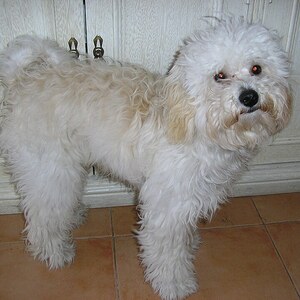
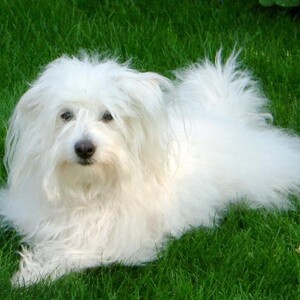
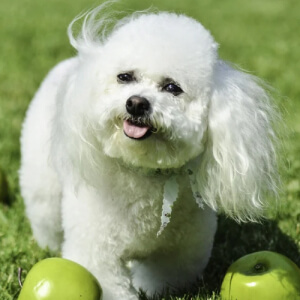
The Bichon Frise is a small, sturdy dog with an elegant look and a fluffy white coat, often compared to a cotton ball.
General appearance
- A small, compact body with a level back and a proud posture.
- A soft, curly white coat with a dense undercoat.
- A rounded head with a short muzzle and large, round, dark eyes with black rims.
- Hanging ears covered with long hair.
- A tail carried in a curve over the back, covered with long hair.
| Characteristic | Bichon Frise |
|---|---|
| Size | Small (about 23-30 cm at the shoulder) |
| Weight | About 5-8 kg |
| Coat | Curly, soft, double |
| Muzzle | Short and delicate |
| Shedding tendency | Very low |
| Build | Small but sturdy |
The Bichon Frise is an attractive, elegant dog with a distinctive coat that needs regular grooming.
Training and Socialization
The Bichon Frise is clever and eager to learn, so it is fairly easy to train, especially with rewards and encouragement. However, it can be stubborn at times, so consistency is needed.
Tips for effective training
- Early socialisation - As a very sociable dog, it should get used to people, animals and places, and to short periods alone, to prevent separation anxiety.
- Reward-based training - It responds very well to treats, praise and play.
- Short, varied training - It gets bored with repetitive exercises, so training should be varied and fun.
- House training - Bichons can be slow to house-train, so patience, a regular routine and plenty of praise are needed.
- Managing barking - The Bichon Frise may bark a lot without training; commands such as "quiet" help.
The Bichon Frise is easy to train, but it needs attention and patience to avoid problems such as excessive dependence on its owner.
Activity and Lifestyle Needs
The Bichon Frise is lively and playful, but it does not need intense exercise. It adapts easily to an apartment or a house with a garden.
| Activity | Recommended duration |
|---|---|
| Daily walks | About 30-45 min |
| Free play at home or in the garden | About 30 min |
| Interactive games and training | About 15-20 min |
Recommendations for a balanced lifestyle
- Good for apartment life - Thanks to its small size and moderate energy, it adapts well to small homes.
- Needs company - It does not like being left alone for long periods and can develop separation anxiety.
- Loves attention - It is happiest with plenty of affection and play.
- Play is important - It loves balls, rope toys and puzzle toys.
The Bichon Frise is lively but not demanding, and suits people of all ages.
Care and Health
The Bichon Frise is generally healthy, but it needs regular coat care and attention to some inherited problems.
Fur and skin care
- Daily or frequent brushing - Its curly coat mats easily, so it should be brushed often, right down to the skin.
- Regular grooming - To keep its typical look, the coat should be trimmed every 4-6 weeks.
- Regular baths - The white coat gets dirty easily, so baths every few weeks help keep it clean.
- Eye and ear care - Wiping around the eyes helps prevent tear stains, and ears should be checked weekly to prevent infections.
Common health problems
| Condition | Description | Common symptoms |
|---|---|---|
| Dental problems | Tartar and gum disease are common in small dogs | Bad breath, tooth loss |
| Skin allergies | Sensitivity to food, fleas or the environment | Itching, skin irritation |
| Bladder stones | The breed is prone to stones in the bladder | Straining to urinate, blood in the urine |
| Patellar luxation | A slipping kneecap | Limping, skipping a step |
Other aspects of care
- Regular veterinary checks - Important for monitoring general health.
- Dental care - Tooth brushing and dental chews are recommended.
- Weight control - In a small dog, even a little extra weight can strain the joints.
The Bichon Frise is a healthy breed, but it needs regular coat and dental care.
Diet and Nutrition
The Bichon Frise needs a balanced diet with carefully controlled calories to prevent obesity.
Recommendations for a healthy diet
Choose a complete, balanced diet suited to age, size and health. Plan home-prepared diets and supplements with a qualified veterinarian; raw pet food can carry harmful bacteria.
| Food type | Daily Amount (Adults) | Frequency |
|---|---|---|
| Premium dry food | Individual amount; follow complete-food guidance and veterinary advice | 2 meals/day |
| Home cooked food | Individual amount; follow complete-food guidance and veterinary advice | 2 meals/day |
| Raw food: bacterial contamination is a concern | Individual amount; follow complete-food guidance and veterinary advice | 2 meals/day |
Forbidden foods
Chocolate, grapes and raisins, onions and xylitol - toxic to dogs. ; Cooked bones - can splinter and cause intestinal blockage. ; Fatty and processed foods - can cause digestive problems. ; Very rich meals and too many treats - increase the risk of digestive problems and obesity.
The Bichon Frise should be fed according to its size, avoiding too much food and processed food.
Reproduction and Development
Breeding requires veterinary planning, suitable health screening and care for the mother and puppies. Pregnancy and birth can involve complications.
Physical and emotional maturity
- Physical maturity: It reaches adult size at about 10-12 months and is fully developed at about 1.5 years.
- Emotional maturity: It stays playful all its life, but usually becomes calmer at about 2-3 years.
Mating and Gestation
- Breeding decisions require veterinary assessment of maturity, health and suitable screening; reaching a fixed age does not establish that breeding is appropriate.
- Duration of gestation: Approximately 58-68 days, usually about 63 days.
- Average number of puppies: Usually about 4-6 puppies.
Puppy care
- The first 3 weeks: Puppies depend completely on their mother for warmth and milk.
- Between 4-8 weeks: They begin to explore and play with littermates and people; early socialisation helps prevent shyness.
- Moving to a new home: When puppies go to their new homes, basic training and socialisation should continue.
Good food and a stimulating environment are essential for healthy growth.
Curiosities and Interesting Facts
- A royal favourite - According to stories, King Henry III of France loved his small bichons so much that he carried them in a basket hung around his neck.
- In art - Small white dogs like the Bichon appear in paintings by artists such as Francisco de Goya.
- A circus performer - In the 19th century, bichons became popular with street performers and circuses, who taught them tricks.
- No dog breed is guaranteed to be hypoallergenic. Allergic responses vary between people and individual animals.
- The name - "Bichon à poil frisé" means "curly-haired little dog" in French.
- Popular in America - The breed arrived in the United States in the 1950s and was recognised by the AKC in 1972.
- A dog-show champion - A Bichon Frise named J.R. won Best in Show at the Westminster Dog Show in 2001.
The Dog in Popular Culture
With its fluffy white coat and cheerful personality, the Bichon Frise is a favourite in photos and advertising.
Bichon Frisé in media and culture
- A photogenic dog - Its cotton-ball look makes it popular in advertising, magazines and social media.
Importance in modern culture
- A therapy dog - Thanks to its gentle nature, the Bichon Frise often visits hospitals and care homes to comfort patients.
- A good companion for older people - It is small, playful and loving, which suits older owners who can manage its grooming.