English MastiffCharacteristics, history, training and care
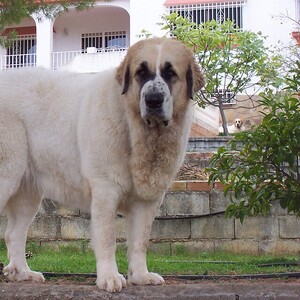
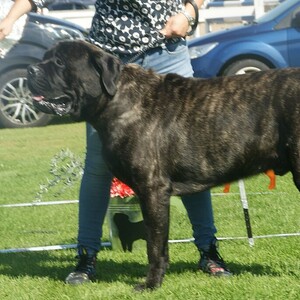
Brindle English Mastiff · Canarian / Wikimedia Commons, CC BY-SA 4.0. Cropped and resized.
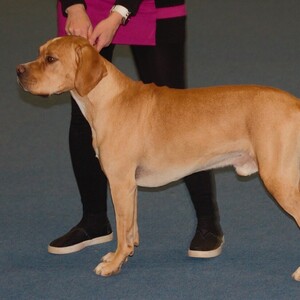
The English Mastiff, known simply as the Mastiff, is a giant British molosser with a massive head and a black mask. It is known for its gentle, loving nature. The standard describes it as a combination of grandeur and courage: calm and affectionate with its owners, but capable of guarding.
Quick facts
| Common name | English Mastiff (Mastiff) |
| Scientific name | Canis lupus familiaris |
| Country of origin | United Kingdom |
| Official recognition | FCI, definitively since 5 November 1964 (group 2, molossoid breeds, mastiff type; standard no. 264); also recognised by the AKC |
| Lifespan | 6–10 years, according to the AKC; a British study found 9 years |
| Size (males) | at least 76 cm at the withers; about 73–104 kg (AKC) |
| Size (females) | at least 70 cm at the withers; about 54–77 kg (AKC) |
| Coat type | Short, close-lying; harsher on the neck and shoulders |
| Common colours | Apricot, fawn or brindle, always with a black mask |
| Energy level | Low to moderate |
| Suited to an apartment? | The AKC says it can adapt, with daily walks |
| Temperament | Calm, affectionate, courageous, dignified |
| Tendency to aggression | Low; indifferent to strangers, but a good guard |
| Good with children | Very good, with supervision |
| Good with other animals | Average |
| Genetic predispositions | Hip and elbow dysplasia, bloat, bone cancer, cystinuria, retinal diseases |
- Primary category:Dog breeds
- Explore this animal's categories:
History and origin
The FCI standard says the Mastiff, perhaps not exactly in its present form, has existed for many hundreds of years and was known for its courage and guarding instinct even before the Battle of Agincourt (1415). When the Romans invaded Britain, they found a mastiff-type dog here that impressed them so much that they took some back to Rome to fight in the arenas.
By the time the Normans arrived, the mastiff type was so widespread that the French word “dogue” entered the English language. Wikipedia says the modern type was settled in the 1880s. The breed almost disappeared from Great Britain after the Second World War and was saved with imported dogs.
How the breed developed
- Antiquity – The Romans find mastiff-type dogs in Britain.
- 1415 – Mastiffs are already known for their courage before the Battle of Agincourt.
- 1880s – The modern type is settled.
- After 1945 – The breed almost disappears from Great Britain and is rebuilt with imported dogs.
- 5 November 1964 – The FCI recognises the breed.
- 8 September 2026 – the current FCI standard is published.
Breed rating
| Feature | Stars |
|---|---|
| Training and intelligence | ★★★☆☆ |
| Easy to train | ★★★☆☆ |
| Intelligence | ★★★★☆ |
| Independence | ★★★☆☆ |
| Stubbornness | ★★★★☆ |
| Behaviour and temperament | ★★★★☆ |
| Affectionate with family | ★★★★★ |
| Friendly with children | ★★★★★ |
| Good with other dogs | ★★★☆☆ |
| Good with cats and other animals | ★★★☆☆ |
| Loyalty | ★★★★★ |
| Tendency to be aggressive | ★★☆☆☆ |
| Tendency to bark | ★☆☆☆☆ |
| Needs and care | ★★★★☆ |
| Shedding | ★★★☆☆ |
| Needs frequent grooming | ★☆☆☆☆ |
| Activity and lifestyle | ★★★★☆ |
| Energy level | ★★★☆☆ |
| Daily exercise needs | ★★★☆☆ |
| Suited to apartment life | ★★★★☆ |
| Health and longevity | ★★★★☆ |
| Life expectancy | ★★☆☆☆ |
| Predisposition to genetic diseases | ★★★★☆ |
| Working abilities and uses | ★★★★★ |
| Good guard dog | ★★★★★ |
| Good companion dog | ★★★★☆ |
Indicative rating: 5 stars means the highest level. It is based on the ratings the American Kennel Club gives the breed and on the FCI standard.
Physical characteristics
The standard describes it as a dog that is extremely large, both in height and in width, with a broad, deep body, plenty of substance and big, strong bones. The head looks square from any angle.
General appearance
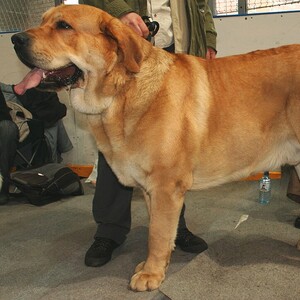
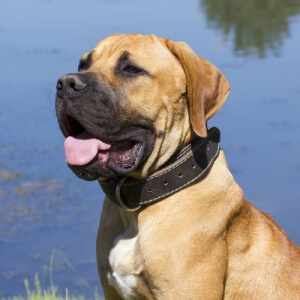
The skull is broad between the ears, with a flat forehead that wrinkles when the dog is alert. The muzzle, ears and nose are black, and the black also surrounds the eyes. Wikipedia says it is recognised by its huge size, massive head, short coat and black mask.
| Feature | English Mastiff |
|---|---|
| Size | Very large |
| Height at the withers | males: at least 76 cm; females: at least 70 cm (AKC) |
| Weight | males: about 73–104 kg; females: 54–77 kg (AKC) |
| Coat | Short, close-lying |
| Head | Massive, square |
| Mask | Black, always present |
The accepted colours are apricot, fawn and brindle. In all cases the muzzle, ears and nose must be black, with black around the eyes. Excessive white on the body, chest or legs is undesirable.
Training and socialisation
The standard describes it as calm, affectionate with its owners, but capable of guarding, and usually indifferent to strangers. Shyness is not accepted.
The AKC says obedience training and early socialisation are essential. Mastiffs learn quickly and want to please their owner, but lots of repetition bores them so much that they may lie down and fall asleep. They communicate a great deal through looks.
Tips for effective training
- Socialise it as a puppy. The AKC says this is essential for such a large dog.
- Keep sessions short. Repetition quickly bores it.
- Look it in the eye. The AKC says it reads human expressions very well.
- Teach it to walk on a lead early. As an adult, it is much heavier than you.
Activity needs and lifestyle
The AKC says that, having been bred as a house guardian, it has relatively modest exercise needs and can even live in a flat. It benefits from free play and daily walks of 1.5–3 km. Puppies and young dogs must not be overexerted: no stairs and no jumping.
| Activity | How often | Why it matters |
|---|---|---|
| Walks of 1.5–3 km | daily | Moderate exercise |
| Free play | daily | Good for body and mind |
| Obedience exercises | a few minutes a day | Control over a giant dog |
Tips for a balanced life
- In summer, keep it out of the heat.
- Keep a cloth handy: it drools a lot.
- Your car and home need room for such a large dog.
Care and health
Coat and skin care
The AKC says the short, dense coat is easy to care for, with a quick brush every few days. During the moult, once or twice a year, a firm-toothed comb is used more often. The ears and the deep wrinkles on the head and muzzle should be checked and cleaned regularly.
Common health problems
The AKC says Mastiffs are generally healthy, but a few problems can occur:
| Condition | Description | Common symptoms |
|---|---|---|
| Hip dysplasia | The hip joint forms incorrectly and, over time, arthritis develops | Limping, difficulty getting up or jumping, hip pain |
| Elbow dysplasia | The elbow joint develops incorrectly and arthritis appears | Limping on the front legs, especially after exercise |
| Gastric dilatation-volvulus (bloat) | The stomach fills with gas and may twist; this is a veterinary emergency | Swollen belly, trying to vomit without success, drooling, restlessness |
| Bone cancer and lymphoma | Forms of cancer that are more common in giant breeds | Lameness, swellings, weight loss |
| Cystinuria | A hereditary disease that can cause kidney stones, especially in entire males | Difficult or bloody urination |
Other care
- Clean the wrinkles on its face regularly.
- Check the ears weekly.
- Trim the nails regularly.
Diet and nutrition
The AKC says that, in a giant breed that grows quickly, correct feeding is essential up to 2 years of age. Slow, steady growth is ideal. Food that is too high in calories or has the wrong calcium-to-phosphorus ratio can cause bone problems.
Tips for a healthy diet
The table gives a starting estimate, calculated with the formula from the Merck Veterinary Manual. The first two calorie columns show the calories per day for a healthy adult dog. The last column shows what this means in dry food with 3,500–4,000 kcal per kilogram.
| Dog's weight | Calories per day (neutered) | Calories per day (not neutered) | Dry food per day (approximate) |
|---|---|---|---|
| 60 kg | 2,410 kcal | 2,720 kcal | 600–780 g |
| 75 kg | 2,850 kcal | 3,210 kcal | 710–920 g |
| 90 kg | 3,270 kcal | 3,680 kcal | 820–1050 g |
- Split the food into two meals a day to reduce the risk of bloat.
- Do not let it run right after a meal.
- A dog is at the right weight when you can feel its ribs without pressing hard.
Foods to avoid
Some human foods are dangerous for dogs: chocolate, coffee, grapes and raisins, onions, garlic, xylitol (a sweetener used in chewing gum), macadamia nuts and alcohol.
Reproduction and development
Physical and emotional maturity
In dogs, sexual maturity usually comes between 6 and 12 months, but in large breeds it can be delayed until about two years. Very large breeds become adults only at around 2 years.
Mating and pregnancy
Pregnancy lasts about 63 days, counted from ovulation. Mating a female on her first heat is not recommended. The FCI standard requires that only healthy dogs of typical breed appearance are used for breeding.
Caring for the puppies
In large breeds, a litter has around 7 puppies on average. The puppies grow very fast, so they need growth food suited to large breeds. Socialisation starts in the first weeks.
Interesting facts
- The weight record. Wikipedia says the heaviest dog on record was the Mastiff Aicama Zorba of La Susa, at 155.6 kg.
- A fighter in Rome's arenas. The Romans took British mastiffs to fight in Rome.
- The word “dogue”. The Normans brought the French word “dogue” into English.
- A vulnerable breed. In 2020, only 104 puppies were registered in Great Britain.
- It falls asleep during training. The AKC says that, bored by repetition, it may lie down and snore.
In popular culture
The Guinness record
Wikipedia says the greatest weight ever recorded for a dog, 155.6 kg, belonged to an English Mastiff called Aicama Zorba of La Susa, entered in the Guinness Book of Records in 1989.
Frequently asked questions
How big does an English Mastiff get?
The AKC gives at least 76 cm and about 73–104 kg for males, and at least 70 cm and 54–77 kg for females.
Is it aggressive?
No. It is calm and affectionate with its family, but capable of guarding.
Can it live in a block of flats?
The AKC says it can, because its exercise needs are fairly modest, but it needs a lot of room.
How long does it live?
The AKC gives 6–10 years; a British study found an average of 9 years.