Black storkCiconia nigra — habitat, diet and reproduction
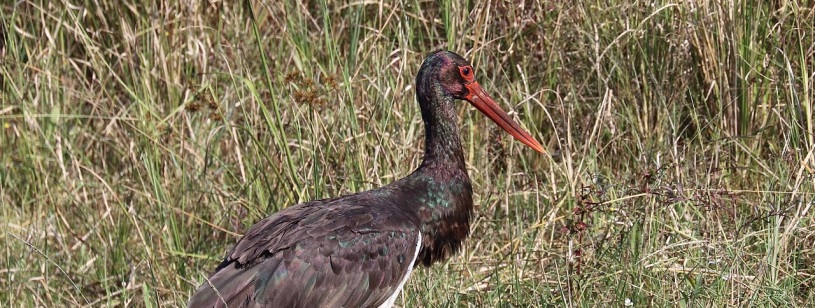
Black stork with dark glossy plumage, a white belly and a red bill. · Charles J. Sharp / Wikimedia Commons / CC BY-SA 4.0 (https://creativecommons.org/licenses/by-sa/4.0/). Cropped and resized. Source: https://commons.wikimedia.org/wiki/File:Black_stork_(Ciconia_nigra)_India.jpg
The black stork (Ciconia nigra) is a large bird with dark plumage and a green-purple sheen. It hides its nest in quiet woodland and feeds in shallow water. Romanian breeding birds migrate south after summer. It generally leads a more secluded life than the white stork.
Quick facts
| Common name | Black stork |
| Scientific name | Ciconia nigra |
| Lifespan | Ringed wild birds can exceed 22 years |
| Length | 90–105 cm |
| Weight | Approximately 3 kg |
| Diet | Carnivorous, predominantly fish |
| Predators | Raptors and mammals can raid nests, depending on region |
| Conservation status | Least Concern globally; some regional populations are threatened |
| Distribution | Europe, Asia and Africa |
| Habitat | Quiet woodland near water; also cliff-nesting in some regions |
| Family | Ciconiidae |
| Reproduction | Usually 3–4 eggs; both parents care for young |
- Primary category:Birds
- Explore this animal's categories:
Interesting facts
- Dark feathers reveal green and purple reflections in good light.
- A nest may be repaired and reused over several years.
- Southern African populations are largely resident.
- Nesting supports and nearby feeding waters form complementary habitat resources.
Records and extremes
A study published in 2024 documented a wild male at least 22 years and two months old. It was still raising chicks. Ringing as a nestling established its age.
A wingspan of approximately 1.73–2.05 m provides a broad surface for soaring. Rising air currents help birds conserve energy on long journeys.
Characteristics
The adult has a black head, neck, upper breast and back, contrasting with a white belly. Bill, legs and bare skin around the eyes are red.
The sexes look similar. Juveniles are browner and less glossy, with grey-green bills and legs. A long neck, broad wings and trailing legs shape the flight silhouette.
Behaviour
Breeding pairs are isolated and sensitive to disturbance. Feeding birds often walk slowly through water alone. Groups can form during migration or at rich feeding sites.
European migration follows major routes through Gibraltar or the Bosphorus and Middle East. Eastern European birds mainly use the eastern route. Safe stopovers matter throughout the journey.
Habitat and distribution
Breeding populations span much of Eurasia, with others in southern Africa. European migrants mainly winter in Africa; Asian populations also use southern Asia. Some populations remain resident.
Romanian birds arrive in spring and leave in autumn. Old woodland near rivers and pools provides suitable habitat. Southern African birds frequently nest on cliffs.
Diet and feeding
Fish dominate the diet, supplemented by amphibians, large insects and other small animals. Shallow streams and pond edges make prey accessible.
Research in Spain linked feeding-site use to gently sloping shores, relatively clear water and distance from roads. Drying or altering watercourses can reduce food supplies.
Reproduction and life cycle
A substantial stick platform is lined with softer materials and placed in an old tree or on a cliff. It may be reused.
Usually 3–4 eggs are incubated for around 32–38 days. Both parents share incubation and care.
Adults regurgitate food into the nest. Young become capable of flight at roughly 63–71 days and continue receiving parental help for a time.
Name and history
Linnaeus described the species in 1758. Ciconia nigra means black stork in Latin.
Ringing and tracking have revealed journeys otherwise difficult to follow. Reading an individual ring can connect distant places and establish a bird’s age.
Conservation and threats
The global classification is Least Concern. Regional conditions differ: BirdLife South Africa assessed it as Endangered in its 2025 regional evaluation.
Loss of old trees, wetland degradation and disturbance reduce suitable habitat. Powerline collisions also pose risks during migration.
Conservation protects nesting trees and feeding waters. Observe nests from a distance and avoid repeated approaches during breeding.
Frequently asked questions
Is it a dark form of the white stork?
It is a separate species, Ciconia nigra.
Does it live in Romania?
It breeds in suitable forests and migrates south for winter.
Why is it rarely seen near houses?
It favours quiet places with nearby woodland and water.
What is its main food?
Fish, supplemented by amphibians and other small animals.
Does it nest only in trees?
Old trees are common nest sites in Europe, but cliffs are also used.
How long can it live?
A study documented a wild bird at least 22 years and two months old.