Basset Artésien NormandCharacteristics, history, training and care
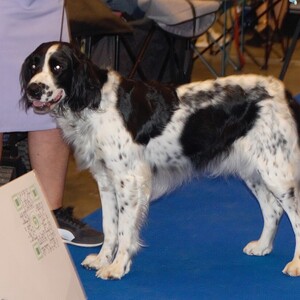
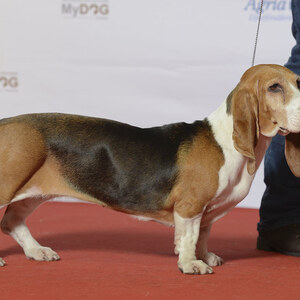
Basset Artésien Normand. · Svenska Mässan from Sweden / Wikimedia Commons, CC BY 2.0. Cropped and resized.
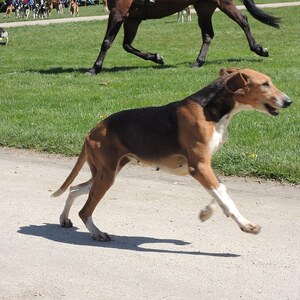
The Basset Artésien Normand is a French dog with short legs, a long body and very long ears. Its short legs help it get through dense undergrowth where a big dog cannot pass, to drive hares out towards the hunter. It is calm and affectionate.
Quick facts
| Common name | Basset Artésien Normand |
| Scientific name | Canis lupus familiaris |
| Country of origin | France |
| Official recognition | FCI, definitively since 29 October 1963 (Group 6, with a working trial; standard no. 34) |
| Lifespan | No published data for the breed; medium-sized breeds usually live 10–13 years |
| Size (males) | 30–36 cm at the withers |
| Size (females) | 30–36 cm at the withers |
| Weight | 15–20 kg |
| Coat type | Short, dense and smooth |
| Common colours | Tricolour (fawn with a black mantle and white) or bicolour (fawn and white) |
| Energy level | Moderate |
| Suited to an apartment? | Yes, with daily walks |
| Temperament | Calm, affectionate, persistent |
| Tendency to aggression | Low |
| Good with children | Good |
| Good with other animals | Good with other dogs; chases small game |
| Genetic predispositions | Like other short-legged breeds, higher risk of intervertebral disc disease |
- Primary category:Dog breeds
- Explore this animal's categories:
History and origin
Controlled breeding of short-haired French bassets began around 1870. Two varieties emerged from the same type of dog: Count Le Couteulx de Canteleu fixed the Artois type, with straight front legs, while Louis Lane created the Normand type, with crooked front legs.
The two types were later merged into a single breed. The better-known Basset Hound has the same French ancestors, but was developed in England with the help of the Bloodhound.
How the breed developed
- 1870 – Controlled breeding of short-haired French bassets begins.
- 1910 – The breed club is founded.
- 1924 – The name “Basset Artésien Normand” is adopted for good.
- 1927 – Léon Verrier, aged 77, takes over the club and puts the emphasis on the breed's Norman character.
- 29 October 1963 – The FCI recognises the breed.
- 1 August 2023 – the current FCI standard is published.
Breed rating
| Feature | Stars |
|---|---|
| Training and intelligence | ★★★☆☆ |
| Easy to train | ★★★☆☆ |
| Intelligence | ★★★☆☆ |
| Independence | ★★★☆☆ |
| Stubbornness | ★★★★☆ |
| Behaviour and temperament | ★★★★☆ |
| Affectionate with family | ★★★★★ |
| Friendly with children | ★★★★★ |
| Good with other dogs | ★★★★★ |
| Good with cats and other animals | ★★★☆☆ |
| Loyalty | ★★★★☆ |
| Tendency to be aggressive | ★☆☆☆☆ |
| Tendency to bark | ★★★★☆ |
| Needs and care | ★★★☆☆ |
| Shedding | ★★☆☆☆ |
| Needs frequent grooming | ★★☆☆☆ |
| Activity and lifestyle | ★★★☆☆ |
| Energy level | ★★★☆☆ |
| Daily exercise needs | ★★★☆☆ |
| Suited to apartment life | ★★★★☆ |
| Health and longevity | ★★★★☆ |
| Life expectancy | ★★★★☆ |
| Predisposition to genetic diseases | ★★★☆☆ |
| Working abilities and uses | ★★★★★ |
| Good hunting dog | ★★★★★ |
| Good companion dog | ★★★★☆ |
Indicative rating: 5 stars means the highest level. The breed has no AKC profile; the rating is based on the FCI standard and on its description of the temperament as “calm and affectionate”.
Physical characteristics
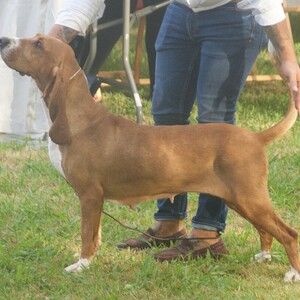
It is a dog that is long for its height, well-balanced and compact. Height and body length are in a ratio of about 5 to 8. The head recalls the noble large Norman hound.
General appearance
The ears are very long, set low and twisted inwards like a corkscrew. They reach at least to the end of the muzzle. The long tail touches the ground at rest and is carried like a sabre.
| Feature | Basset Artésien Normand |
|---|---|
| Size | Small to medium, with short legs |
| Height at the withers | 30–36 cm (tolerance ±1 cm) |
| Weight | 15–20 kg |
| Coat | Short, dense and smooth |
| Ears | Very long, twisted like a corkscrew |
| Tail | Long, touches the ground at rest |
The coat is tricolour (fawn with a black mantle and white) or bicolour (fawn and white). In tricolour dogs the head is mostly tan, with a darker ring on each temple.
Training and socialisation
It is a calm dog, but very persistent on a trail. It follows the game unhurriedly but without giving up, and gives tongue to signal it.
As with all hounds, scents can distract it, so training takes patience and rewards.
Tips for effective training
- Keep training sessions short and fun. It gets bored with long, repetitive exercises.
- Use food rewards. They motivate it well, but take them out of the daily portion.
- Practise the recall. On a trail, its nose leads it.
- Play search games. Hide pieces of food and let it find them.
Activity needs and lifestyle
Bassets are hunting dogs that the hunter follows on foot. They need calm but long daily walks and plenty of new smells.
| Activity | How often | Why it matters |
|---|---|---|
| Walks at a gentle pace | daily | Exercise without much strain on the back |
| Scent games | several times a week | Uses its excellent nose |
| Outings in nature | weekly | New smells and terrain |
Tips for a balanced life
- Avoid jumps off the sofa or out of the car and a lot of stairs, to protect its back.
- Keep it on a lead outside the yard.
- Keep it at the right weight: extra kilos put strain on its long back.
Care and health
Coat and skin care
The short coat is easy to look after, with brushing once a week. The long ears need more attention than the coat.
Common health problems
French bassets descend from short-legged dogs whose bones grow differently (osteochondrodysplasia). According to the ACVS, short-legged breeds account for most cases of intervertebral disc disease.
| Condition | Description | Common symptoms |
|---|---|---|
| Intervertebral disc disease | A disc between the vertebrae ruptures and presses on the spinal cord | Back or neck pain, unsteady walking on the hind legs; in severe cases, paralysis |
Other care
- Clean the long ears once a week and check them after walks.
- Lift it properly: one hand under the chest and one under the rump.
- Trim the nails when they start to touch the floor.
Diet and nutrition
For a long-bodied dog, the right weight is very important. Extra kilos strain its back.
Tips for a healthy diet
The table gives a starting estimate, calculated with the formula from the Merck Veterinary Manual. The first two calorie columns show the calories per day for a healthy adult dog. The last column shows what this means in dry food with 3,500–4,000 kcal per kilogram.
| Dog's weight | Calories per day (neutered) | Calories per day (not neutered) | Dry food per day (approximate) |
|---|---|---|---|
| 15 kg | 850 kcal | 960 kcal | 210–270 g |
| 17 kg | 940 kcal | 1,050 kcal | 240–300 g |
| 20 kg | 1,060 kcal | 1,190 kcal | 260–340 g |
- Give it its food in two meals a day.
- Do not give it table scraps.
- A dog is at the right weight when you can feel its ribs without pressing hard.
Foods to avoid
Some human foods are dangerous for dogs: chocolate, coffee, grapes and raisins, onions, garlic, xylitol (a sweetener used in chewing gum), macadamia nuts and alcohol.
Reproduction and development
Physical and emotional maturity
In dogs, sexual maturity usually comes between 6 and 12 months. Most breeds become adults at around 13–15 months.
Mating and pregnancy
Pregnancy lasts about 63 days, counted from ovulation. Mating a female on her first heat is not recommended. The FCI standard requires that only healthy dogs of typical breed appearance are used for breeding.
Caring for the puppies
In dogs, a litter has 5–6 puppies on average, and the number rises with the size of the breed. Socialisation starts in the first weeks: gentle handling, everyday noises and new people.
Interesting facts
- Corkscrew ears. The standard calls for ears twisted inwards “like a corkscrew”.
- Two types in one. The breed combines the Artois type, with straight legs, and the Normand type, with crooked legs.
- A 77-year-old president. Léon Verrier took over the breed club in 1927, at the age of 77.
- It hunts where others cannot. Its short legs help it get through the thickest undergrowth.
- A relative of the Basset Hound. They share the same French ancestors, but the Basset Hound was developed in England.
Frequently asked questions
What is the difference between the Basset Artésien Normand and the Basset Hound?
They share ancestors, but the Basset Hound was developed in England with the Bloodhound and is more massive. The French basset is lighter.
How big does it get?
It stands 30–36 cm at the withers and weighs 15–20 kg.
Can it live in an apartment?
Yes, if it gets daily walks and avoids stairs and jumping.
What health problems does it have?
As a short-legged breed, it has a higher risk of intervertebral disc disease.