Brussels GriffonCharacteristics, history, training and care
The Brussels Griffon is a small companion dog associated with Belgium. Its expressive face and close attachment to people are well-known breed characteristics, although temperament and care needs vary between individual dogs.
Quick facts
| Common name | Brussels Griffon |
| Scientific name | Canis lupus familiaris |
| Country of origin | Belgium |
| Official Recognition | Recognized by FCI (as three breeds), AKC, UKC |
| Typical lifespan | About 12-15 years |
| Dimensions (Males & Females) | About 18-25 cm / 3.5-6 kg |
| Coat type | Rough and wiry, or short and smooth |
| Common colours | Red, belge (mixed red and black), black and tan, black |
| Energy Level | Moderate |
| Suitable for an apartment? | Depends on exercise, training, health and the individual dog |
| Temperament | Playful, intelligent, affectionate |
| Behaviour towards unfamiliar people and dogs | Individual behaviour varies; socialisation, training and management matter |
| Compatibility with children | Depends on the individual; adult supervision and suitable handling are essential |
| Compatibility with other animals | Depends on socialisation, prey drive and the animals involved |
| Health considerations | Breathing problems, patellar luxation, eye injuries, syringomyelia, dental problems |
- Primary category:Dog breeds
- Explore this animal's categories:
History and Origin
The Brussels Griffon developed in Belgium. Crosses made during the 19th century helped establish the modern breed type; these small dogs guarded carriages and kept stables free of rodents.
Evolution of the breed
- Belgian stable dogs - Its ancestors were small, rough-coated stable dogs ("griffons d'écurie") kept by cab drivers in Brussels to catch rats; they may have been related to the Affenpinscher.
- Toy breed influences - In the 19th century, breeders crossed them with the Pug and the King Charles Spaniel, which gave the breed its short face and affectionate nature.
- A royal favourite - Queen Marie Henriette of Belgium loved these dogs, which helped turn the Brussels Griffon from a stable dog into a fashionable companion.
- Three varieties - The FCI recognises three related breeds: the red, rough-coated Griffon Bruxellois, the dark rough-coated Griffon Belge and the smooth-coated Petit Brabançon; the AKC treats them as one breed.
Breed Evaluation
The Brussels Griffon is an intelligent, affectionate and alert dog, suitable for families, single people and lovers of small dogs. These are general editorial ratings, not measured scores; individual dogs vary.
| Characteristic | Stars |
|---|---|
| Training and Intelligence | ★★★★☆ |
| Easy to train | ★★★★☆ |
| Intelligence | ★★★★★ |
| Level of independence | ★★★☆☆ |
| Level of stubbornness | ★★★☆☆ |
| Behavior and Temperament | ★★★★★ |
| Affectionate with family | ★★★★★ |
| Friendly with children | ★★★★☆ |
| Compatible with other dogs | ★★★★☆ |
| Compatible with cats and other animals | ★★★★☆ |
| Degree of loyalty | ★★★★★ |
| Tendency to be aggressive | ★☆☆☆☆ |
| Tendency to bark | ★★★☆☆ |
| Needs and Care | ★★★★☆ |
| Shedding level | ★★☆☆☆ |
| Requires frequent care | ★★★★★ |
| Activity and Lifestyle | ★★★★☆ |
| Energy level | ★★★★☆ |
| Daily exercise requirement | ★★★☆☆ |
| Suitable for apartment living | ★★★★★ |
| Health and Longevity | ★★★★☆ |
| Life expectancy | ★★★★★ |
| Predisposition to genetic diseases | ★★★☆☆ |
| Work and Utility Features | ★★★☆☆ |
| Good guard dog | ★★☆☆☆ |
| Good companion dog | ★★★★★ |
Physical Characteristics
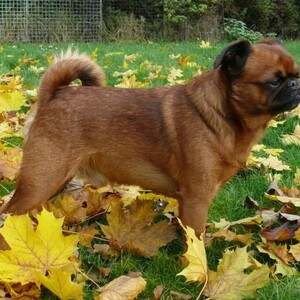
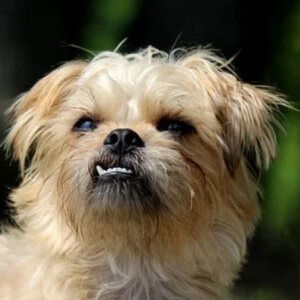
The Brussels Griffon is a small, sturdy and very expressive dog with a distinctive, almost human face.
General appearance
- A small, square, sturdy body.
- Either a rough, wiry coat with a beard and moustache, or a short, smooth coat.
- A large, round head with a very short muzzle and an undershot jaw.
- Large, round, dark eyes set wide apart, with a curious, almost human expression.
- Small, high-set ears, natural (semi-erect) or cropped in some countries.
- A tail carried high, natural or docked where this is legal.
| Characteristic | Brussels Griffon |
|---|---|
| Size | Small (about 18-25 cm at the shoulder) |
| Weight | About 3.5-6 kg |
| Coat | Rough and wiry, or smooth |
| Muzzle | Very short |
| Shedding tendency | Low (rough coat) to moderate (smooth coat) |
| Build | Small but solid |
The Brussels Griffon is an expressive, cheeky little dog with a lively personality.
Training and Socialization
The Brussels Griffon is clever but sensitive, so training must be gentle, consistent and positive. Because it bonds closely with its owner, it responds well to praise and rewards.
Tips for effective training
- Start early - Puppies should meet many people, animals and places to prevent shyness.
- Positive methods - The Griffon does not respond well to harsh corrections, but does well with rewards and encouragement.
- Short, varied sessions - It is clever but easily bored, so training should be short and fun.
- Managing barking - It can be vocal and alert, so it should learn not to bark without reason.
- House training - Like many small breeds, it can take a while to house-train, so patience is needed.
With good training, the Brussels Griffon becomes a well-mannered, friendly and balanced dog.
Activity and Lifestyle Needs
The Brussels Griffon has moderate energy and needs daily exercise, but not intense activity.
| Activity | Recommended duration |
|---|---|
| Daily walks | About 30 min |
| Interactive games | About 20 min |
| Obedience and trick training | About 10 min |
| Puzzle games | Recommended |
Recommendations for a balanced lifestyle
- Good for apartment life - Its small size and moderate activity level suit small homes.
- Good for people who are often at home - The Griffon bonds strongly with its owner and does not like being left alone for long.
- Families - It usually gets on with older, gentle children and other pets if well socialised; small children may hurt such a small dog.
- Needs mental stimulation - It enjoys puzzle toys and games.
- Careful in the heat - Because of its short muzzle, it can overheat easily.
Without enough attention and stimulation, the Griffon may become anxious and destructive.
Care and Health
The Brussels Griffon needs regular coat care and is prone to some health problems, partly because of its short muzzle.
Fur and skin care
- Regular brushing - The coat should be brushed 1-2 times a week, more often for the rough coat.
- Hand-stripping - Rough-coated Griffons are usually hand-stripped a few times a year to keep the coat's wiry texture.
- Occasional baths - A bath every few weeks with a gentle dog shampoo is enough.
- Eye and ear care - Its large eyes are easily injured and should be checked daily, and the beard kept clean.
Common health problems
| Condition | Description | Common symptoms |
|---|---|---|
| Breathing problems | The short muzzle can cause breathing difficulties | Snoring, wheezing, overheating |
| Patellar luxation | A slipping kneecap | Limping, skipping a step |
| Eye problems | Its large eyes are prone to injuries and ulcers | Watery eyes, squinting |
| Syringomyelia | A disorder where fluid-filled cavities form in the spinal cord | Neck pain, scratching at the neck |
Other aspects of care
- Weight control - Griffons can gain weight quickly, so they should be fed carefully.
- Dental care - Small dogs often have dental problems, so regular tooth brushing helps.
- Regular veterinary visits - Yearly check-ups are recommended, especially for the teeth, eyes and joints.
The Brussels Griffon can live a long life, but its breathing, eyes and teeth need careful monitoring.
Diet and Nutrition
The Brussels Griffon needs a balanced diet in small, measured portions to avoid obesity and digestive problems.
Recommendations for a healthy diet
Choose a complete, balanced diet suited to age, size and health. Plan home-prepared diets and supplements with a qualified veterinarian; raw pet food can carry harmful bacteria.
| Food type | Daily Amount (Adults) | Frequency |
|---|---|---|
| Premium dry food | Individual amount; follow complete-food guidance and veterinary advice | 2 meals/day |
| Home cooked food | Individual amount; follow complete-food guidance and veterinary advice | 2 meals/day |
| Raw food: bacterial contamination is a concern | Individual amount; follow complete-food guidance and veterinary advice | 2 meals/day |
Forbidden foods
Chocolate, grapes and raisins, onions and xylitol - toxic to dogs. / Cooked bones - can splinter and cause intestinal blockage. / Fatty or processed food - can lead to pancreatitis. / Overfeeding - Griffons can gain weight quickly, which affects their joints.
The Brussels Griffon should be fed carefully to prevent digestive problems and extra weight.
Reproduction and Development
Giving birth can be difficult in this breed because the mothers are small and the puppies have large heads, so many litters need a Caesarean section. Breeding requires veterinary planning and suitable health screening.
Physical and emotional maturity
- Physical maturity: It grows quickly in the first year and is usually fully grown at about 12-18 months.
- Emotional maturity: It usually becomes calmer at about 2 years, but stays playful and lively all its life.
Mating and Gestation
- Breeding decisions require veterinary assessment of maturity, health and suitable screening; a fixed age does not establish that breeding is appropriate.
- Duration of gestation: Approximately 58-68 days, usually about 63 days.
- Average number of puppies: Usually about 1-4 puppies, fewer than in larger breeds.
Puppy care
- First 3 weeks: Puppies depend completely on their mother for warmth and milk.
- Between 4-8 weeks: They begin to explore and play with their littermates.
- Moving to a new home: When puppies go to their new homes, socialisation and training should continue; because they are so small, many breeders keep them a little longer.
Brussels Griffon puppies are tiny and need careful handling in their first weeks.
Curiosities and Interesting Facts
- A "human" face - Many people say the Brussels Griffon has an almost human expression, thanks to its large eyes and beard.
- From stables to palaces - It began as a rat-catcher in Brussels stables and became a favourite of Belgian royalty.
- In old art - A small rough-coated dog in Jan van Eyck's famous painting "The Arnolfini Portrait" (1434) is often linked with the breed's ancestors.
- Big dog in a small body - Although tiny, it is alert and will bark to warn its family.
- Very attached - The Griffon dislikes being left alone for long and can develop separation anxiety.
- Saved after the wars - The World Wars made the breed very rare in Belgium, but breeders in Britain and other countries helped keep it going.
- Three in one - The red rough-coated, dark rough-coated and smooth-coated varieties are treated as separate breeds by the FCI.
The Dog in Popular Culture
The Brussels Griffon became famous worldwide thanks to a Hollywood film.
Brussels Griffin in Modern Media and Culture
- "As Good as It Gets" (1997) - Verdell, the little dog who wins over Jack Nicholson's grumpy character, is a Brussels Griffon.
- Advertising - Its unusual, expressive face makes it popular in advertising and on social media.
Importance in modern culture
- A royal history - Thanks to Queen Marie Henriette, the Griffon is linked with the Belgian royal court.
- A good companion for small-dog lovers - Its lively personality and intelligence make it a good apartment dog for active owners.
- Rare but loved - Although not common, the Griffon has many devoted fans around the world.