Sealyham TerrierCharacteristics, history, training and care
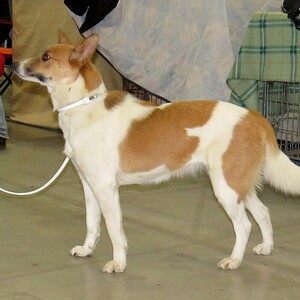
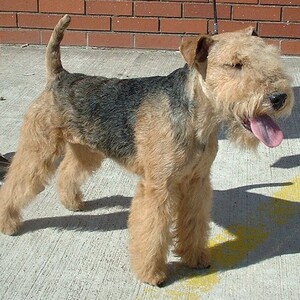
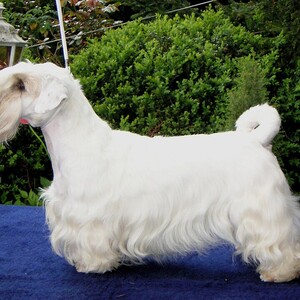
Sealyham Terrier. · Dr. Sabine Schumann / Wikimedia Commons, public domain. Cropped and resized.
The Sealyham Terrier is a small, white, harsh-coated terrier created in the second half of the 19th century by Captain John Edwardes at Sealyham House, in Wales. The FCI standard describes it as sturdy, courageous and a good worker, alert and fearless, but friendly. The AKC says that, although small, it is one of the strongest of small dogs, with an outgoing, charming personality.
Quick facts
| Common name | Sealyham Terrier |
| Scientific name | Canis lupus familiaris |
| Country of origin | United Kingdom (Wales) |
| Official recognition | FCI, definitively since 19 October 1954 (group 3, terriers; standard no. 74); also recognised by the AKC |
| Lifespan | 12–14 years, according to the AKC |
| Size (males) | maximum 31 cm at the withers; about 9 kg |
| Size (females) | maximum 31 cm at the withers; about 8.2 kg |
| Coat type | Long, harsh, wiry topcoat, weather-resistant undercoat |
| Common colours | White, or white with lemon, brown, blue or badger markings on the head and ears |
| Energy level | Medium |
| Suited to an apartment? | Yes |
| Temperament | Sturdy, courageous, alert, friendly, with a sense of humour |
| Tendency to aggression | Low; may guard its food |
| Good with children | Good with older, respectful children |
| Good with other animals | Moderate; needs socialisation |
| Genetic predispositions | Lens luxation, degenerative myelopathy, allergies, eye diseases |
- Primary category:Dog breeds
- Explore this animal's categories:
History and origin
Wikipedia says the breed was created between 1850 and 1891 by Captain John Edwardes at Sealyham House, near Wolfscastle, in Pembrokeshire, Wales. It was used to hunt small game and vermin, especially badgers. Edwardes wanted a small white dog with strong jaws and a harsh coat; the white set it apart from the quarry. He kept no records, but the Welsh Corgi, the Wire Fox Terrier and the extinct English White Terrier are thought to have contributed to the breed.
The breed was first shown in 1903, its club was founded in 1908, and the Kennel Club recognised it in 1911. After the First World War it became very popular in Britain and the United States. Today it is a rare breed: in 2008 only 43 puppies were registered in the United Kingdom.
How the breed developed
- 1850–1891 – John Edwardes creates the breed at Sealyham House.
- 1903 – The first show.
- 1911 – Recognition by the Kennel Club.
- 19 October 1954 – The FCI recognises the breed.
- 2008 – An all-time low: 43 puppies registered in the United Kingdom.
- 2009 – A Sealyham wins Best in Show at Crufts.
Breed rating
| Feature | Stars |
|---|---|
| Training and intelligence | ★★★★☆ |
| Easy to train | ★★★★★ |
| Intelligence | ★★★☆☆ |
| Independence | ★★★★☆ |
| Stubbornness | ★★★★☆ |
| Behaviour and temperament | ★★★☆☆ |
| Affectionate with family | ★★★★☆ |
| Friendly with children | ★★★★☆ |
| Good with other dogs | ★★★★☆ |
| Good with cats and other animals | ★★★★☆ |
| Loyalty | ★★★★☆ |
| Tendency to be aggressive | ★★☆☆☆ |
| Tendency to bark | ★★★☆☆ |
| Needs and care | ★★★☆☆ |
| Shedding | ★★★☆☆ |
| Needs frequent grooming | ★★★☆☆ |
| Activity and lifestyle | ★★★★☆ |
| Energy level | ★★★★☆ |
| Daily exercise needs | ★★★☆☆ |
| Suited to apartment life | ★★★★★ |
| Health and longevity | ★★★★☆ |
| Life expectancy | ★★★★☆ |
| Predisposition to genetic diseases | ★☆☆☆☆ |
| Working abilities and uses | ★★★★☆ |
| Good companion dog | ★★★★☆ |
| Good companion dog | ★★★☆☆ |
Indicative rating: 5 stars means the highest level. It is based on the ratings the American Kennel Club gives the breed and on the FCI standard.
Physical characteristics
The standard describes it as a free-moving, active, balanced dog with “great substance in small compass”, rectangular rather than square in outline. The AKC says that at under 28 cm and about 11 kg it is not big enough to count as medium-sized, but it is among the strongest of small dogs.
General appearance
It has square, powerful, long jaws. The coat has a long, harsh, wiry topcoat and a weather-resistant undercoat.
| Feature | Sealyham Terrier |
|---|---|
| Size | Small |
| Height at the withers | maximum 31 cm |
| Weight | males: ~9 kg; females: ~8.2 kg |
| Coat | Long, harsh |
| Colour | White, with or without head markings |
| Body | Rectangular, low |
The standard accepts all white or white with lemon, brown, blue or badger markings on the head and ears. Black patches or heavy ticking on the body are not wanted.
Training and socialisation
The standard describes it as sturdy, courageous and a good worker, alert and fearless, but friendly. The AKC says it can be stubborn, but has an amusing sense of humour.
The AKC recommends firm but not harsh training and early socialisation with many dogs, people and places, so that it does not become quarrelsome with other dogs. It may guard its food, and this habit should be corrected at once.
Tips for effective training
- Be firm, but not harsh. It is a stubborn terrier.
- Socialise it early. It prevents quarrels with other dogs.
- Correct food guarding. The AKC says not to let it get away with it.
- Use its sense of humour. Games motivate it.
Activity needs and lifestyle
The AKC says it loves to run in a safe, fenced area and needs plenty of exercise. It can overheat in hot, humid weather, so walks are best early in the morning and in the evening. It should be moderately tired, not exhausted.
| Activity | How often | Why it matters |
|---|---|---|
| Walks | daily | Fitness |
| Running in a fenced area | several times a week | Energy |
| Search games | several times a week | Terrier instinct |
Tips for a balanced life
- In summer, walk it in the morning and evening.
- Keep it on a lead in the street.
- Be prepared for a lot of brushing.
Care and health
Coat and skin care
The AKC says the double coat and the abundant hair on the legs and body need combing and brushing every two or three days, as they tangle easily. It does not shed much, but it needs regular hand-stripping or clipping. Pet dogs can be kept clipped short to make grooming easier.
Common health problems
Wikipedia says the breed has few specific diseases, the most common being lens luxation and degenerative myelopathy. The AKC adds:
| Condition | Description | Common symptoms |
|---|---|---|
| Lens luxation | The lens of the eye becomes displaced; a DNA test exists | Red, painful eye, blurred vision |
| Degenerative myelopathy | A progressive disease of the spinal cord | Weakness in the hind legs |
| Allergies | Fairly common, usually mild | Itching, paw licking |
Other care
- Ask for the DNA test for lens luxation.
- Wipe the area around the eyes.
- Wash the beard after meals.
Diet and nutrition
The AKC recommends good-quality food suited to its age. For show dogs, food without colourings is better, as they stain the beard.
Tips for a healthy diet
The table gives a starting estimate, calculated with the formula from the Merck Veterinary Manual. The first two calorie columns show the calories per day for a healthy adult dog. The last column shows what this means in dry food with 3,500–4,000 kcal per kilogram.
| Dog's weight | Calories per day (neutered) | Calories per day (not neutered) | Dry food per day (approximate) |
|---|---|---|---|
| 8 kg | 530 kcal | 600 kcal | 130–170 g |
| 9 kg | 580 kcal | 650 kcal | 140–190 g |
| 10 kg | 630 kcal | 710 kcal | 160–200 g |
- Give it its food in two meals a day.
- Treats count towards the daily portion.
- A dog is at the right weight when you can feel its ribs without pressing hard.
Foods to avoid
Some human foods are dangerous for dogs: chocolate, coffee, grapes and raisins, onions, garlic, xylitol (a sweetener used in chewing gum), macadamia nuts and alcohol.
Reproduction and development
Physical and emotional maturity
In dogs, sexual maturity usually comes between 6 and 12 months. Small breeds become adults faster than large ones, usually at around one year.
Mating and pregnancy
Pregnancy lasts about 63 days, counted from ovulation. Mating a female on her first heat is not recommended. The FCI standard requires that only healthy dogs of typical breed appearance are used for breeding.
Caring for the puppies
In small breeds, a litter has 3–4 puppies on average. The puppies are very small and fragile in the first weeks, so they must be kept warm and handled with care. Socialisation starts early: gentle handling, everyday noises and new people.
Interesting facts
- White so it could be seen. This is how the hunter told it apart from the quarry.
- Hitchcock's dog. Alfred Hitchcock appears with two Sealyhams at the start of “The Birds” (1963).
- An actor's name. Cary Grant named his dog Archie Leach, his real name.
- Small and very strong. The AKC counts it among the strongest of small dogs.
- Crufts champion. In 2009, a Sealyham won Best in Show at Crufts.
In popular culture
Hollywood
Wikipedia says that after the First World War the breed was fashionable in Hollywood: Humphrey Bogart, Bette Davis, Elizabeth Taylor and the writer Agatha Christie all had Sealyhams.
Hitchcock's films
Alfred Hitchcock showed one of his dogs in “Suspicion” (1941) and appears with two Sealyhams at the start of “The Birds” (1963).
The British royal family
King George V had a Sealyham called Jack, and Princess Margaret had two, Pippin and Johnny.
Frequently asked questions
Is it a rare breed?
Yes; the Kennel Club lists it among the Vulnerable Native Breeds.
How much does it weigh?
Males about 9 kg, females about 8.2 kg.
Does it shed a lot?
No, but the coat needs frequent brushing and regular stripping.
How long does it live?
The AKC gives 12–14 years.