LadybirdInteresting facts and information
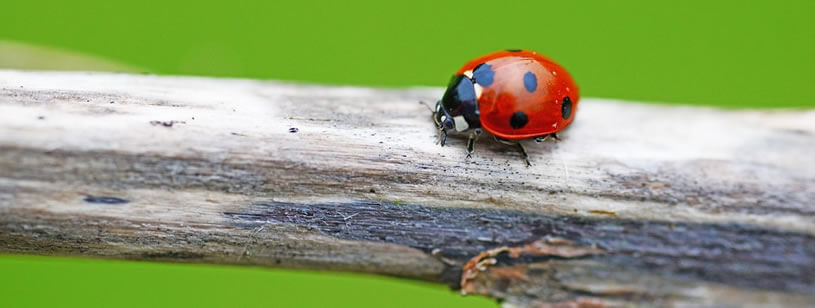
Ladybirds, also called ladybugs or lady beetles, belong to the beetle family Coccinellidae. Many adults and larvae eat aphids or other small insects, helping limit some plant pests.
Ladybirds have many colours and patterns: red with black spots is familiar, but yellow, orange, dark and unspotted forms also occur. Their markings depend on species and individual variation, not simply their age.
Some ladybird species are used in biological pest management. Their impact varies, and introducing a species without considering its local ecology can create problems.
Quick facts
| Common name | Ladybird / ladybug |
| Scientific name | Coccinellidae (family) |
| Typical lifespan | Usually up to about 1 year as an adult; some live 2 years or more |
| Length | About 1-15 mm (depending on the species) |
| Weight | A few milligrams to a few tens of milligrams |
| Diet type | Varies by species; many eat aphids and other small insects, while some feed on plants or fungi |
| Main predators | Birds, frogs, spiders, wasps, dragonflies |
| Conservation status | Varies by species and region; some native ladybirds have declined |
| Distribution | On all continents except Antarctica |
| Living environment | Forests, meadows, gardens, farmland |
Interesting facts
- A ladybird can eat about 5,000 aphids in its lifetime - It is one of the most effective natural enemies of these plant pests.
- Their colours are a warning to predators - Bright colours tell birds and other predators that ladybirds taste bad and may be toxic.
- They "bleed" to defend themselves - When disturbed, ladybirds release a smelly yellow fluid from their leg joints, which puts off birds and other predators.
- They spend the winter in groups - In cold weather, ladybirds gather in sheltered places, such as under bark, in cracks in rocks or inside buildings.
- Not all ladybirds have spots - Some have stripes, some have no markings at all, and the pine ladybird (Exochomus quadripustulatus) is black with a few red marks.
Records and remarkable features
- One of the largest ladybirds - The giant ladybird Megalocaria dilatata from Asia can reach about 15 mm; in Europe, the eyed ladybird (Anatis ocellata) reaches about 9 mm.
- The smallest ladybirds - Some tiny species of the tribe Scymnini are only about 1 mm long.
- Long-lived - Some ladybirds can live for two years or more.
- The most widespread - The harlequin ladybird (Harmonia axyridis), native to Asia, was introduced to control aphids and has now spread to many parts of the world.
- Long-distance flyers - With the help of the wind, ladybirds have been recorded flying at about 60 km/h, high in the sky, and travelling up to about 120 km in one flight.
Physical characteristics and adaptations
Ladybirds are small but highly adapted beetles, with rounded bodies, bright colours and an effective chemical defence.
Key physical adaptations
- A dome-shaped body - Makes it hard for predators to grab them; when threatened, they pull in their legs and clamp down on the leaf.
- Elytra (hard wing cases) - Protect the delicate flying wings underneath.
- Warning colours - Red, orange and yellow tell predators that ladybirds taste unpleasant and can be toxic.
- Short legs - Allow them to walk quickly over plants in search of prey.
- Flying wings under the elytra - Thin, folded wings that unfold for flight.
What do ladybirds look like?
| Feature | Details |
|---|---|
| Colour | Red, yellow, orange, black, with or without spots |
| Length | About 1-15 mm, depending on the species |
| Weight | A few milligrams to a few tens of milligrams |
| Wings | Two pairs: hard wing cases (elytra) and thin flying wings |
| Legs | 3 pairs, short and strong |
| Antennae | Short, used to smell and touch |
Habits and behaviour
Most ladybirds are active predators that spend much of their time looking for food and avoiding predators.
Daily life
- Active by day - Ladybirds look for food and mates during the day.
- Warming up in the sun - They bask in the morning sun before becoming active.
- Playing dead - When threatened, they may drop, keep still and release a bitter fluid to deter attackers.
- Winter gatherings - They hide in groups in cracks in rocks, under bark or even in people's homes.
Specific behaviours
- Hunting aphids - Ladybirds and their larvae move quickly over leaves, attacking colonies of aphids.
- Short flights - They fly to find new food sources, but usually walk over plants.
- Adapting to the climate - In cold climates, ladybirds rest through the winter, while in warm regions some are active all year.
Survival strategies
- Warning colours that scare off predators.
- A bitter, toxic fluid released from the leg joints.
- A rounded body that is hard to grab.
- Winter rest to survive the cold.
Habitat and geographic distribution
Ladybirds live on almost every continent and prefer places with plenty of plants, where they find food and shelter.
Distribution context
| Region | Notable species | Habitat examples |
|---|---|---|
| Europe | Coccinella septempunctata (seven-spot ladybird) | Gardens, meadows |
| North America | Hippodamia convergens (convergent lady beetle); Harmonia axyridis (introduced) | Farmland, orchards, grasslands |
| Asia | Harmonia axyridis (harlequin ladybird, native) | Forests, farmland |
| Africa | Cheilomenes lunata (lunate ladybird) | Savannas and forests |
| Australia | Cryptolaemus montrouzieri (mealybug destroyer) | Temperate and tropical areas |
Habitat types
- Gardens and farmland - Where there are many aphids and other pests.
- Forests and grasslands - Wild species prefer areas with plenty of vegetation.
- Mountains - Some ladybirds, such as the convergent lady beetle in California, gather in huge numbers on mountain slopes to spend the winter.
- Towns - Many species live in parks, gardens and even on balconies.
Environmental change
- Pesticides harm ladybird populations.
- Climate change affects their winter rest and breeding.
- Introduced species, such as the harlequin ladybird, compete with native ladybirds.
Diet and feeding
Most ladybirds are predators that help farmers by eating pests such as aphids, scale insects and mites. Some species, however, eat plants or fungi.
What do ladybirds eat?
| Diet type | Examples of food |
|---|---|
| Predators | Aphids, scale insects, mealybugs, insect larvae, mites |
| Extra food | Pollen, nectar, honeydew |
| Plant-eaters (rare) | Leaves of potatoes, beans and squash (species of the subfamily Epilachninae) |
| Fungus-eaters | Mildew on leaves (for example, the 22-spot ladybird) |
Feeding methods
- Hunting aphids - Ladybirds move quickly over leaves and attack aphid colonies.
- Chewing prey - Their jaws bite into the prey; larvae often suck out the body contents.
- Pollen and nectar - Some species eat pollen for extra energy, especially when prey is scarce.
- Cannibalism - Ladybirds sometimes eat the eggs and larvae of other ladybirds, especially when food is short.
Ecological role
- Natural pest control - A ladybird can eat dozens of aphids a day.
- Pollination - Species that visit flowers can carry some pollen.
- Fewer pesticides - Farmers use ladybirds for the biological control of pests.
Reproduction and life cycle
Ladybirds go through complete metamorphosis, with four stages of development: egg, larva, pupa and adult.
Breeding season
- Mating takes place in spring and summer, when it is warm and food is plentiful.
- Males and females find each other using scents called pheromones, and mating can last several hours.
- After mating, a female lays from a few dozen to over 1,000 eggs, depending on the species.
Developmental stages
| Stage | Duration | Details |
|---|---|---|
| Egg | 3-10 days | Yellow, laid in clusters on leaves near aphids |
| Larva | 2-4 weeks | Dark and spiky, often with orange or yellow marks; eats huge numbers of aphids |
| Pupa | 5-10 days | Attached to a leaf and does not move |
| Adult | Usually up to about 1 year | Hardens its wing cases and starts looking for food |
Adaptations for survival
- The larvae are very active and eat a lot so that they grow quickly.
- Pupae are protected by warning colours and a bitter taste.
- Adults rest through the winter, slowing their metabolism to save energy.
Name and history
Origin of the name
- The English name "ladybird" means "Our Lady's bird": in the Middle Ages, the insect was linked with the Virgin Mary, perhaps because the red wing cases were like her red cloak.
- In North America, the insect is usually called a "ladybug", and scientists also use the name "lady beetle"; it is a beetle, not a true bug.
- In many other languages, the ladybird's name is also linked with God or the Virgin Mary, as in the German Marienkäfer, "Mary's beetle".
Taxonomic classification
| Classification | Name |
|---|---|
| Kingdom | Animalia |
| Phylum | Arthropoda |
| Class | Insecta |
| Order | Coleoptera |
| Family | Coccinellidae |
| Species | More than 6,000 species |
Evolution and fossils
- Ladybirds are beetles, in the order Coleoptera. The age of the wider beetle lineage is not the age of the ladybird family.
- Fossils help researchers investigate ladybird evolution; the source’s exact oldest-fossil claim needs documentation.
- Over time, ladybirds developed warning colours and bitter chemicals that protect them from predators.
Cultural significance and mythology
In many cultures, the ladybird is a symbol of good luck, protection and love. Because of its bright colours and its usefulness to farmers, it has long been well liked.
The ladybird in myths and symbolism
- A lucky charm - In many countries, a ladybird landing on you is said to bring good luck, and killing one is thought to bring bad luck.
- Counting the spots - A popular belief says that the number of spots shows how many years of luck you will have, or how many months until a wish comes true.
- A nursery rhyme - Children in England have long sung "Ladybird, ladybird, fly away home, your house is on fire and your children are gone."
Conservation status and threats
Ladybird conservation differs by species and region; common garden species should not be used to represent the whole family.
Main pressures
- Heavy use of pesticides - Chemicals kill ladybirds along with the pests they eat.
- Climate change - Warmer winters affect their winter rest and breeding.
- Competition with invasive species - The harlequin ladybird (Harmonia axyridis), introduced for pest control, has replaced native species in parts of Europe and North America.
- Habitat loss - Urban growth and intensive farming reduce the places where ladybirds can live and breed.
Protection efforts
| Measure | Organisation / action |
|---|---|
| Promoting organic farming | Environmental organisations and farmers |
| Using fewer pesticides | Biological pest control programmes |
| Monitoring species | Surveys such as the UK Ladybird Survey and the Lost Ladybug Project in North America |
Declining species
- Two-spot ladybird (Adalia bipunctata) - Declining in parts of Europe, partly because of competition with the harlequin ladybird.
- Nine-spotted ladybird (Coccinella novemnotata) - Once common in North America, it became very rare; it is the state insect of New York.
- Island ladybirds - Some species found only on small islands are threatened by habitat loss.
Ladybirds in popular culture
The ladybird is a much-loved character in books, art, films and cartoons, often linked with kindness, luck and protection.
Ladybirds in literature and art
- The Bad-Tempered Ladybird (Eric Carle, 1977) - A picture book about a grumpy ladybird who wants to pick a fight with everyone.
- Ladybird Books - A famous British publisher of children's books has used a ladybird as its logo since 1914.
Ladybirds in films and cartoons
- Miraculous: Tales of Ladybug & Cat Noir - A French animated series whose heroine has ladybird-inspired superpowers.
- A Bug's Life (1998) - In this Pixar film, Francis is a grumpy male ladybird who is often mistaken for a female.
- Minuscule (2006) - A French animated series about the lives of insects, featuring ladybirds.
Ladybirds as a symbol
- Organic farming - The ladybird is a symbol of natural crop protection.
- Nature campaigns - It appears in campaigns to reduce pesticides and protect biodiversity.
- Decoration - Ladybirds are popular on jewellery, clothes and crafts because of their positive meaning.