Braque d’AuvergneCharacteristics, history, training and care
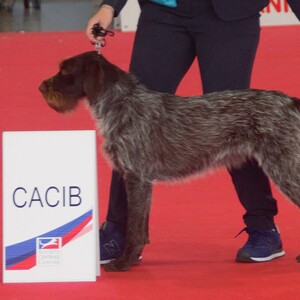
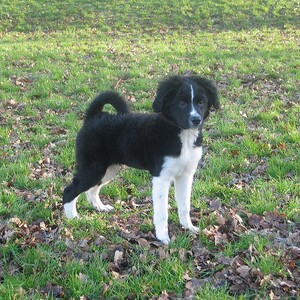
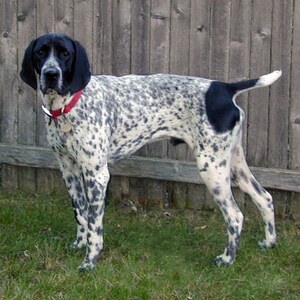
Braque d'Auvergne · Mrsthurlow / Wikimedia Commons, CC BY-SA 3.0. Cropped and resized.
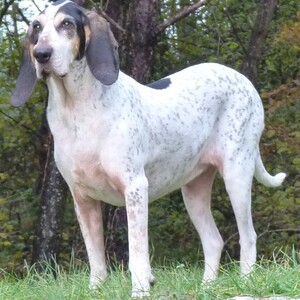
The Braque d'Auvergne is a French pointing dog from the Cantal region, with a short black-and-white coat and a black head. It is sturdy yet elegant and can work a whole day on difficult ground. At home it is gentle, very affectionate and obedient.
Quick facts
| Common name | Braque d'Auvergne (Auvergne Pointer) |
| Scientific name | Canis lupus familiaris |
| Country of origin | France (Cantal, Auvergne) |
| Official recognition | FCI, definitively since 30 June 1955 (group 7, pointing dogs, with working trial; standard no. 180); The Kennel Club (United Kingdom), since 2016 |
| Lifespan | No published data for the breed; large breeds usually live 10–13 years |
| Size (males) | 57–63 cm at the withers (ideally 60 cm) |
| Size (females) | 53–59 cm at the withers (ideally 56 cm) |
| Weight | The standard gives no figure |
| Coat type | Short, glossy, neither too fine nor harsh |
| Common colours | Black and white: finely speckled or grey; black head, preferably with a white stripe |
| Energy level | High |
| Suited to an apartment? | Not really; it needs plenty of exercise |
| Temperament | Gentle, very affectionate, intelligent, obedient |
| Tendency to aggression | Very low |
| Good with children | Good |
| Good with other animals | Good with other dogs |
| Genetic predispositions | No breed-specific diseases are known |
- Primary category:Dog breeds
- Explore this animal's categories:
History and origin
The Braque d'Auvergne is a very old breed that has lived in the Cantal region for more than two centuries. It comes from a common type of pointing dog, and the standard says the Knights of Malta may also have played a part in its selection.
It was created by hunters, for hunters. It has a strong identity, reinforced by its unmistakable coat.
How the breed developed
- More than two centuries – The breed lives in the Cantal region.
- 30 June 1955 – The FCI recognises the breed.
- 24 March 2004 – The current FCI standard is published.
- 1 April 2016 – The Kennel Club in the United Kingdom recognises the breed.
Breed rating
| Feature | Stars |
|---|---|
| Training and intelligence | ★★★★★ |
| Easy to train | ★★★★★ |
| Intelligence | ★★★★☆ |
| Independence | ★★☆☆☆ |
| Stubbornness | ★★☆☆☆ |
| Behaviour and temperament | ★★★★★ |
| Affectionate with family | ★★★★★ |
| Friendly with children | ★★★★☆ |
| Good with other dogs | ★★★★☆ |
| Good with cats and other animals | ★★★☆☆ |
| Loyalty | ★★★★☆ |
| Tendency to be aggressive | ★☆☆☆☆ |
| Tendency to bark | ★★★☆☆ |
| Needs and care | ★★★☆☆ |
| Shedding | ★★☆☆☆ |
| Needs frequent grooming | ★★☆☆☆ |
| Activity and lifestyle | ★★★★☆ |
| Energy level | ★★★★★ |
| Daily exercise needs | ★★★★★ |
| Suited to apartment life | ★★☆☆☆ |
| Health and longevity | ★★★★☆ |
| Life expectancy | ★★★★☆ |
| Predisposition to genetic diseases | ★★☆☆☆ |
| Working abilities and uses | ★★★★★ |
| Good hunting dog (pointing) | ★★★★★ |
| Good companion dog | ★★★★★ |
Indicative rating: 5 stars means the highest level. The breed has no AKC profile; the rating is based on the FCI standard (“gentle, very affectionate, intelligent and obedient”).
Physical characteristics
It is a sturdy dog with strong bones, but never heavy. The body is almost as long as it is tall. Its build helps it cover long distances and stay active for a whole day on the most difficult ground.
General appearance
The head is large, with long ears and pendulous lips. The fairly large, oval, dark brown eyes have a frank, gentle expression.
| Feature | Braque d'Auvergne |
|---|---|
| Size | Large |
| Height at the withers | males: 57–63 cm; females: 53–59 cm |
| Coat | Short, glossy |
| Head | Black, preferably with a white stripe on the muzzle |
| Eyes | Oval, dark brown |
| Ears | Long, supple, slightly turned inwards |
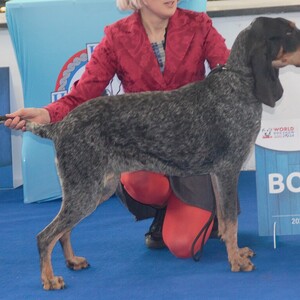
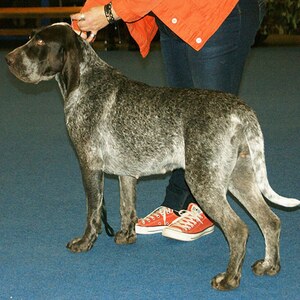
The coat is black and white, in two types: finely speckled or grey. White with small black spots gives a bluish impression. The head and ears are black, and a white stripe on the muzzle is preferred.
Training and socialisation
The standard says that training consists mainly of developing its natural qualities. It has a very keen nose.
It is intelligent and obedient, so it learns easily with calm methods.
Tips for effective training
- Work with its instincts. Search and retrieve games keep it happy.
- Be gentle. It is sensitive and very affectionate.
- Practise the recall. In the field, its nose can lead it a long way.
- Give it time with the family. It adapts well to family life.
Activity needs and lifestyle
It is a hardy hunting dog, made to work for hours on end. It needs plenty of exercise every day.
| Activity | How often | Why it matters |
|---|---|---|
| Running or long walks | daily | Its stamina demands a lot of effort |
| Retrieve and search games | several times a week | Uses its keen nose |
| Hunting or dog sports | weekly | Gives it a job to do |
Tips for a balanced life
- The yard must be fenced.
- Keep it on a lead outside safe areas.
- It suits active families or hunters.
Care and health
Coat and skin care
The short, glossy coat is easy to look after, with a brush once a week.
Common health problems
There are no known hereditary diseases specific to the breed. The long ears should be checked often to prevent infections.
Other care
- Clean the ears once a week.
- Check for ticks after outings in the field.
- Trim the nails regularly.
Diet and nutrition
An active pointing dog needs plenty of energy, especially during the hunting season. Weigh it regularly, as the standard gives no weight.
Tips for a healthy diet
The table gives a starting estimate, calculated with the formula from the Merck Veterinary Manual. The first two calorie columns show the calories per day for a healthy adult dog. The last column shows what this means in dry food with 3,500–4,000 kcal per kilogram.
| Dog's weight | Calories per day (neutered) | Calories per day (not neutered) | Dry food per day (approximate) |
|---|---|---|---|
| 22 kg | 1,140 kcal | 1,280 kcal | 280–370 g |
| 26 kg | 1,290 kcal | 1,450 kcal | 320–410 g |
| 30 kg | 1,440 kcal | 1,620 kcal | 360–460 g |
- Give it its food in two meals a day.
- Increase the portion on days of hard exercise.
- A dog is at the right weight when you can feel its ribs without pressing hard.
Foods to avoid
Some human foods are dangerous for dogs: chocolate, coffee, grapes and raisins, onions, garlic, xylitol (a sweetener used in chewing gum), macadamia nuts and alcohol.
Reproduction and development
Physical and emotional maturity
In dogs, sexual maturity usually comes between 6 and 12 months, but in large breeds it can be delayed until about two years. The body also reaches its adult form later than in small breeds.
Mating and pregnancy
Pregnancy lasts about 63 days, counted from ovulation. Mating a female on her first heat is not recommended. The FCI standard requires that only healthy dogs of typical breed appearance are used for breeding.
Caring for the puppies
In large breeds, a litter has around 7 puppies on average. Socialisation starts in the first weeks: gentle handling, everyday noises and new people.
Interesting facts
- Linked to the Knights of Malta. The standard says the Knights of Malta may have played a part in its selection.
- It looks blue. The small black spots on a white background give the coat a bluish tint.
- Its head is always black. The head and ears are always black.
- Tireless all day. It is built to work a whole day on difficult ground.
- Recognised only recently in Britain. The Kennel Club did not recognise it until 2016.
Frequently asked questions
What is a Braque d'Auvergne?
A black-and-white French pointing dog from Cantal, with a black head.
How big does it get?
Males measure 57–63 cm and females 53–59 cm at the withers.
Is it a good family dog?
Yes. The standard says it adapts well to family life and is very affectionate.
How much exercise does it need?
A lot. It is a hunting dog that can work a whole day.