KomondorCharacteristics, history, training and care
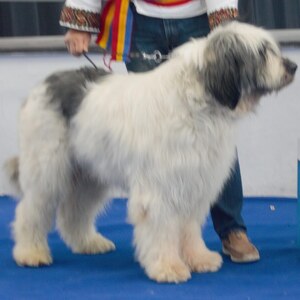
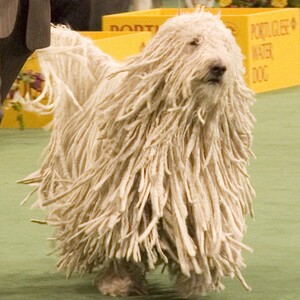
Komondor. · whartonds (Flickr) / Wikimedia Commons, CC BY-SA 2.5. Cropped and resized.
The Komondor is a very large, powerful Hungarian dog covered in a long white coat that forms thick cords, like ropes. It is an old flock guardian, with unwavering courage in defending the animals and its owner's home. The AKC says that, although it looks like a giant mop, it is a dog to be taken seriously.
Quick facts
| Common name | Komondor (Hungarian sheepdog) |
| Scientific name | Canis lupus familiaris |
| Country of origin | Hungary |
| Official recognition | FCI, definitively since 9 August 1954 (group 1, sheepdogs; standard no. 53); also recognised by the AKC |
| Lifespan | 10–12 years, according to the AKC |
| Size (males) | at least 70 cm at the withers; 50–60 kg |
| Size (females) | at least 65 cm at the withers; 40–50 kg |
| Coat type | Long, dense, in thick cords (corded) |
| Common colours | Ivory (white) |
| Energy level | Moderate |
| Suited to an apartment? | No |
| Temperament | Brave, territorial, independent, affectionate with the family |
| Tendency to aggression | High towards intruders; a serious guard dog |
| Good with children | Average; with supervision |
| Good with other animals | Good with the family's animals; poor with strange dogs |
| Genetic predispositions | No known breed-specific diseases; hip dysplasia and bloat, as in all large dogs |
- Primary category:Dog breeds
- Explore this animal's categories:
History and origin
The FCI standard says the Komondor is an old Hungarian herding breed of Asian origin. Its ancestors almost certainly came to the Carpathian Basin with the ancient Hungarians, who were nomadic herders.
Wikipedia says the breed may have been brought by the Cumans, a nomadic people who settled in Hungary in the 12th–13th centuries, and that the name may come from “Koman-dor”, meaning “dog of the Cumans”. The oldest known mention is in a Hungarian codex from 1544. Today, the Komondor is declared a national treasure of Hungary.
How the breed developed
- 12th–13th centuries – The Cumans settle in Hungary with their dogs, according to Wikipedia.
- 1544 – The oldest known mention appears in a Hungarian codex.
- 9 August 1954 – The FCI recognises the breed.
- 6 April 2010 – The current FCI standard is published.
Breed rating
| Feature | Stars |
|---|---|
| Training and intelligence | ★★★☆☆ |
| Easy to train | ★★★★☆ |
| Intelligence | ★★★★☆ |
| Independence | ★★★★★ |
| Stubbornness | ★★★★☆ |
| Behaviour and temperament | ★★★★☆ |
| Affectionate with family | ★★★★★ |
| Friendly with children | ★★★☆☆ |
| Good with other dogs | ★★☆☆☆ |
| Good with cats and other animals | ★★★☆☆ |
| Loyalty | ★★★★★ |
| Tendency to be aggressive | ★★★★☆ |
| Tendency to bark | ★★★☆☆ |
| Needs and care | ★★★★☆ |
| Shedding | ★☆☆☆☆ |
| Needs frequent grooming | ★★★★★ |
| Activity and lifestyle | ★★★☆☆ |
| Energy level | ★★★☆☆ |
| Daily exercise needs | ★★★☆☆ |
| Suited to apartment life | ★☆☆☆☆ |
| Health and longevity | ★★★☆☆ |
| Life expectancy | ★★★☆☆ |
| Predisposition to genetic diseases | ★★☆☆☆ |
| Working abilities and uses | ★★★★☆ |
| Good guard dog | ★★★★★ |
| Good companion dog | ★★★☆☆ |
Indicative rating: 5 stars means the highest level. It is based on the ratings the American Kennel Club gives the breed and on the FCI standard.
Physical characteristics
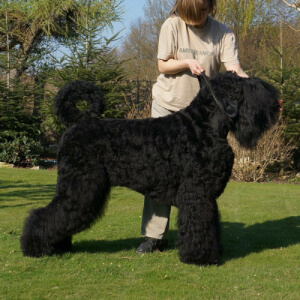
The standard describes it as a large, powerful dog whose dignified bearing inspires respect and even fear. The body is covered in long, dense hair matted into cords. The AKC says that, although massive, it is agile and light on its feet.
General appearance
The head, covered in abundant hair, is held above the body. The tail hangs down, with the tip slightly raised. The coat has a coarser topcoat and a finer undercoat; together they form the characteristic cords, which are longest on the croup, loins and the back of the thighs.
| Feature | Komondor |
|---|---|
| Size | Very large |
| Height at the withers | males: at least 70 cm; females: at least 65 cm |
| Weight | males: 50–60 kg; females: 40–50 kg |
| Coat | Long, corded |
| Colour | Ivory |
| Tail | Hanging, with a raised tip |
The only accepted colour is ivory. The AKC says the white coat helps it blend in with the sheep it guards and protects it if a predator attacks.
Training and socialisation
The standard says it has unwavering courage in guarding the flocks, the house and its owner's property. It attacks silently and boldly, regards its territory as its own and does not tolerate other creatures in it. It is suspicious by nature.
The AKC says it is an independent thinker and can become overprotective if not trained. By the age of one, it should obey commands consistently.
Tips for effective training
- Socialise it intensively as a puppy. It is suspicious by nature.
- Be calm and consistent. It is an independent thinker.
- Avoid dog parks. The AKC says they are usually not a good idea for it.
- Start training early. It must obey commands by the age of one.
Activity needs and lifestyle
The AKC says it is agile and athletic for its size and needs a fair amount of exercise: free running in a large, well-fenced yard, walks and play with the family's dogs.
| Activity | How often | Why it matters |
|---|---|---|
| Walks on the lead | daily | Exercise |
| Time in a large, fenced yard | daily | It guards its territory |
| Play with the family's dogs | often | Keeps it fit |
Tips for a balanced life
- The fence must be high and solid.
- It is not suited to beginners.
- In summer, its thick coat makes it suffer in the heat.
Care and health
Coat and skin care
The AKC says the corded coat needs special care. One breeder says they never brush their dogs but bathe them regularly. At around 9–10 months, when the coat starts to form mats, these are separated by hand into small sections, from which the cords grow.
Common health problems
The AKC says there are no known health problems specific to the breed. Responsible breeders nevertheless screen their dogs for:
| Condition | Description | Common symptoms |
|---|---|---|
| Hip dysplasia | The hip joint forms incorrectly and, over time, arthritis develops | Limping, difficulty getting up or jumping, hip pain |
| Gastric dilatation-volvulus (bloat) | The stomach fills with gas and may twist; this is a veterinary emergency | Swollen belly, trying to vomit without success, drooling, restlessness |
| Eye diseases | Eye conditions checked by breeders | Watery eyes, red eyes, poor vision |
Other care
- Check the skin under the cords for irritation.
- Dry the coat thoroughly after a bath.
- Check the ears regularly.
Diet and nutrition
The AKC says it eats little for its size and sometimes skips a meal if it is not hungry. Some owners notice that too much protein can lead to itching or skin irritation.
Tips for a healthy diet
The table gives a starting estimate, calculated with the formula from the Merck Veterinary Manual. The first two calorie columns show the calories per day for a healthy adult dog. The last column shows what this means in dry food with 3,500–4,000 kcal per kilogram.
| Dog's weight | Calories per day (neutered) | Calories per day (not neutered) | Dry food per day (approximate) |
|---|---|---|---|
| 40 kg | 1,780 kcal | 2,000 kcal | 440–570 g |
| 50 kg | 2,110 kcal | 2,370 kcal | 530–680 g |
| 60 kg | 2,410 kcal | 2,720 kcal | 600–780 g |
- Split the food into two meals a day to reduce the risk of bloat.
- Do not let it run right after a meal.
- Puppies need food suited to large breeds.
Foods to avoid
Some human foods are dangerous for dogs: chocolate, coffee, grapes and raisins, onions, garlic, xylitol (a sweetener used in chewing gum), macadamia nuts and alcohol.
Reproduction and development
Physical and emotional maturity
In dogs, sexual maturity usually comes between 6 and 12 months, but in large breeds it can be delayed until about two years. Very large breeds become adults only at around 2 years.
Mating and pregnancy
Pregnancy lasts about 63 days, counted from ovulation. Mating a female on her first heat is not recommended. The FCI standard requires that only healthy dogs of typical breed appearance are used for breeding.
Caring for the puppies
In large breeds, a litter has around 7 puppies on average. The puppies grow very fast, so they need growth food suited to large breeds. Socialisation starts in the first weeks.
Interesting facts
- A Hungarian plural. The AKC says the plural of Komondor is “Komondorok”.
- Lost among the sheep. Its white coat helps it blend in with the flock.
- The dog of the Cumans. The name may come from “Koman-dor”, according to Wikipedia.
- A national treasure. It is declared a national treasure of Hungary.
- It eats little. The AKC says it eats little for its size.
Frequently asked questions
Does the Komondor need brushing?
Not like other dogs: the cords are separated by hand and the coat is bathed regularly.
How big does it get?
Males measure at least 70 cm and weigh 50–60 kg; females measure at least 65 cm and weigh 40–50 kg.
Is it a family dog?
It is affectionate with the family, but it is a serious guard dog, for experienced owners.
How long does it live?
The AKC gives 10–12 years.