Freshwater angelfishPterophyllum scalare — habitat, diet and reproduction
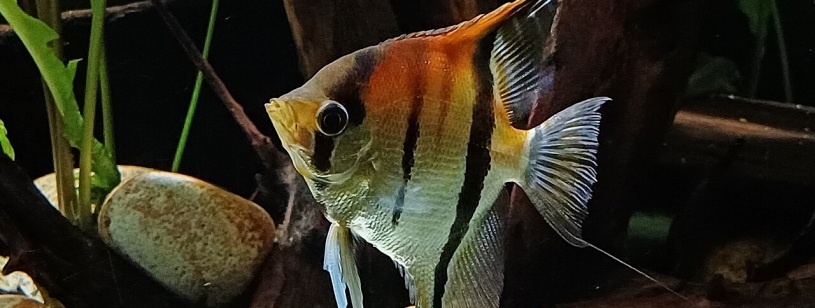
Freshwater angelfish (Pterophyllum scalare), an ornamental colour variety. · Botev / CC BY-SA 4.0 (https://creativecommons.org/licenses/by-sa/4.0). Cropped and resized.
The freshwater angelfish is a South American fish with a tall, laterally flattened body. Long fins give it an almost triangular outline. In Amazonian waters it moves among plants and roots. During breeding, a pair cleans a surface, lays eggs and guards them.
Quick facts
| Common name | Freshwater angelfish |
| Scientific name | Pterophyllum scalare |
| Lifespan | Can live 10–15 years with good care |
| Length | Can reach about 15 cm; fins greatly increase its height |
| Diet | Omnivore, frequently eating small animals |
| Predators | Larger fish |
| Conservation status | Least Concern (LC) |
| Distribution | Amazon basin and other northern South American drainages |
| Habitat | Quiet waters with plants, roots and submerged wood |
| Family | Cichlidae |
| Reproduction | Eggs laid on a surface and guarded by the pair |
| Visible adaptation | Laterally flattened body and elongated fins |
- Primary category:Fish
- Explore this animal's categories:
Interesting facts
- Pairs can fan their eggs with their fins.
- Wild fish have dark bars, while aquarium varieties show many other colours.
- The pelvic fins resemble two long threads beneath the body.
- An adult may swallow small tankmates that fit its mouth.
Characteristics
The body is much taller than it is wide. The dorsal and anal fins extend this profile, while the pelvic fins are slender and elongated. This shape suits movement among vertical obstacles.
Wild fish have a silver background with dark bars. Aquarium varieties include black, gold, marbled and orange-marked forms, sometimes with especially long fins. Body length alone does not describe their space needs: aquarium height also matters.
Behaviour
Angelfish explore planted areas and shelters but can become territorial. Breeding pairs drive other fish away from their eggs. Behaviour depends on space, social conditions and breeding stage.
A suitably tall aquarium should provide both swimming room and shelter. Very strong currents do not match the quiet waters they often inhabit. Tankmate compatibility must account for adult size: a small fish may become prey.
Habitat and distribution
The species occurs in the Amazon basin and other northern South American drainages. It uses slow water, floodplain habitats and places containing vegetation or submerged wood. Water may be clear or turbid.
Roots and plants provide shelter and breeding surfaces. Changing water levels alter access to food and refuge across these habitats.
Diet and feeding
Food includes worms, small crustaceans and other aquatic animals. Very small fish may also be eaten. This is not an exclusively plant-eating species.
Captive fish need suitable complete food and appropriate variety, offered in manageable portions. Uneaten food harms water quality. Persistent refusal to feed should be considered alongside competition, stress and water conditions.
Reproduction and life cycle
A pair chooses and cleans a surface, often a broad leaf or an almost vertical support. The female lays eggs and the male fertilises them. Parents may guard and fan the clutch.
Newly hatched larvae use their yolk reserves before becoming free-swimming and taking tiny foods. Parental care does not guarantee survival: disturbance and unsuitable conditions can lead to egg loss.
Name and history
Schultze described Pterophyllum scalare in 1823. It belongs to the cichlid family. Related species, such as Pterophyllum altum, also occur in the aquarium trade and require separate identification.
The English name angelfish also refers to unrelated marine fishes. The animal described here lives in freshwater.
Conservation and threats
The species is globally Least Concern. This does not mean every local population is unaffected by habitat degradation. Clean water and intact riverside vegetation help protect feeding and breeding areas.
Ornamental varieties should remain in controlled systems. Releasing aquarium fish can harm local aquatic communities.
Frequently asked questions
Can angelfish live with very small fish?
Fish small enough to swallow may be eaten. Compatibility depends on adult size and behaviour.
Who guards the eggs?
The pair may guard and fan the clutch, then protect larvae and fry.
Why does it need a tall aquarium?
Its deep body and elongated fins require vertical space as well as swimming room.
Is it a marine fish?
No. Pterophyllum scalare lives in freshwater, although the name angelfish is also used for unrelated marine fishes.