Gascon SaintongeoisCharacteristics, history, training and care
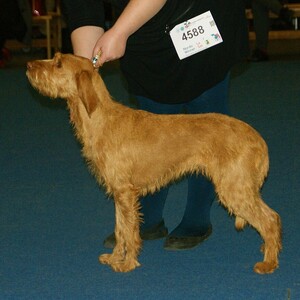
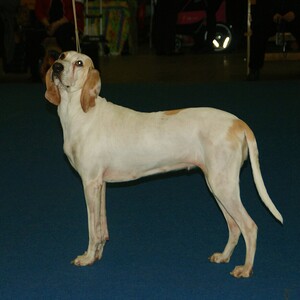
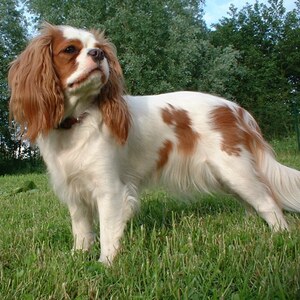
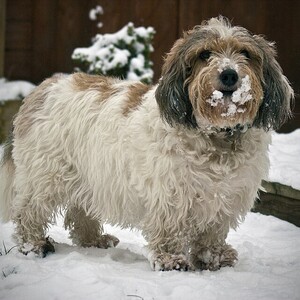
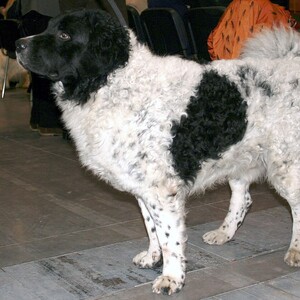
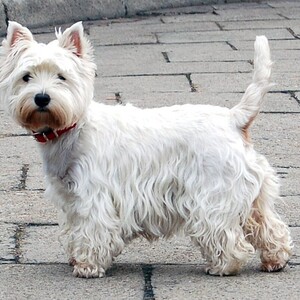
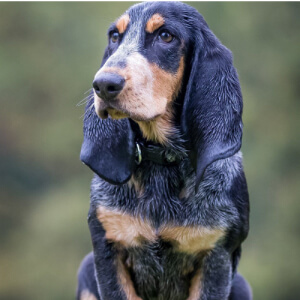
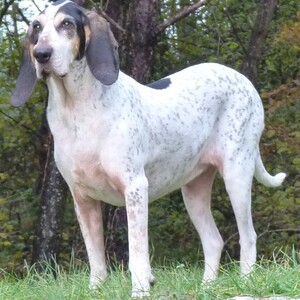
Petit Gascon Saintongeois · Jérôme Bardiau, Anka Friedrich / Wikimedia Commons, CC BY-SA 3.0. Cropped and resized.
The Gascon Saintongeois is a French pack hound, white with black patches, with long ears and pendulous lips. It comes in two varieties: Grand (large) and Petit (smaller, but still a fairly large dog). It has a fine nose, a very powerful voice and a beautiful gallop. It is calm, affectionate and obedient.
Quick facts
| Common name | Gascon Saintongeois (Grand and Petit) |
| Scientific name | Canis lupus familiaris |
| Country of origin | France (south-west) |
| Official recognition | FCI, definitively since 10 August 1963 (group 6, scent hounds; standard no. 21) |
| Lifespan | No published data for the breed; large hounds usually live 10–13 years |
| Size (males) | Grand: 65–72 cm; Petit: 56–62 cm at the withers |
| Size (females) | Grand: 62–68 cm; Petit: 54–59 cm at the withers |
| Weight | Grand: about 30–32 kg (Wikipedia) |
| Coat type | Short and close-lying |
| Common colours | White with black patches, sometimes ticked; tan markings on the cheeks and above the eyes |
| Energy level | High |
| Suited to an apartment? | No |
| Temperament | Calm, affectionate, obedient, a pack dog |
| Tendency to aggression | Very low |
| Good with children | Good |
| Good with other animals | Very good with dogs; hunting instinct |
| Genetic predispositions | No breed-specific diseases are known |
- Primary category:Dog breeds
- Explore this animal's categories:
History and origin
Wikipedia says that only three dogs of the old Saintonge hound survived the French Revolution. In the mid-19th century, Count Joseph de Carayon-Latour wanted to save this endangered breed and crossed its last descendants with Bleu de Gascogne dogs belonging to Baron de Ruble. This is how the Gascon Saintongeois was born, while the old Saintonge hound disappeared.
In the mid-20th century, a few hunters in south-western France selected the smallest dogs from Grand Gascon Saintongeois litters and created the Petit variety, originally for hunting hares.
How the breed developed
- Late 18th century – Only three Saintonge hounds survive the French Revolution.
- Mid-19th century – Count Carayon-Latour creates the Gascon Saintongeois.
- Mid-20th century – Hunters in the south-west create the Petit variety.
- 10 August 1963 – The FCI recognises the breed.
- 1 August 2023 – the current FCI standard is published.
Breed rating
| Feature | Stars |
|---|---|
| Training and intelligence | ★★★☆☆ |
| Easy to train | ★★★★☆ |
| Intelligence | ★★★★☆ |
| Independence | ★★★★☆ |
| Stubbornness | ★★★☆☆ |
| Behaviour and temperament | ★★★★☆ |
| Affectionate with family | ★★★★☆ |
| Friendly with children | ★★★★☆ |
| Good with other dogs | ★★★★★ |
| Good with cats and other animals | ★★☆☆☆ |
| Loyalty | ★★★★☆ |
| Tendency to be aggressive | ★☆☆☆☆ |
| Tendency to bark | ★★★★★ |
| Needs and care | ★★★★☆ |
| Shedding | ★★★☆☆ |
| Needs frequent grooming | ★☆☆☆☆ |
| Activity and lifestyle | ★★★★☆ |
| Energy level | ★★★★☆ |
| Daily exercise needs | ★★★★★ |
| Suited to apartment life | ★☆☆☆☆ |
| Health and longevity | ★★★★☆ |
| Life expectancy | ★★★★☆ |
| Predisposition to genetic diseases | ★★☆☆☆ |
| Working abilities and uses | ★★★★☆ |
| Good hunting dog | ★★★★★ |
| Good companion dog | ★★★☆☆ |
Indicative rating: 5 stars means the highest level. The breed has no AKC profile; the rating is based on the FCI standard (“a pack hound par excellence, calm, affectionate and obedient”).
Physical characteristics
The standard describes the Grand Gascon Saintongeois as a very well-built dog that gives an impression of strength and elegance, very French in type through its head, coat and expression. The Petit is a medium-sized, well-proportioned and distinguished dog.
General appearance
Wikipedia says it has a lean, muscular body, long legs, long hanging ears and pendulous lips. The eyes are dark chestnut, the nose is black, and the elegant tail is carried sabre-like.
| Feature | Gascon Saintongeois |
|---|---|
| Size | Large (Grand) or medium to large (Petit) |
| Height at the withers | Grand: 62–72 cm; Petit: 54–62 cm |
| Coat | Short, close-lying |
| Eyes | Dark chestnut |
| Ears | Long, hanging |
| Tail | Elegant, sabre-shaped |
The base colour is white with black patches, sometimes ticked, but not excessively. Two black patches usually cover the ears and surround the eyes. The cheeks are tan, and two tan spots above the eyes give it a “four-eyed” look. Sometimes there is a tan spot on the thigh, called the “roe deer mark”.
Training and socialisation
The standard describes it as a pack hound par excellence, with a fine nose, that searches over wide areas and has a very resonant voice. It instinctively joins the pack and is calm, affectionate and obedient.
Like any hound, it follows a scent stubbornly, so recall needs a lot of practice. It is happy in the company of other dogs.
Tips for effective training
- Give it company. It is a pack dog.
- Practise recall. On a fresh trail it may forget about you.
- Think of the neighbours. It has a very resonant voice.
- Work with its nose. Tracking games make use of its talent.
Activity needs and lifestyle
It is a hunter with great stamina that needs plenty of exercise every day and space. Wikipedia mentions its beautiful gallop, important for a hunting dog.
| Activity | How often | Why it matters |
|---|---|---|
| Long walks in nature | daily | Great stamina |
| Scent work | several times a week | Hound instinct |
| Time with other dogs | daily | It is a pack dog |
Tips for a balanced life
- It is best suited to hunters.
- It needs a large, fenced yard.
- Keep it on a lead outside the yard.
Care and health
Coat and skin care
The short, close-lying coat is easy to care for, with one brushing a week.
Common health problems
There are no published health studies for the breed and no known breed-specific diseases. As with any large hound, the following are worth watching:
| Condition | Description | Common symptoms |
|---|---|---|
| Hip dysplasia | The hip joint forms incorrectly and, over time, arthritis develops | Limping, difficulty getting up or jumping, hip pain |
| Ear infections | Infections of the long, hanging ears | Scratching, unpleasant smell, tilted head |
Other care
- Check the ears after every outing.
- Check for ticks after hunting.
- Trim the nails if they do not wear down on their own.
Diet and nutrition
A large hunting hound needs plenty of energy during the season. The portion should be adjusted to its workload and weight.
Tips for a healthy diet
The table gives a starting estimate, calculated with the formula from the Merck Veterinary Manual. The first two calorie columns show the calories per day for a healthy adult dog. The last column shows what this means in dry food with 3,500–4,000 kcal per kilogram.
| Dog's weight | Calories per day (neutered) | Calories per day (not neutered) | Dry food per day (approximate) |
|---|---|---|---|
| 25 kg | 1,250 kcal | 1,410 kcal | 310–400 g |
| 30 kg | 1,440 kcal | 1,620 kcal | 360–460 g |
| 32 kg | 1,510 kcal | 1,700 kcal | 380–490 g |
- Split the food into two meals a day to reduce the risk of bloat.
- Fresh water should always be available.
- A dog is at the right weight when you can feel its ribs without pressing hard.
Foods to avoid
Some human foods are dangerous for dogs: chocolate, coffee, grapes and raisins, onions, garlic, xylitol (a sweetener used in chewing gum), macadamia nuts and alcohol.
Reproduction and development
Physical and emotional maturity
In dogs, sexual maturity usually comes between 6 and 12 months, but in large breeds it can be delayed until about two years. The body also reaches its adult form later than in small breeds.
Mating and pregnancy
Pregnancy lasts about 63 days, counted from ovulation. Mating a female on her first heat is not recommended. The FCI standard requires that only healthy dogs of typical breed appearance are used for breeding.
Caring for the puppies
In large breeds, a litter has around 7 puppies on average. Socialisation starts in the first weeks: gentle handling, everyday noises and new people.
Interesting facts
- Saved by three dogs. Only three Saintonge hounds survived the French Revolution.
- “Four eyes”. The tan spots above its eyes make it look as if it has four eyes.
- The roe deer mark. Some dogs have a tan spot on the thigh, called the “roe deer mark”.
- Two sizes. The Petit variety was created for hunting hares.
- A very powerful voice. The standard praises its resonant voice.
Frequently asked questions
What is the difference between the Grand and the Petit?
Only size: the Grand measures 62–72 cm and the Petit 54–62 cm.
What kind of hunting is it used for?
It is a pack hound; the Petit variety was created for hares.
Is it a family dog?
It is calm and affectionate, but it needs plenty of space and exercise.
What colour is it?
White with black patches, with tan markings on the cheeks and above the eyes.