Whale sharkRhincodon typus — habitat, diet and reproduction
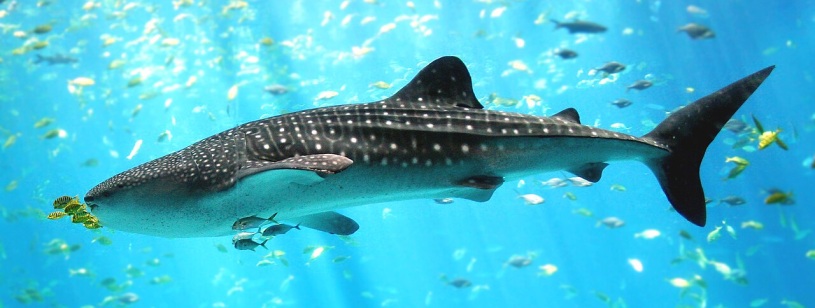
Whale shark, Rhincodon typus, photographed at Georgia Aquarium, with pale spots across its back. · User:Zac Wolf (original), en:User:Stefan (cropping) / CC BY-SA 2.5 (https://creativecommons.org/licenses/by-sa/2.5). Cropped and resized.
The whale shark is the largest fish alive today, yet it feeds mainly by filtering small organisms from water. Rhincodon typus has a broad head, wide mouth and pale spots and stripes across its back. Its name recalls a whale’s size, but it is a shark with gills and a cartilaginous skeleton. Its journeys connect distant ocean regions.
Quick facts
| Common name | Whale shark |
| Scientific name | Rhincodon typus |
| Longevity | At least 50 years, verified in one specimen; maximum lifespan remains uncertain |
| Diet | Filter feeder: plankton and other small aquatic organisms |
| Conservation status | Endangered (EN) |
| Distribution | Warm Atlantic, Indian and Pacific waters |
| Habitat | Open ocean, coastal areas and sometimes lagoons |
| Length | Commonly around 5.5–10 m; larger individuals occur |
| Family | Rhincodontidae |
| Reproduction | Live young from eggs that hatch within the mother |
| Distinctive feature | Spot patterns allow individual identification |
- Primary category:Fish
- Explore this animal's categories:
Interesting facts
- It is the largest living fish, not a marine mammal.
- Its spot pattern can serve as an individual signature.
- It can feed by actively sucking water into its mouth.
- Researchers verified an age of 50 years in one specimen.
Characteristics
The broad, flattened head has relatively small eyes on the sides. A wide mouth faces forward, with five pairs of gill slits behind the head.
Pale spots and stripes cover a darker background. Photographs of standard body regions help researchers recognise an individual on different occasions. Fins and a sweeping tail move the enormous body, but size should not be confused with aggression or a diet based on large prey.
Behaviour
Whale sharks travel thousands of kilometres. Satellite tags reveal that they do not remain permanently near places where tourists commonly see them.
Seasonal gatherings can reflect concentrated food supplies. Sharks swim near the surface but also make very deep dives. A sighting in one bay shows only a fraction of their movements; protecting a migratory species requires understanding routes and cooperation across the regions it visits.
Habitat and distribution
The species inhabits warm Atlantic, Indian and Pacific waters. Open ocean, coastal areas, lagoons and island surroundings all form part of its habitat.
Currents that concentrate food can create important gathering places. Seasonal appearances at Ningaloo, Australia, have allowed repeated study of individuals. This marine giant depends on connected habitats, and national boundaries do not limit its journeys.
Diet and feeding
Food includes zooplankton, fish eggs, small crustaceans and small fishes. The shark opens its mouth and separates food particles from water passing through its filtering apparatus.
It can swim forward with an open mouth or actively suck in food-rich water, sometimes feeding almost vertically near the surface. A huge mouth does not mean it hunts divers. Nevertheless, touching or crowding can disrupt feeding, and the movement of such a large body demands respectful distance.
Reproduction and life cycle
Whale sharks produce live young. Embryos develop within eggs that hatch inside the female, and fully formed pups are released into the water.
Reproduction remains poorly understood. One examined female provided evidence of more than 300 embryos, but that case does not establish a normal litter size. Age, maturity and birthing locations remain important research questions. Long lives mean losing adults can affect populations over extended periods.
Name and history
The common name combines membership of the sharks with a whale-like size. The biological distinction is clear: whale sharks are fish, whereas whales are mammals.
The species belongs to Rhincodontidae. Its cartilaginous skeleton links it to other sharks and rays. Comparative photographs, electronic tags and age analysis have expanded knowledge, complementing direct observation of an animal that ranges widely across the ocean.
Conservation and threats
The whale shark is Endangered. Capture, entanglement in fishing gear and vessel collisions are significant threats. Near-surface swimming exposes it to propellers and shipping traffic.
Poorly managed tourism adds pressure when animals are pursued, touched or surrounded. Monitoring and reducing these risks support conservation of a long-lived species. Responsibly taken photographs can assist research without turning an encounter into a disturbance.
Frequently asked questions
Is a whale shark a whale?
No. It is a cartilaginous fish that breathes through gills; whales are mammals.
What does such a large animal eat?
It filters plankton and other small organisms, including fish eggs and crustaceans.
How are individuals recognised?
Researchers compare photographs of their spot and stripe patterns.
Can we say it certainly lives for 100 years?
Not for every individual. An age of 50 years has been verified, while the maximum remains uncertain.