Cavalier King Charles SpanielCharacteristics, history, training and care
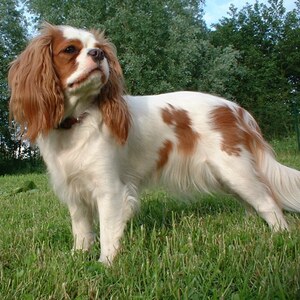
Cavalier King Charles Spaniel. · Mapovfille / Wikimedia Commons, CC BY 3.0. Cropped and resized.
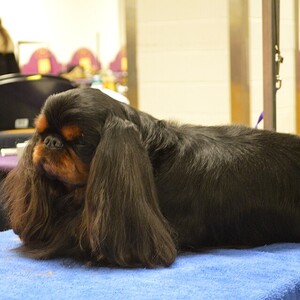
The Cavalier King Charles Spaniel is a small, elegant spaniel with large, round eyes and long ears covered in silky hair. It is the breed linked to King Charles II of England. It is gentle, affectionate, friendly with everyone and very good with children.
Quick facts
| Common name | Cavalier King Charles Spaniel |
| Scientific name | Canis lupus familiaris |
| Country of origin | United Kingdom |
| Official recognition | FCI, definitively since 20 January 1955 (group 9, English toy spaniels; standard no. 136); also recognised by the AKC |
| Lifespan | 12–15 years, according to the AKC; other sources give 8–12 years |
| Size (males) | about 30–33 cm at the withers |
| Size (females) | about 30–33 cm at the withers |
| Weight | 5.4–8 kg |
| Coat type | Long, silky, free from curl, with plenty of feathering |
| Common colours | Blenheim (white with chestnut), tricolour, black and tan, ruby |
| Energy level | Moderate |
| Suited to an apartment? | Yes |
| Temperament | Gentle, affectionate, cheerful, friendly, fearless |
| Tendency to aggression | Very low |
| Good with children | Very good |
| Good with other animals | Very good |
| Genetic predispositions | Mitral valve disease, syringomyelia, juvenile cataracts, patellar luxation, hip dysplasia, ear infections |
- Primary category:Dog breeds
- Explore this animal's categories:
History and origin
The breed is famous as the favourite pet of King Charles II of England. In the 19th century, small companion spaniels were crossed with flat-faced breeds and changed a great deal.
In the 1920s, breeders tried to recreate the original look, that of Charles II's spaniel from the time of the English Civil War, when the king's supporters were called “Cavaliers”. This is where the breed's name comes from.
How the breed developed
- 17th century – King Charles II is known for his small spaniels.
- 19th century – Companion spaniels are crossed with flat-faced breeds.
- 1920s – Breeders recreate the old type, with a longer muzzle: the Cavalier is born.
- 20 January 1955 – The FCI recognises the breed.
- 8 September 2026 – The newest FCI standard is published.
Breed rating
| Feature | Stars |
|---|---|
| Training and intelligence | ★★★★☆ |
| Easy to train | ★★★★☆ |
| Intelligence | ★★★★☆ |
| Independence | ★★☆☆☆ |
| Stubbornness | ★★☆☆☆ |
| Behaviour and temperament | ★★★★★ |
| Affectionate with family | ★★★★★ |
| Friendly with children | ★★★★★ |
| Good with other dogs | ★★★★★ |
| Good with cats and other animals | ★★★★☆ |
| Loyalty | ★★★★★ |
| Tendency to be aggressive | ★☆☆☆☆ |
| Tendency to bark | ★★★☆☆ |
| Needs and care | ★★☆☆☆ |
| Shedding | ★★☆☆☆ |
| Needs frequent grooming | ★★☆☆☆ |
| Activity and lifestyle | ★★★☆☆ |
| Energy level | ★★★☆☆ |
| Daily exercise needs | ★★★☆☆ |
| Suited to apartment life | ★★★★☆ |
| Health and longevity | ★★★☆☆ |
| Life expectancy | ★★★★☆ |
| Predisposition to genetic diseases | ★★★★☆ |
| Working abilities and uses | ★★☆☆☆ |
| Good guard dog | ★★★☆☆ |
| Good companion dog | ★★★★★ |
Indicative rating: 5 stars means the highest level. It is based on the ratings the American Kennel Club gives the breed and on the FCI standard.
Physical characteristics
It is a small, active, graceful and well-balanced spaniel with a gentle expression. The AKC says its face, with its large, round eyes, is the hallmark of the breed.
General appearance
The large, dark eyes are set well apart. The long, high-set ears carry plenty of feathering. The tail is carried merrily, but not much above the level of the back. The long, silky coat is never trimmed.
| Feature | Cavalier King Charles Spaniel |
|---|---|
| Size | Small |
| Height at the withers | about 30–33 cm |
| Weight | 5.4–8 kg |
| Coat | Long, silky, with feathering |
| Eyes | Large, round, dark |
| Ears | Long, with plenty of feathering |
Four colours are recognised: Blenheim (chestnut markings on a pearly white background, with a characteristic spot on the top of the head), tricolour (white with black and tan), black and tan and ruby (a rich, solid red).
Training and socialisation
The AKC says it is sweet, gentle and affectionate, very eager to please its owner. It is intelligent and easy to train.
It does well in obedience, rally and agility, and its gentle nature makes it a very good therapy dog.
Tips for effective training
- Socialise it early. Puppy classes help it develop good manners.
- Use rewards. It responds very well to praise.
- Do not let it off the lead in unfenced places. It has kept its hunting instinct and may follow a scent.
- Try dog sports. It enjoys obedience, rally and agility.
Activity needs and lifestyle
It was bred to sit on laps, but it descends from hunting dogs. The AKC says it enjoys walks and outdoor activities, but is just as happy on the sofa.
| Activity | How often | Why it matters |
|---|---|---|
| Walks | daily | Moderate exercise |
| Play in the garden or indoors | daily | It enjoys playing with the family |
| Dog sports | weekly | Activity for body and mind |
Tips for a balanced life
- It suits both active owners and quieter ones.
- The yard must be fenced.
- Do not leave it alone for many hours: it loves company.
Care and health
Coat and skin care
The silky coat needs only regular brushing and an occasional bath. The ears should be checked weekly and the nails trimmed at least once a month.
Common health problems
The AKC says the breed is prone to several conditions for which tests are available. Responsible breeders test all their breeding dogs:
| Condition | Description | Common symptoms |
|---|---|---|
| Mitral valve disease | One of the heart valves no longer closes properly | Heart murmur, tiredness, coughing, laboured breathing |
| Syringomyelia | A neurological disease in which fluid-filled cavities form in the spinal cord | Frequent scratching at the neck or shoulder, pain, sensitivity to touch |
| Juvenile cataracts | The lens of the eye becomes cloudy at a young age | Cloudy eyes, poorer vision |
| Patellar luxation | The kneecap slips out of place | Suddenly holds a hind leg up for a few steps, then uses it again |
Other care
- Take it for regular heart check-ups: any murmur should be investigated.
- Check the ears weekly for signs of infection.
- Trim the nails at least once a month.
Diet and nutrition
Choose a good-quality food for small breeds. The right weight is also important for the heart.
Tips for a healthy diet
The table gives a starting estimate, calculated with the formula from the Merck Veterinary Manual. The first two calorie columns show the calories per day for a healthy adult dog. The last column shows what this means in dry food with 3,500–4,000 kcal per kilogram.
| Dog's weight | Calories per day (neutered) | Calories per day (not neutered) | Dry food per day (approximate) |
|---|---|---|---|
| 5.4 kg | 400 kcal | 450 kcal | 100–130 g |
| 6.5 kg | 460 kcal | 510 kcal | 120–150 g |
| 8 kg | 530 kcal | 600 kcal | 130–170 g |
- Give it its food in two meals a day.
- Training treats count towards the daily portion.
- A dog is at the right weight when you can feel its ribs without pressing hard.
Foods to avoid
Some human foods are dangerous for dogs: chocolate, coffee, grapes and raisins, onions, garlic, xylitol (a sweetener used in chewing gum), macadamia nuts and alcohol.
Reproduction and development
Physical and emotional maturity
In dogs, sexual maturity usually comes between 6 and 12 months. Small breeds become adults faster than large ones, usually at around one year.
Mating and pregnancy
Pregnancy lasts about 63 days, counted from ovulation. Mating a female on her first heat is not recommended. The FCI standard requires that only healthy dogs of typical breed appearance are used for breeding.
Caring for the puppies
In small breeds, a litter has 3–4 puppies on average. The puppies are very small and fragile in the first weeks, so they must be kept warm and handled with care. Socialisation starts early: gentle handling, everyday noises and new people.
Interesting facts
- A king's dog. The breed is famous as the beloved pet of King Charles II.
- A “lozenge” spot. In the Blenheim colour, a spot on the top of the head, between the ears, is a feature unique to the breed.
- It is not trimmed. The standard requires the coat to be left completely untrimmed.
- A therapy dog. Its gentle nature makes it very well suited to visiting hospitals and care homes.
- The name comes from the Cavaliers. King Charles's supporters in the English Civil War were called “Cavaliers”.
In popular culture
The dogs of King Charles II
The breed is linked to King Charles II of England, known for his love of small spaniels. The name “Cavalier” recalls his supporters in the English Civil War.
Frequently asked questions
How big does it get?
It measures about 30–33 cm at the withers and weighs 5.4–8 kg.
Is it good with children?
Yes. The AKC gives it the top score for compatibility with children and other dogs.
What health problems does it have?
Mainly mitral valve disease and syringomyelia; good breeders test their dogs.
What colours does it come in?
Blenheim, tricolour, black and tan, and ruby.
Can it live in an apartment?
Yes, it adapts very well.