Kerry Blue TerrierCharacteristics, history, training and care
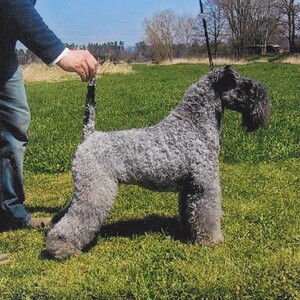
Kerry Blue Terrier. · Peter Kumpert / Wikimedia Commons, CC BY-SA 3.0 de. Cropped and resized.
The Kerry Blue Terrier is a muscular, medium-sized Irish terrier with a soft, dense, wavy coat in shades of blue. It was used to hunt otters in deep water, badgers and rodents, and also as a guard and companion. The AKC describes it as bold, spirited and gentle.
Quick facts
| Common name | Kerry Blue Terrier (Irish Blue Terrier) |
| Scientific name | Canis lupus familiaris |
| Country of origin | Ireland |
| Official recognition | FCI, definitively since 2 April 1963 (group 3, large and medium-sized terriers; standard no. 3); also recognised by the AKC |
| Lifespan | 12–15 years, according to the AKC |
| Size (males) | 45.5–49.5 cm at the withers; 15–18 kg |
| Size (females) | 44.5–48 cm at the withers; proportionately lighter |
| Coat type | Soft, abundant, wavy; does not shed |
| Common colours | Blue, in any shade |
| Energy level | High |
| Suited to an apartment? | Only with plenty of exercise |
| Temperament | Bold, alert, affectionate with its family |
| Tendency to aggression | Average towards other dogs |
| Good with children | Good, according to the AKC |
| Good with other animals | Poor with other dogs, according to the AKC |
| Genetic predispositions | Hip dysplasia, eye diseases |
- Primary category:Dog breeds
- Explore this animal's categories:
History and origin
The FCI standard says that, like the other Irish terrier breeds, the Kerry Blue has probably existed in Ireland for centuries, but, being a humble ratter and farm dog, it hardly appears in writing before the 20th century. The first probable reference dates from 1847 and describes a slate-blue dog with darker patches, found mainly in County Kerry.
The breed first appeared at shows in 1913, and the Dublin Blue Terrier Club was founded in 1920. It became a kind of mascot for Irish patriots; Wikipedia says the nationalist leader Michael Collins owned a famous Kerry Blue and tried to make it the national breed of Ireland. By 1928 the breed had become popular all over the world.
How the breed developed
- 1847 – The first probable reference to the breed.
- 1913 – Its first appearance at shows.
- 1920 – The Dublin Blue Terrier Club is founded.
- 1922–1924 – The breed clubs hold six shows and six working trials.
- 2 April 1963 – The FCI recognises the breed.
- 2000 – A Kerry Blue wins “Best in Show” at Crufts.
Breed rating
| Feature | Stars |
|---|---|
| Training and intelligence | ★★★☆☆ |
| Easy to train | ★★★☆☆ |
| Intelligence | ★★★★☆ |
| Independence | ★★★★☆ |
| Stubbornness | ★★★★☆ |
| Behaviour and temperament | ★★★★☆ |
| Affectionate with family | ★★★★★ |
| Friendly with children | ★★★★☆ |
| Good with other dogs | ★★☆☆☆ |
| Good with cats and other animals | ★★☆☆☆ |
| Loyalty | ★★★★★ |
| Tendency to be aggressive | ★★★☆☆ |
| Tendency to bark | ★★★★☆ |
| Needs and care | ★★★☆☆ |
| Shedding | ★☆☆☆☆ |
| Needs frequent grooming | ★★★★☆ |
| Activity and lifestyle | ★★★☆☆ |
| Energy level | ★★★★☆ |
| Daily exercise needs | ★★★★☆ |
| Suited to apartment life | ★★★☆☆ |
| Health and longevity | ★★★☆☆ |
| Life expectancy | ★★★★★ |
| Predisposition to genetic diseases | ★★☆☆☆ |
| Working abilities and uses | ★★★☆☆ |
| Good guard dog | ★★★★★ |
| Good companion dog | ★★★★☆ |
Indicative rating: 5 stars means the highest level. It is based on the ratings the American Kennel Club gives the breed and on the FCI standard.
Physical characteristics
It is a muscular, well-developed terrier with true terrier character. The AKC says it stands under 50 cm at the withers and weighs up to 18 kg. Males have a stronger head and are more muscular than females.
General appearance
The head has plenty of hair, the nose is black, and the expression must be keen and alert. The coat is soft, abundant and wavy and, according to the AKC, so soft that it is pleasant to touch.
| Feature | Kerry Blue Terrier |
|---|---|
| Size | Medium |
| Height at the withers | males: 45.5–49.5 cm; females: 44.5–48 cm |
| Weight | males: 15–18 kg; females: lighter |
| Coat | Soft, abundant, wavy |
| Nose | Black |
| Shedding | Practically does not shed |
The colour is blue, in any shade, with or without black tips. Black is accepted only up to the age of 18 months, as is a reddish tinge: the blue colour settles with age.
Training and socialisation
The AKC says the Kerry Blue is very intelligent and that most of them enjoy dog sports: agility, obedience, rally, barn hunt, herding and even dock diving.
Socialisation is important, as is an obedience course with an instructor who has worked with terriers. The AKC gives it a low score for getting along with other dogs.
Tips for effective training
- Socialise it in puppyhood. Especially with other dogs.
- Choose an instructor who knows terriers. The advice comes from the AKC.
- Keep its mind busy. Dog sports make it a well-balanced dog.
- Be consistent. It has terrier character.
Activity needs and lifestyle
The AKC says it has “two speeds”: it enjoys exercise outdoors, playing ball or running alongside its owner, but also quiet time beside the family. Above all, it wants to be where its people are.
| Activity | How often | Why it matters |
|---|---|---|
| Walks or running | daily | High energy |
| Ball games | daily | It loves fetching |
| Dog sports | weekly | Mental activity |
Tips for a balanced life
- It suits active families.
- Supervise it around unfamiliar dogs.
- Keep it close to the family.
Care and health
Coat and skin care
The AKC says it does not shed, so the coat must be brushed and combed thoroughly once a week to prevent matting. A full trim every 6–8 weeks keeps it easy to care for.
Common health problems
The AKC says most Kerry Blues are healthy. As with all breeds, the following can occur:
| Condition | Description | Common symptoms |
|---|---|---|
| Hip dysplasia | The hip joint forms incorrectly and, over time, arthritis develops | Limping, difficulty getting up or jumping, hip pain |
| Eye disease | Hereditary eye conditions | Watery eyes, red eyes, poor vision |
Other care
- Check the ears regularly.
- Brush its teeth often.
- Trim the nails regularly.
Diet and nutrition
The AKC says some dogs gain weight easily, so calories and weight should be watched.
Tips for a healthy diet
The table gives a starting estimate, calculated with the formula from the Merck Veterinary Manual. The first two calorie columns show the calories per day for a healthy adult dog. The last column shows what this means in dry food with 3,500–4,000 kcal per kilogram.
| Dog's weight | Calories per day (neutered) | Calories per day (not neutered) | Dry food per day (approximate) |
|---|---|---|---|
| 13 kg | 770 kcal | 860 kcal | 190–250 g |
| 15 kg | 850 kcal | 960 kcal | 210–270 g |
| 18 kg | 980 kcal | 1,100 kcal | 240–310 g |
- Give it its food in two meals a day.
- Treats count towards the daily portion.
- A dog is at the right weight when you can feel its ribs under the coat without pressing hard.
Foods to avoid
Some human foods are dangerous for dogs: chocolate, coffee, grapes and raisins, onions, garlic, xylitol (a sweetener used in chewing gum), macadamia nuts and alcohol.
Reproduction and development
Physical and emotional maturity
In dogs, sexual maturity usually comes between 6 and 12 months. Most breeds become adults at around 13–15 months.
Mating and pregnancy
Pregnancy lasts about 63 days, counted from ovulation. Mating a female on her first heat is not recommended. The FCI standard requires that only healthy dogs of typical breed appearance are used for breeding.
Caring for the puppies
In dogs, a litter has 5–6 puppies on average, and the number rises with the size of the breed. Socialisation starts in the first weeks: gentle handling, everyday noises and new people.
Interesting facts
- Blue with age. The standard accepts black only up to 18 months.
- It does not shed. The AKC says its coat practically does not fall out.
- An otter hunter. The standard says it hunted otters in deep water.
- The patriots' mascot. It became a symbol of Irish patriots.
- A breed at risk. Wikipedia says that in the 21st century it is an endangered breed.
In popular culture
Michael Collins and Convict 224
Wikipedia says the Irish nationalist leader Michael Collins owned a famous Kerry Blue called Convict 224 and tried to make the Kerry Blue the national breed of Ireland.
Frequently asked questions
Does the Kerry Blue Terrier shed?
Practically not, but the coat must be brushed weekly and trimmed every 6–8 weeks.
How big does it get?
Males measure 45.5–49.5 cm and weigh 15–18 kg; females are slightly smaller.
Can it be black?
Only up to 18 months; an adult must be blue.
How long does it live?
The AKC gives 12–15 years.