PuliCharacteristics, history, training and care
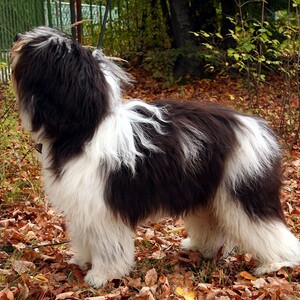
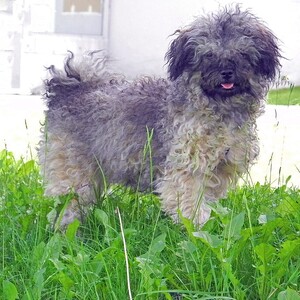
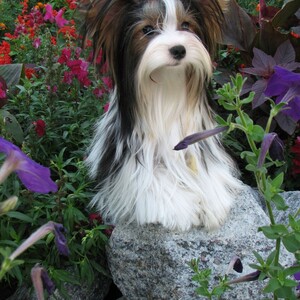
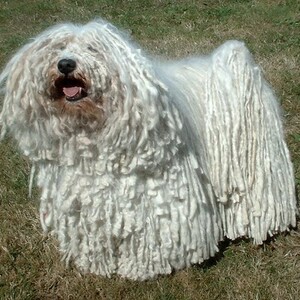
Puli. · Sannse / Wikimedia Commons, CC BY-SA 3.0. Cropped and resized.
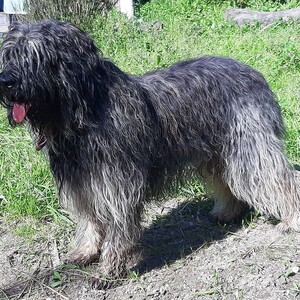
The Puli is a Hungarian herding dog, medium-sized, square and muscular, covered in a coat that forms thick cords, usually black. The head looks round, and the eyes are almost covered by hair. The standard describes it as lively, extremely eager to learn, fond of children and an excellent guard dog.
Quick facts
| Common name | Puli (plural: Pulik) |
| Scientific name | Canis lupus familiaris |
| Country of origin | Hungary |
| Official recognition | FCI, definitively since 11 August 1954 (group 1, sheepdogs; standard no. 55); also recognised by the AKC |
| Lifespan | 10–15 years, according to the AKC |
| Size (males) | 39–45 cm at the withers (ideally 41–43 cm); 13–15 kg |
| Size (females) | 36–42 cm at the withers; 10–13 kg |
| Coat type | Forms thick cords; puppies have a wavy coat |
| Common colours | Black, fawn with a black mask, grey, pearl white |
| Energy level | High |
| Suited to an apartment? | Yes, with plenty of exercise |
| Temperament | Lively, very clever, loyal, fond of children |
| Tendency to aggression | Low; an excellent guard dog |
| Good with children | Good, according to the standard |
| Good with other animals | Average |
| Genetic predispositions | Hip dysplasia, eye diseases, patellar luxation, degenerative myelopathy |
- Primary category:Dog breeds
- Explore this animal's categories:
History and origin
The FCI standard says the Puli is a Hungarian herding breed of Asian origin. Its ancestors probably came to the Carpathian Basin with the ancient Hungarians, who were nomadic herders.
Wikipedia says a similar but much larger Hungarian dog is the Komondor. The AKC says that, thanks to its agility, the Puli has earned a reputation as the “acrobat of the dog world”.
How the breed developed
- Hungarian settlement – Its ancestors reach the Carpathian Basin with the Hungarians.
- 11 August 1954 – The FCI recognises the breed.
- 29 October 2013 – The current FCI standard is published.
Breed rating
| Feature | Stars |
|---|---|
| Training and intelligence | ★★★★★ |
| Easy to train | ★★★★★ |
| Intelligence | ★★★★☆ |
| Independence | ★★★★☆ |
| Stubbornness | ★★★☆☆ |
| Behaviour and temperament | ★★★★☆ |
| Affectionate with family | ★★★★★ |
| Friendly with children | ★★★★☆ |
| Good with other dogs | ★★★☆☆ |
| Good with cats and other animals | ★★★☆☆ |
| Loyalty | ★★★★★ |
| Tendency to be aggressive | ★★☆☆☆ |
| Tendency to bark | ★★★☆☆ |
| Needs and care | ★☆☆☆☆ |
| Shedding | ★★★★★ |
| Needs frequent grooming | ★★★☆☆ |
| Activity and lifestyle | ★★★☆☆ |
| Energy level | ★★★★☆ |
| Daily exercise needs | ★★★★☆ |
| Suited to apartment life | ★★★☆☆ |
| Health and longevity | ★★★★☆ |
| Life expectancy | ★★★★☆ |
| Predisposition to genetic diseases | ★★☆☆☆ |
| Working abilities and uses | ★★★★★ |
| Good herding dog | ★★★★☆ |
| Good companion dog | ★★★★★ |
Indicative rating: 5 stars means the highest level. It is based on the ratings the American Kennel Club gives the breed and on the FCI standard.
Physical characteristics
The standard describes it as a medium-sized dog of strong constitution and square build, with fine but not too light bones and a muscular body. Because the coat covers the whole body, judges must examine the dog by hand.
General appearance
In puppies the coat is dense, wavy or curly; later it forms tufts and cords. The coat has a harsher topcoat and a finer undercoat, and the balance between them gives the coat its character. On the head it is so abundant that the head looks round and the eyes are almost covered.
| Feature | Puli |
|---|---|
| Size | Medium |
| Height at the withers | males: 39–45 cm; females: 36–42 cm |
| Weight | males: 13–15 kg; females: 10–13 kg |
| Coat | Corded |
| Head | Looks round |
| Body | Square |
The accepted colours are black (with or without rusty or grey shading), fawn with a clear black mask, grey in any shade and pearl white. A white spot on the chest of no more than 3 cm is allowed.
Training and socialisation
The standard describes it as having a lively temperament and being extremely eager to learn. It loves children and is an excellent guard dog. Its present-day form also makes it suitable for sport.
The AKC says it is incredibly intelligent, agile and loyal, learns quickly and wants to please its owner, but it “does not suffer fools” — a joke goes that you have to be very clever to own a Puli. It needs a firm but fair hand.
Tips for effective training
- Keep its mind busy. Mental stimulation matters as much as exercise.
- Be firm but fair. It is stubborn.
- Do not overdo exercise with puppies. Their bones are still developing.
- Try dog sports. It excels at herding and agility.
Activity needs and lifestyle
The AKC says it needs both physical and mental exercise. With puppies, exercise should not be overdone while the bones are still growing. It excels at herding, obedience and other dog sports.
| Activity | How often | Why it matters |
|---|---|---|
| Walks | daily | Energy |
| Brain games | daily | Top need for mental stimulation |
| Herding or agility | weekly | Agility |
Tips for a balanced life
- Set aside time for coat care.
- Dry the coat thoroughly after a bath.
- It suits experienced owners.
Care and health
Coat and skin care
The AKC says it can be kept corded, brushed out or clipped. Until 8–10 months it needs only baths, ear cleaning and nail filing. Then, when the undercoat appears, the coat starts to felt, and the clumps are separated by hand to form cords. The AKC gives it top marks for grooming needs.
Common health problems
The AKC says it is generally a hardy, healthy breed, but the following may occur:
| Condition | Description | Common symptoms |
|---|---|---|
| Hip dysplasia | The hip joint forms incorrectly and, over time, arthritis develops | Limping, difficulty getting up or jumping, hip pain |
| Eye diseases | Inherited eye conditions | Watery eyes, poor vision |
| Patellar luxation | The kneecap slips out of place | Suddenly holds a hind leg up for a few steps, then uses it again |
| Degenerative myelopathy | A disease that gradually affects the spinal cord | Weakness in the hind legs |
Other care
- Dry the cords thoroughly after a bath.
- Clean the ears regularly.
- Check the skin under the cords.
Diet and nutrition
The AKC says some dogs gain weight easily, so calories and weight should be watched.
Tips for a healthy diet
The table gives a starting estimate, calculated with the formula from the Merck Veterinary Manual. The first two calorie columns show the calories per day for a healthy adult dog. The last column shows what this means in dry food with 3,500–4,000 kcal per kilogram.
| Dog's weight | Calories per day (neutered) | Calories per day (not neutered) | Dry food per day (approximate) |
|---|---|---|---|
| 10 kg | 630 kcal | 710 kcal | 160–200 g |
| 12.5 kg | 740 kcal | 840 kcal | 180–240 g |
| 15 kg | 850 kcal | 960 kcal | 210–270 g |
- Give it its food in two meals a day.
- Treats count towards the daily portion.
- A dog is at the right weight when you can feel its ribs under the coat without pressing hard.
Foods to avoid
Some human foods are dangerous for dogs: chocolate, coffee, grapes and raisins, onions, garlic, xylitol (a sweetener used in chewing gum), macadamia nuts and alcohol.
Reproduction and development
Physical and emotional maturity
In dogs, sexual maturity usually comes between 6 and 12 months. Most breeds become adults at around 13–15 months.
Mating and pregnancy
Pregnancy lasts about 63 days, counted from ovulation. Mating a female on her first heat is not recommended. The FCI standard requires that only healthy dogs of typical breed appearance are used for breeding.
Caring for the puppies
In dogs, a litter has 5–6 puppies on average, and the number rises with the size of the breed. Socialisation starts in the first weeks: gentle handling, everyday noises and new people.
Interesting facts
- The “acrobat of the dog world”. The AKC says it is remarkably agile.
- A Hungarian plural. The plural of Puli is “Pulik”.
- It must be felt. At shows, the coat hides the body, so the judge examines it by hand.
- Curly puppies. The cords only appear at around 8–10 months.
- The Komondor's small relative. It resembles the Komondor, but is much smaller.
Frequently asked questions
How are the cords cared for?
The clumps are separated by hand, and the coat is dried thoroughly after a bath.
How big does it get?
Males measure 39–45 cm and weigh 13–15 kg; females measure 36–42 cm and weigh 10–13 kg.
Is it good with children?
The standard says it loves children.
How long does it live?
The AKC gives 10–15 years.