Scottish TerrierCharacteristics, history, training and care
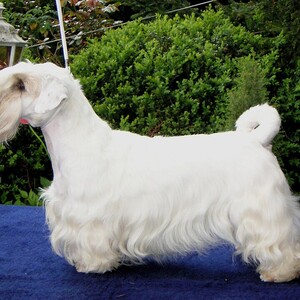
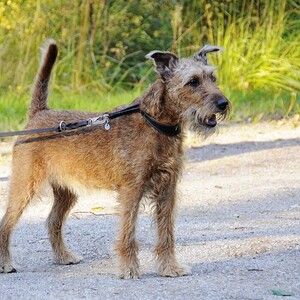
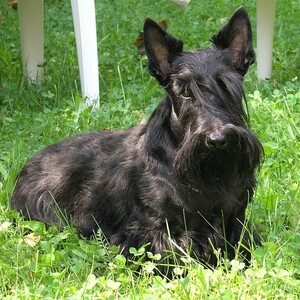
Scottish Terrier. · Mider / Wikimedia Commons, CC BY-SA 3.0. Cropped and resized.
The Scottish Terrier, popularly known as the Scottie, is a small terrier from the Scottish Highlands with short legs, a thickset body, a long head and a beard. The FCI standard describes it as loyal and faithful, dignified, independent and reserved, but courageous and highly intelligent, bold but never aggressive. With its family it is affectionate and cheerful, but it jumps at the slightest noise to guard its home.
Quick facts
| Common name | Scottish Terrier (Scottie) |
| Scientific name | Canis lupus familiaris |
| Country of origin | United Kingdom (Scotland) |
| Official recognition | FCI, definitively since 18 October 1954 (group 3, terriers; standard no. 73); also recognised by the AKC |
| Lifespan | About 12 years, according to the AKC |
| Size (males) | 25–28 cm at the withers; 8.5–10.5 kg |
| Size (females) | 25–28 cm at the withers; 8.5–10.5 kg |
| Coat type | Double: harsh, wiry topcoat, soft, dense undercoat |
| Common colours | Black, wheaten, brindle |
| Energy level | Medium |
| Suited to an apartment? | Yes |
| Temperament | Loyal, dignified, independent, reserved, brave |
| Tendency to aggression | Low towards people; may be quarrelsome with other dogs |
| Good with children | Good with older, respectful children |
| Good with other animals | Moderate; the AKC gives 2 out of 5 for getting on with other dogs |
| Genetic predispositions | Von Willebrand disease, “Scottie cramp”, craniomandibular osteopathy, bladder cancer, allergies |
- Primary category:Dog breeds
- Explore this animal's categories:
History and origin
Wikipedia says the Scottie was originally one of the Highland terriers grouped under the name Skye Terrier and is a close relative of the West Highland White Terrier: the ancestors of both came from the Blackmount region of Perthshire and the Moor of Rannoch. It was bred to hunt rodents on farms, as well as badgers and foxes.
The FCI standard says the breed as we know it today began in 1879 with Captain Gordon Murray, supported by Sewallis Evelyn Shirley, founder of the Kennel Club. The first standard was written in 1881, and the breed club was founded in 1882.
How the breed developed
- 1879 – Captain Gordon Murray fixes the breed type.
- 1881 – The first standard.
- 1882 – The Scottish Terrier Club is founded.
- 1911 – First Best in Show title at Westminster.
- 18 October 1954 – The FCI recognises the breed.
Breed rating
| Feature | Stars |
|---|---|
| Training and intelligence | ★★★★☆ |
| Easy to train | ★★★★★ |
| Intelligence | ★★★☆☆ |
| Independence | ★★★★☆ |
| Stubbornness | ★★★☆☆ |
| Behaviour and temperament | ★★☆☆☆ |
| Affectionate with family | ★★★★☆ |
| Friendly with children | ★★★★☆ |
| Good with other dogs | ★★★★☆ |
| Good with cats and other animals | ★★★★☆ |
| Loyalty | ★★★★☆ |
| Tendency to be aggressive | ★★☆☆☆ |
| Tendency to bark | ★★★☆☆ |
| Needs and care | ★★★☆☆ |
| Shedding | ★★★☆☆ |
| Needs frequent grooming | ★★★☆☆ |
| Activity and lifestyle | ★★★★☆ |
| Energy level | ★★★★☆ |
| Daily exercise needs | ★★★☆☆ |
| Suited to apartment life | ★★★★★ |
| Health and longevity | ★★★☆☆ |
| Life expectancy | ★★★★☆ |
| Predisposition to genetic diseases | ★★☆☆☆ |
| Working abilities and uses | ★★★☆☆ |
| Good guard dog | ★★★★☆ |
| Good companion dog | ★★★☆☆ |
Indicative rating: 5 stars means the highest level. It is based on the ratings the American Kennel Club gives the breed and on the FCI standard.
Physical characteristics
The standard describes it as thickset, of a suitable size to go to ground, short-legged, alert in carriage and with “great power and activity in small compass”. The head looks long for the size of the dog. It is very agile despite its short legs.
General appearance
The coat is double and close-fitting: a short, dense, soft undercoat and a harsh, dense, wiry topcoat, which together protect it from bad weather. The beard, legs and underside of the body have longer hair.
| Feature | Scottish Terrier |
|---|---|
| Size | Small |
| Height at the withers | 25–28 cm |
| Weight | 8.5–10.5 kg |
| Coat | Double, harsh |
| Colour | Black, wheaten, brindle |
| Legs | Short and strong |
The standard accepts only black, wheaten or brindle of any shade. Any other colour or combination is not accepted.
Training and socialisation
The standard describes it as loyal and faithful, dignified, independent and reserved, but courageous and highly intelligent. Bold, but never aggressive. Its public image is that of a dour Scot, but with family and friends it is affectionate and cheerful.
Wikipedia says it is territorial and spirited, a good guard dog and very loyal to its family. Being independent, it needs consistent, reward-based training.
Tips for effective training
- Be consistent. It is independent.
- Socialise it early. It is reserved with strangers and other dogs.
- Use rewards. It responds better to them than to harshness.
- Keep it on a lead. Its terrier instinct is strong.
Activity needs and lifestyle
It is an active terrier but does not need very hard exercise. Daily walks and play keep it fit, and as a former earth dog it enjoys search games.
| Activity | How often | Why it matters |
|---|---|---|
| Walks | daily | Fitness |
| Play | daily | Energy |
| Search games | several times a week | Terrier instinct |
Tips for a balanced life
- It can also live in an apartment.
- Keep it on a lead in the street.
- Be careful when meeting other dogs.
Care and health
Coat and skin care
The AKC says the coat needs regular grooming. Ideally it is hand-stripped, starting in puppyhood, about once a month. Clipping is acceptable, but over time the coat loses its harsh texture. The beard and legs should be brushed often.
Common health problems
The AKC says the breed is generally healthy, but the main problems include:
| Condition | Description | Common symptoms |
|---|---|---|
| Von Willebrand disease | A serious clotting disorder, detected by a DNA test | Bleeding that is hard to stop |
| “Scottie cramp” | A neurological disorder named after the breed | Cramps and a stiff gait during exercise or excitement |
| Craniomandibular osteopathy | Abnormal growth of the jaw bones in puppies | Pain when chewing, swollen jaw |
| Bladder cancer | Wikipedia says the breed has a higher risk than others | Bloody or difficult urination |
Other care
- Ask for the DNA test for von Willebrand disease.
- Check the skin for allergies.
- Have yearly check-ups at the vet.
Diet and nutrition
The AKC says a healthy coat, without dry skin or itching, shows that the diet is right.
Tips for a healthy diet
The table gives a starting estimate, calculated with the formula from the Merck Veterinary Manual. The first two calorie columns show the calories per day for a healthy adult dog. The last column shows what this means in dry food with 3,500–4,000 kcal per kilogram.
| Dog's weight | Calories per day (neutered) | Calories per day (not neutered) | Dry food per day (approximate) |
|---|---|---|---|
| 8.5 kg | 560 kcal | 630 kcal | 140–180 g |
| 9.5 kg | 610 kcal | 680 kcal | 150–190 g |
| 10.5 kg | 650 kcal | 730 kcal | 160–210 g |
- Give it its food in two meals a day.
- Treats count towards the daily portion.
- A dog is at the right weight when you can feel its ribs without pressing hard.
Foods to avoid
Some human foods are dangerous for dogs: chocolate, coffee, grapes and raisins, onions, garlic, xylitol (a sweetener used in chewing gum), macadamia nuts and alcohol.
Reproduction and development
Physical and emotional maturity
In dogs, sexual maturity usually comes between 6 and 12 months. Small breeds become adults faster than large ones, usually at around one year.
Mating and pregnancy
Pregnancy lasts about 63 days, counted from ovulation. Mating a female on her first heat is not recommended. The FCI standard requires that only healthy dogs of typical breed appearance are used for breeding.
Caring for the puppies
In small breeds, a litter has 3–4 puppies on average. The puppies are very small and fragile in the first weeks, so they must be kept warm and handled with care. Socialisation starts early: gentle handling, everyday noises and new people.
Interesting facts
- “Diehard”. The first Earl of Dumbarton is said to have nicknamed it so for its courage.
- A Monopoly token. The Scottie is one of the game's best-known tokens.
- Westminster champion. It has won Best in Show nine times, most recently in 2010.
- Related to the Westie. They have ancestors from the same Scottish region.
- A disease named after it. “Scottie cramp” is named after the breed.
In popular culture
Fala, Roosevelt's dog
Wikipedia says Fala, President Franklin D. Roosevelt's Scottie, appears beside him in a statue in Washington. President George W. Bush also had Scotties.
Monopoly
The Scottie is one of the playing tokens in the game of Monopoly.
Frequently asked questions
Is it aggressive?
The standard says it is bold, but never aggressive.
How much does it weigh?
Between 8.5 and 10.5 kg.
What colours does it come in?
Black, wheaten or brindle.
How do you care for the coat?
Ideally by hand-stripping, about once a month.
How long does it live?
The AKC gives about 12 years.