Manchester TerrierCharacteristics, history, training and care
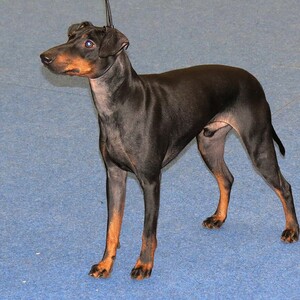
Manchester Terrier. · Томасина / Wikimedia Commons, CC BY-SA 3.0. Cropped and resized.
The Manchester Terrier is an elegant, graceful English terrier with a short, glossy coat of jet black and rich mahogany tan. It was bred in the 19th century in Manchester as a ratter, probably with some Whippet blood. The standard describes it as keen, alert, cheerful, sporting, discerning and devoted.
Quick facts
| Common name | Manchester Terrier |
| Scientific name | Canis lupus familiaris |
| Country of origin | United Kingdom |
| Official recognition | FCI, definitively since 15 October 1954 (group 3, large and medium-sized terriers; standard no. 71); also recognised by the AKC |
| Lifespan | 15–17 years, according to the AKC |
| Size (males) | ideally 41 cm at the withers |
| Size (females) | ideally 38 cm at the withers |
| Weight | 5.5–10 kg, according to the AKC (standard variety) |
| Coat type | Short, smooth, glossy, firm |
| Common colours | Jet black and rich mahogany tan |
| Energy level | High |
| Suited to an apartment? | Yes, with daily exercise |
| Temperament | Keen, alert, cheerful, sporting, devoted |
| Tendency to aggression | Low |
| Good with children | Good, according to the AKC |
| Good with other animals | Poor with rodents; terrier instinct |
| Genetic predispositions | Eye diseases, autoimmune thyroiditis, von Willebrand disease, juvenile cardiomyopathy |
- Primary category:Dog breeds
- Explore this animal's categories:
History and origin
The FCI standard says the name shows where the breed comes from and that it probably also has some Whippet blood. It was bred as a ratter. Rat-catching reached its peak in the middle of the 19th century, and weekly shows began to be held in Manchester, with classes of their own for this terrier.
Wikipedia says the breeder John Hulme crossed a Black and Tan Terrier with a Whippet to produce a dog good both at ratting and at rabbit hunting. By 1860, Manchester had become the centre of the breed. After the Second World War, numbers fell sharply, and the Kennel Club now considers it a vulnerable breed.
How the breed developed
- Early 19th century – John Hulme crosses a terrier with a Whippet.
- Mid-19th century – Rat-catching reaches its peak.
- 1860 – Manchester becomes the centre of the breed.
- 15 October 1954 – The FCI recognises the breed.
- After 1945 – Numbers fall and the breed becomes vulnerable.
Breed rating
| Feature | Stars |
|---|---|
| Training and intelligence | ★★★★☆ |
| Easy to train | ★★★★☆ |
| Intelligence | ★★★★☆ |
| Independence | ★★★☆☆ |
| Stubbornness | ★★★☆☆ |
| Behaviour and temperament | ★★★★☆ |
| Affectionate with family | ★★★★★ |
| Friendly with children | ★★★★☆ |
| Good with other dogs | ★★★☆☆ |
| Good with cats and other animals | ★★☆☆☆ |
| Loyalty | ★★★★★ |
| Tendency to be aggressive | ★☆☆☆☆ |
| Tendency to bark | ★★★★☆ |
| Needs and care | ★★★☆☆ |
| Shedding | ★★☆☆☆ |
| Needs frequent grooming | ★☆☆☆☆ |
| Activity and lifestyle | ★★★★☆ |
| Energy level | ★★★★☆ |
| Daily exercise needs | ★★★★☆ |
| Suited to apartment life | ★★★★☆ |
| Health and longevity | ★★★★★ |
| Life expectancy | ★★★★☆ |
| Predisposition to genetic diseases | ★★☆☆☆ |
| Working abilities and uses | ★★★★☆ |
| Good guard dog | ★★★★☆ |
| Good companion dog | ★★★★☆ |
Indicative rating: 5 stars means the highest level. It is based on the ratings the American Kennel Club gives the breed and on the FCI standard.
Physical characteristics
The standard describes it as compact, elegant and sound. The AKC says it combines the grace of a coursing sighthound with the instinct of a fearless rat-catching terrier.
General appearance
The skull is long, flat and narrow, wedge-shaped, and the nose is jet black. The coat is short, smooth, glossy and firm to the touch.
| Feature | Manchester Terrier |
|---|---|
| Size | Small |
| Height at the withers | males: ideally 41 cm; females: ideally 38 cm |
| Weight | 5.5–10 kg (AKC) |
| Coat | Short, glossy |
| Head | Long, wedge-shaped |
| Colour | Black and rich mahogany tan |
The colour is jet black and rich mahogany tan, sharply divided: a tan muzzle up to the nose, a tan spot on each cheek and above each eye, a tan “V” on the throat and tan legs from the knee down, with black pencilling on the toes and a black mark (the “thumb mark”) just above the feet.
Training and socialisation
The AKC says it is very intelligent and likes to think each situation through for itself. It is eager to please its people and trains easily with positive, reward-based methods.
It does not respond well to harsh corrections, so sessions should be fun and full of praise. The AKC says it is an ideal candidate for many dog sports.
Tips for effective training
- Use rewards and praise. It cannot bear harsh corrections.
- Keep sessions fun. It thinks each situation through for itself.
- Try dog sports. It is an ideal candidate.
- Keep it away from rodents. It has the instinct of a ratter.
Activity needs and lifestyle
The AKC says it is active, quick and athletic and needs a few good walks every day. It can relax on the sofa, but can hardly wait to chase balls or play energetically outdoors.
| Activity | How often | Why it matters |
|---|---|---|
| Good walks | twice a day | Physical and mental health |
| Ball games | daily | Energy |
| Dog sports | weekly | Intelligence |
Tips for a balanced life
- It can also live in an apartment.
- In winter, its short coat does not protect it from the cold.
- Keep it on the lead near small animals.
Care and health
Coat and skin care
The AKC says it is a very low-maintenance dog: an occasional bath and a weekly rub with a damp cloth or a grooming mitt give the coat its shine. The nails are trimmed every few weeks.
Common health problems
The AKC says the breed is generally healthy, but a few problems can occur. If it needs surgery, the vet should use anaesthesia with the same care as for its sighthound ancestors.
| Condition | Description | Common symptoms |
|---|---|---|
| Eye diseases | Inherited eye conditions | Watery eyes, poor vision |
| Autoimmune thyroiditis | The body attacks the thyroid gland | Tiredness, weight gain, thin coat |
| Von Willebrand disease | An inherited blood-clotting disorder | Bleeding that is hard to stop |
| Juvenile cardiomyopathy | Serious heart disease in young dogs | Sudden weakness, laboured breathing |
Other care
- Tell the vet about its sensitivity to anaesthesia.
- Brush its teeth often.
- Trim the nails every few weeks.
Diet and nutrition
The AKC says some dogs gain weight easily, so calories and weight should be watched.
Tips for a healthy diet
The table gives a starting estimate, calculated with the formula from the Merck Veterinary Manual. The first two calorie columns show the calories per day for a healthy adult dog. The last column shows what this means in dry food with 3,500–4,000 kcal per kilogram.
| Dog's weight | Calories per day (neutered) | Calories per day (not neutered) | Dry food per day (approximate) |
|---|---|---|---|
| 6 kg | 430 kcal | 480 kcal | 110–140 g |
| 8 kg | 530 kcal | 600 kcal | 130–170 g |
| 10 kg | 630 kcal | 710 kcal | 160–200 g |
- Give it its food in two meals a day.
- Treats count towards the daily portion.
- A dog is at the right weight when you can feel its ribs without pressing hard.
Foods to avoid
Some human foods are dangerous for dogs: chocolate, coffee, grapes and raisins, onions, garlic, xylitol (a sweetener used in chewing gum), macadamia nuts and alcohol.
Reproduction and development
Physical and emotional maturity
In dogs, sexual maturity usually comes between 6 and 12 months. Small breeds become adults faster than large ones, usually at around one year.
Mating and pregnancy
Pregnancy lasts about 63 days, counted from ovulation. Mating a female on her first heat is not recommended. The FCI standard requires that only healthy dogs of typical breed appearance are used for breeding.
Caring for the puppies
In small breeds, a litter has 3–4 puppies on average. The puppies are very small and fragile in the first weeks, so they must be kept warm and handled with care. Socialisation starts early: gentle handling, everyday noises and new people.
Interesting facts
- The “thumb mark”. It has a black mark just above the feet.
- Whippet blood. The standard says it probably also has some Whippet blood.
- “Wash and wear”. The AKC describes it as a very low-maintenance dog.
- Shows in the pub. Around 1850, shows were usually held in pubs.
- It lives a long time. The AKC gives a life expectancy of 15–17 years.
In popular culture
Eliza Soane and Fanny
Wikipedia shows a portrait painted by John Jackson between 1804 and 1815: Eliza Soane, wife of the architect John Soane, with her Manchester Terrier, Fanny.
Frequently asked questions
Where does the name come from?
From the city of Manchester, where the breed was developed.
How big does it get?
Males ideally measure 41 cm and females 38 cm.
Is it easy to groom?
Yes, it is a very low-maintenance dog.
How long does it live?
The AKC gives 15–17 years.