MalteseCharacteristics, history, training and care
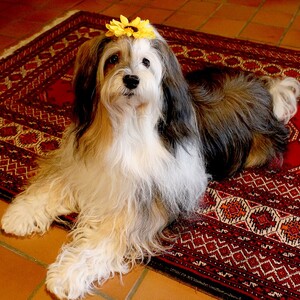
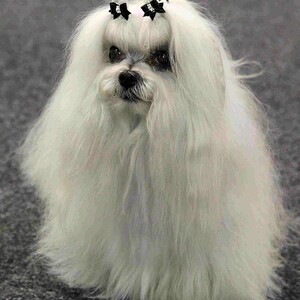
Maltese. · Chantiquemaltese / Wikimedia Commons, CC0 (public domain). Cropped and resized.
The Maltese is a small white companion dog with a very long, straight, silky coat that falls like a mantle to the ground. Its ancestors lived in the ports of the central Mediterranean and have been mentioned since the time of Aristotle. The standard describes it as lively, affectionate, very calm and very intelligent.
Quick facts
| Common name | Maltese (Bichon Maltais) |
| Scientific name | Canis lupus familiaris |
| Country of origin | Central Mediterranean area; patronage: Italy |
| Official recognition | FCI, definitively since 13 April 1955 (group 9, bichons and related breeds; standard no. 65); also recognised by the AKC |
| Lifespan | 12–15 years, according to the AKC |
| Size (males) | 21–25 cm at the withers; 3–4 kg |
| Size (females) | 20–23 cm at the withers; 3–4 kg |
| Coat type | Very long, straight, silky |
| Common colours | Pure white; an ivory shade permitted |
| Energy level | Moderate |
| Suited to an apartment? | Yes |
| Temperament | Lively, affectionate, very calm, very intelligent |
| Tendency to aggression | Very low |
| Good with children | Average; it is a small, delicate dog |
| Good with other animals | Average |
| Genetic predispositions | Patellar luxation, patent ductus arteriosus, portosystemic shunt |
- Primary category:Dog breeds
- Explore this animal's categories:
History and origin
The FCI standard says the name does not mean the breed comes from the island of Malta: the word “Maltese” comes from the Semitic “màlat”, meaning refuge or port, a root found in the names of several places by the sea. Its ancestors lived in the ports and coastal towns of the central Mediterranean, where they hunted the mice and rats in warehouses and in the holds of ships.
A list of dogs from the time of Aristotle (384–322 BC) includes a breed of small dogs called “canes melitenses” in Latin. The dog was known in ancient Rome, where it was the favourite companion of Roman matrons, and it was painted by many Renaissance artists.
How the breed developed
- 4th century BC – “Canes melitenses” appear in a list from the time of Aristotle.
- Ancient Rome – The favourite companion of Roman matrons.
- The Renaissance – It appears in the paintings of many artists.
- 13 April 1955 – The FCI recognises the breed.
- 13 November 2015 – The current FCI standard is published.
Breed rating
| Feature | Stars |
|---|---|
| Training and intelligence | ★★★☆☆ |
| Easy to train | ★★★☆☆ |
| Intelligence | ★★★★☆ |
| Independence | ★★★☆☆ |
| Stubbornness | ★★★★☆ |
| Behaviour and temperament | ★★★★★ |
| Affectionate with family | ★★★★★ |
| Friendly with children | ★★★☆☆ |
| Good with other dogs | ★★★☆☆ |
| Good with cats and other animals | ★★★☆☆ |
| Loyalty | ★★★★★ |
| Tendency to be aggressive | ★☆☆☆☆ |
| Tendency to bark | ★★★☆☆ |
| Needs and care | ★★★☆☆ |
| Shedding | ★☆☆☆☆ |
| Needs frequent grooming | ★★★★★ |
| Activity and lifestyle | ★★★☆☆ |
| Energy level | ★★★☆☆ |
| Daily exercise needs | ★★★☆☆ |
| Suited to apartment life | ★★★★★ |
| Health and longevity | ★★★★☆ |
| Life expectancy | ★★★★★ |
| Predisposition to genetic diseases | ★★★☆☆ |
| Working abilities and uses | ★★★★☆ |
| Good guard dog | ★★★☆☆ |
| Good companion dog | ★★★★★ |
Indicative rating: 5 stars means the highest level. It is based on the ratings the American Kennel Club gives the breed and on the FCI standard.
Physical characteristics
The AKC describes it as a small dog, under 3.2 kg, covered in a long, straight, silky mantle. Beneath it lies a compact body that moves smoothly and effortlessly. Its face, with large dark eyes and a black nose, wins everyone over.
General appearance
The coat is dense, glossy, very long all over the body and straight, without waves or curls. On the trunk it is longer than the height at the withers and falls heavily to the ground, like a cape close to the body.
| Feature | Maltese |
|---|---|
| Size | Very small |
| Height at the withers | males: 21–25 cm; females: 20–23 cm |
| Weight | 3–4 kg |
| Coat | Very long, silky |
| Colour | Pure white |
| Eyes | Large, dark |
The colour is pure white; a pale ivory shade is permitted. Traces of pale orange are tolerated but not desirable.
Training and socialisation
The AKC says the Maltese is very intelligent and that, over centuries of living with people, it has learned to get exactly what it wants. That is why training must be consistent. It can be stubborn and determined.
It is athletic and talented, so it can be a fun partner in dog sports such as obedience or agility. The AKC describes it as affectionate, playful and fearless.
Tips for effective training
- Be consistent. It knows how to get what it wants.
- Use small treats. It is very small, and calories count.
- Try dog sports. It is athletic and talented.
- Be careful with small children. It is very small and delicate.
Activity needs and lifestyle
The Maltese has moderate exercise needs: daily walks and indoor play keep it fit. It is well suited to flat life.
| Activity | How often | Why it matters |
|---|---|---|
| Short walks | daily | Exercise |
| Indoor play | daily | Keeps it active |
| Obedience or agility | weekly | Mental stimulation |
Tips for a balanced life
- It suits an apartment very well.
- In winter, protect it from the cold.
- Do not leave it alone for long.
Care and health
Coat and skin care
The AKC says the long white coat needs gentle daily brushing and combing, right down to the skin, so that it does not mat. It also needs regular baths and conditioner. The nails grow quickly and should be trimmed regularly, and the ears checked weekly.
Common health problems
The AKC says it is a healthy breed with few problems, which usually lives more than 10 years. Responsible breeders screen their dogs for:
| Condition | Description | Common symptoms |
|---|---|---|
| Patellar luxation | The kneecap slips out of place | Suddenly holds a hind leg up for a few steps, then uses it again |
| Patent ductus arteriosus (PDA) | A blood vessel of the heart does not close after birth | Heart murmur, tires quickly |
| Portosystemic shunt | Blood bypasses the liver (a congenital problem) | Poor growth, odd behaviour after meals |
Other care
- Clean its eyes every day to prevent staining.
- Check the ears weekly.
- Brush its teeth often.
Diet and nutrition
The AKC says some dogs gain weight easily, so calories and weight should be watched.
Tips for a healthy diet
The table gives a starting estimate, calculated with the formula from the Merck Veterinary Manual. The first two calorie columns show the calories per day for a healthy adult dog. The last column shows what this means in dry food with 3,500–4,000 kcal per kilogram.
| Dog's weight | Calories per day (neutered) | Calories per day (not neutered) | Dry food per day (approximate) |
|---|---|---|---|
| 3 kg | 260 kcal | 290 kcal | 65–83 g |
| 3.5 kg | 290 kcal | 320 kcal | 72–91 g |
| 4 kg | 320 kcal | 360 kcal | 80–103 g |
- Give it its food in three small meals a day, especially as a puppy.
- Treats count towards the daily portion.
- Choose small kibble, suited to very small breeds.
Foods to avoid
Some human foods are dangerous for dogs: chocolate, coffee, grapes and raisins, onions, garlic, xylitol (a sweetener used in chewing gum), macadamia nuts and alcohol.
Reproduction and development
Physical and emotional maturity
In dogs, sexual maturity usually comes between 6 and 12 months. Small breeds become adults faster than large ones, usually at around one year.
Mating and pregnancy
Pregnancy lasts about 63 days, counted from ovulation. Mating a female on her first heat is not recommended. The FCI standard requires that only healthy dogs of typical breed appearance are used for breeding.
Caring for the puppies
In small breeds, a litter has 3–4 puppies on average. The puppies are very small and fragile in the first weeks, so they must be kept warm and handled with care. Socialisation starts early: gentle handling, everyday noises and new people.
Interesting facts
- It does not come from Malta. The name comes from a Semitic word for port.
- A former mouser. Its ancestors caught mice in ports and ships.
- The matrons' dog. In ancient Rome it was the favourite companion of ladies.
- A gumdrop nose. The AKC compares its black nose to a gumdrop.
- Painted by Landseer. Wikipedia mentions Landseer's painting “The Lion Dog of Malta”.
In popular culture
“The Lion Dog of Malta”
Wikipedia mentions an 1844 engraving by William Turner Davey, after Edwin Landseer's painting “The Lion Dog of Malta”, which shows a Maltese dog.
Frequently asked questions
Does the Maltese come from Malta?
Not necessarily. The standard says the name comes from a Semitic word for port.
How much does it weigh?
The standard gives 3–4 kg.
Does it shed?
Very little, but the coat needs daily brushing.
How long does it live?
The AKC gives 12–15 years.