Westphalian DachsbrackeCharacteristics, history, training and care
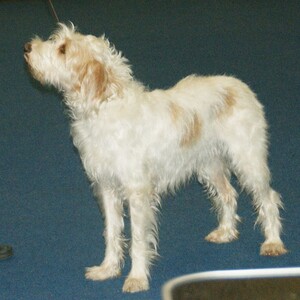
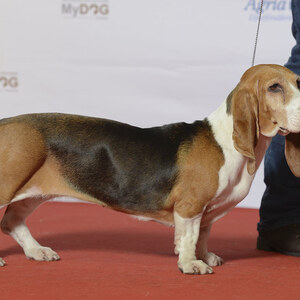
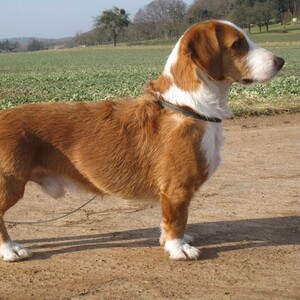
Westphalian Dachsbracke. · Volbu1 / Wikimedia Commons, CC BY-SA 3.0. Cropped and resized.
The Westphalian Dachsbracke (Westfälische Dachsbracke) is the short-legged version of the German Hound (Deutsche Bracke), from the Westphalia region. The FCI standard says it is essentially like the long-legged version, but looks more compact and powerful, and describes its expression as loyal, friendly, serious and alert. Wikipedia says the Swedish Drever was created from it.
Quick facts
| Common name | Westphalian Dachsbracke (Westfälische Dachsbracke) |
| Scientific name | Canis lupus familiaris |
| Country of origin | Germany |
| Official recognition | FCI, definitively since 29 November 1954 (group 6, small hounds; standard no. 100); VDH since 1935 |
| Lifespan | No published data for the breed; small breeds usually live 12–15 years |
| Size (males) | 30–38 cm at the withers |
| Size (females) | 30–38 cm at the withers |
| Coat type | Very dense and harsh, short on the head and legs |
| Common colours | Red to yellow with a black saddle and white markings |
| Energy level | High |
| Suited to an apartment? | Only with plenty of exercise |
| Temperament | Loyal, friendly, serious, alert |
| Tendency to aggression | Low |
| Good with children | No specific data; the standard describes it as friendly |
| Good with other animals | Good with dogs; poor with small animals |
| Genetic predispositions | No specific diseases are known; the long back needs care |
- Primary category:Dog breeds
- Explore this animal's categories:
History and origin
Wikipedia says the Westphalian Dachsbracke was first described in 1886, as a variety of the German Hound. It was recognised under its present name by the German kennel club (VDH) in 1935, and the FCI listed it as number 100.
Wikipedia adds that the Swedish Drever was created from it: the dogs were registered in Sweden in 1910 as “Westfälische Dachsbracke”, and the name was changed in 1947. Today the Drever has largely replaced it for hunting, and the Westphalian Dachsbracke is rarely seen, even in Germany.
How the breed developed
- 1886 – Described as a variety of the German Hound.
- 1910 – In Sweden, the future Drever starts from it.
- 1935 – Recognised by the VDH under its present name.
- 29 November 1954 – The FCI recognises the breed.
Breed rating
| Feature | Stars |
|---|---|
| Training and intelligence | ★★★★☆ |
| Easy to train | ★★★★☆ |
| Intelligence | ★★★★☆ |
| Independence | ★★★★☆ |
| Stubbornness | ★★★☆☆ |
| Behaviour and temperament | ★★★★☆ |
| Affectionate with family | ★★★★★ |
| Friendly with children | ★★★★☆ |
| Good with other dogs | ★★★☆☆ |
| Good with cats and other animals | ★★☆☆☆ |
| Loyalty | ★★★★★ |
| Tendency to be aggressive | ★★☆☆☆ |
| Tendency to bark | ★★★★★ |
| Needs and care | ★★★☆☆ |
| Shedding | ★★★☆☆ |
| Needs frequent grooming | ★★☆☆☆ |
| Activity and lifestyle | ★★★★☆ |
| Energy level | ★★★★☆ |
| Daily exercise needs | ★★★★☆ |
| Suited to apartment life | ★★★☆☆ |
| Health and longevity | ★★★☆☆ |
| Life expectancy | ★★★★☆ |
| Predisposition to genetic diseases | ★★☆☆☆ |
| Working abilities and uses | ★★★☆☆ |
| Good hunting dog | ★★★★☆ |
| Good companion dog | ★★★★☆ |
Indicative rating: 5 stars means the highest level. The breed has no AKC profile, so the rating is based on the FCI standard.
Physical characteristics
The standard describes it as a moderately long, sturdy hunting dog, 30–38 cm tall, with a noble, medium-sized head and a tail carried up like a sabre or hanging down, slightly curved at the tip. Wikipedia says it has a narrower chest and longer legs than the Dachshund.
General appearance
The whole body, including the belly, is covered with very dense, harsh hair, short on the head, ears and lower legs and longer on the back, neck and under the tail.
| Feature | Westphalian Dachsbracke |
|---|---|
| Size | Small |
| Height at the withers | 30–38 cm |
| Coat | Dense, harsh |
| Colour | Tricolour |
| Legs | Short |
| Type | Hound |
The colour is red to yellow, with a black saddle or mantle and the typical white Bracke markings: a blaze, white muzzle, white collar, and white chest, feet and tail tip. Bicolour dogs and dogs with black on the head are not desirable.
Training and socialisation
The standard describes its expression as loyal, friendly, serious and alert. It is a compact, powerful hunting hound.
Like any scent hound, it needs a lot of patience with the recall and plenty of work for its nose.
Tips for effective training
- Practise the recall. On a scent, it forgets about you.
- Keep it on a lead. Its hunting instinct is strong.
- Keep it from jumping. It has a long back.
- Give its nose work to do. Scent trails keep it content.
Activity needs and lifestyle
As a hunting hound, it needs long daily walks and plenty of work for its nose.
| Activity | How often | Why it matters |
|---|---|---|
| Long walks | daily | Stamina |
| Scent work | several times a week | Hound instinct |
| Play | daily | Energy |
Tips for a balanced life
- Best suited to hunters.
- Keep it at the right weight.
- Check the ears often.
Care and health
Coat and skin care
The dense, harsh coat should be brushed once a week. The ears should be checked regularly, especially after hunting.
Common health problems
No health studies have been published for the breed and no specific diseases are known. As with any dog with short legs and a long back, it is worth watching out for:
| Condition | Description | Common symptoms |
|---|---|---|
| Intervertebral disc disease | A disc between the vertebrae ruptures and presses on the spinal cord | Back or neck pain, unsteady walking on the hind legs; in severe cases, paralysis |
| Ear infections | Infections of the ears | Head shaking, bad smell |
Other care
- Keep it from jumping down from heights.
- Check for ticks after outings.
- Clean the ears regularly.
Diet and nutrition
An active hound needs good-quality food adapted to its workload; extra weight puts strain on its back.
Tips for a healthy diet
The table gives a starting estimate, calculated with the formula from the Merck Veterinary Manual. The first two calorie columns show the calories per day for a healthy adult dog. The last column shows what this means in dry food with 3,500–4,000 kcal per kilogram.
| Dog's weight | Calories per day (neutered) | Calories per day (not neutered) | Dry food per day (approximate) |
|---|---|---|---|
| 13 kg | 770 kcal | 860 kcal | 190–250 g |
| 15 kg | 850 kcal | 960 kcal | 210–270 g |
| 18 kg | 980 kcal | 1,100 kcal | 240–310 g |
- Split the food into two meals a day.
- Treats count towards the daily portion.
- A dog is at the right weight when you can feel its ribs without pressing hard.
Foods to avoid
Some human foods are dangerous for dogs: chocolate, coffee, grapes and raisins, onions, garlic, xylitol (a sweetener used in chewing gum), macadamia nuts and alcohol.
Reproduction and development
Physical and emotional maturity
In dogs, sexual maturity usually comes between 6 and 12 months. Small breeds become adults faster than large ones, usually at around one year.
Mating and pregnancy
Pregnancy lasts about 63 days, counted from ovulation. Mating a female on her first heat is not recommended. The FCI standard requires that only healthy dogs of typical breed appearance are used for breeding.
Caring for the puppies
In small breeds, a litter has 3–4 puppies on average. The puppies are very small and fragile in the first weeks, so they must be kept warm and handled with care. Socialisation starts early: gentle handling, everyday noises and new people.
Interesting facts
- Ancestor of the Drever. The Drever was developed from it, in Sweden.
- A “badger hound”. That is what “Dachsbracke” means.
- Described in 1886. As a variety of the German Hound.
- Rare even in Germany. Wikipedia says it is rarely seen.
- Bracke markings. The typical white on the face, chest and tail.
Frequently asked questions
How does it differ from the Drever?
They are very alike; the Drever was created from it.
How big does it get?
30–38 cm at the withers.
What colour is it?
Red-yellow with a black saddle and white markings.
Is it a family dog?
It is mainly a hunting dog.