BeaverInteresting facts and information
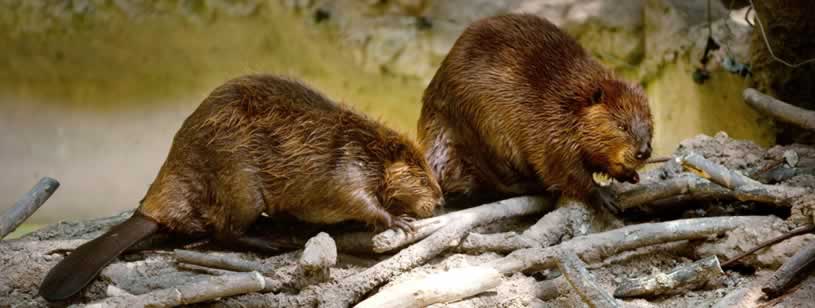
Beavers are semi-aquatic rodents in the genus Castor. The Eurasian beaver (Castor fiber) and North American beaver (Castor canadensis) are different species. Their tree cutting, burrowing and, in suitable places, dam building can change wetland habitats.
Beavers have strong incisors and a broad tail. Historic hunting greatly reduced some populations, and protection and reintroduction have supported recovery in parts of their range.
Quick facts
| Common name | Beaver |
| Scientific name | Castor fiber; Castor canadensis |
| Typical lifespan | Often 10-15 years in the wild; about 20 years or more in captivity |
| Maximum speed | Swims at up to about 8 km/h; slower and clumsier on land |
| Dimensions | About 1-1.3 m long, including the 25-50 cm tail |
| Weight | 16-32 kg (can reach about 40 kg) |
| Diet type | Herbivore (tree bark, leaves, roots, water plants) |
| Main predators | Wolves, bears, lynxes, coyotes, humans |
| Conservation status | Both species Least Concern (IUCN); some local populations are still small |
| Main species | Eurasian beaver (Castor fiber), North American beaver (Castor canadensis) |
| Distribution | North America, Europe, Asia |
| Habitat | Rivers, streams, lakes, marshes, wetlands |
- Primary category:Mammals
- Explore this animal's categories:
Interesting facts
- Their teeth never stop growing - A beaver's front teeth grow throughout its life and are kept short by constant gnawing on wood.
- They are nature's engineers - Beaver dams can completely change a landscape, creating wetlands that support many other species.
- Their broad tail has many uses - It helps with balance on land and steering in water, stores fat for winter and is slapped on the water to warn of danger.
- They build dams and lodges - Dams are often tens of metres long and are built to keep the water at the right depth.
- They can stay underwater for up to 15 minutes - Clear inner eyelids protect their eyes, and their nostrils and ears close underwater.
- Their fur is waterproof - Beavers comb an oily secretion through their fur, which keeps them dry and warm.
- They help against floods and droughts - Beaver dams hold back water, slow down floods and help refill groundwater.
- They are hard workers - A beaver can fell a tree about 10 cm thick in less than an hour.
- They communicate with smells and sounds - They mark their territory with scent and warn their family of danger by slapping their tails on the water.
- Beavers are "ecosystem engineers" - Few animals apart from humans change their surroundings as much as beavers do.
Records and remarkable features
- The Eurasian beaver (Castor fiber) and the North American beaver (Castor canadensis) are separate species and the largest rodents in the Northern Hemisphere.
- The longest known beaver dam, in Wood Buffalo National Park in Canada, is about 850 m long and can be seen from space.
Characteristics
Beavers are semi-aquatic mammals, well adapted for life both in water and on land. They have a sturdy body, dense fur, strong front teeth and feet specialised for swimming and building.
Main physical characteristics
- Thick, waterproof fur - Beavers have two layers of fur: long outer guard hairs and a dense, soft underfur that keeps out cold water.
- A broad, flat tail - It helps with balance on land and steering in the water, stores fat and is used to signal with loud slaps on the water.
- Strong front teeth - They grow throughout life and are covered with an orange, iron-rich enamel that makes them very hard.
- Webbed hind feet - Push the beaver powerfully through the water, while the front paws, with strong claws, handle food and building materials.
- Built-in goggles and plugs - A clear inner eyelid protects the eyes underwater, and the nostrils and ears can close to keep water out.
- Scent glands - Castor sacs near the base of the tail produce castoreum, used to mark territory, while separate oil glands produce the oil that waterproofs the fur.
Special adaptations for survival
- Shaping their environment - By building dams and canals, beavers change natural landscapes and create wetlands rich in wildlife.
- Long dives - They can stay underwater for up to 15 minutes by saving oxygen.
- Safe homes - Their lodges and burrows have underwater entrances that predators cannot easily reach.
- Many ways to communicate - Beavers use tail slaps, calls and scent marks to send messages to other beavers.
Habits and behaviour
Beavers are social animals that live in family groups and are famous for their building skills.
Social behaviour
- Family colonies - A beaver family usually includes a breeding pair, their kits of the year and the young from the previous year.
- Shared tasks - All family members help maintain the dam and lodge, and the young learn by copying their parents.
- Territorial - They mark their territory with scent mounds and can be aggressive towards intruders.
Building dams and lodges
- Dams are essential - They create deep ponds that protect beavers from predators and give them easy access to food.
- Clever lodges - Built on riverbanks or in the middle of the ponds created by dams, lodges have underwater entrances and a dry chamber above the water for resting.
- Canals - Beavers dig canals to float wood and reach new feeding areas.
Activity and feeding
- Mostly nocturnal - Most of their activity, including building and feeding, takes place at dusk and at night.
- Winter stores - Beavers collect branches and store them underwater near the lodge to eat in winter.
- Bark and leaves - Their favourite trees include aspens, poplars, willows, alders and birches.
Habitat and geographic distribution
Beavers are semi-aquatic animals that need fresh water, where they can build dams and lodges.
Habitat types
- Rivers and streams - They prefer slow-flowing water, where they can control the water level with dams.
- Lakes and marshes - Ideal places for lodges and food stores.
- Wet woodland - Broadleaf trees along rivers give them food and building materials.
- Mountains and cold regions - Beavers can live at fairly high altitudes and cope well with cold.
Geographic distribution and estimated population
| Region | Species present | Estimated population |
|---|---|---|
| North America | Castor canadensis | Stable, over 10 million |
| Europe | Castor fiber | Increasing; together with Asia, about 1.5 million |
| Asia (Russia, Mongolia, China, Kazakhstan) | Castor fiber | Large in Russia, small and scattered elsewhere |
Threats to their habitat
- Changing rainfall - Can affect how much water there is and whether beavers can build dams.
- Loss of riverside woods - Reduces food and building materials.
- Spreading towns - Conflicts with people arise when beavers settle near houses, roads or farmland.
Beavers are important for healthy wetlands, and protection has allowed them to return to many regions where they had been hunted out.
Diet and feeding
Beavers are herbivores that mainly eat bark, leaves and water plants. Microbes in their gut help them digest woody food, and they re-eat some of their droppings to get more nutrients.
Main food
- Bark and twigs - Their main food, especially from aspen, poplar, willow, alder and birch.
- Leaves and green shoots - Eaten mainly in spring and summer, when they are juicy.
- Water plants - Water lilies, pondweeds and the roots of other water plants.
- Grasses and herbs - They also eat plants growing along riverbanks and lake shores.
Feeding techniques
- Felling trees - Beavers gnaw through trunks with their strong teeth to reach bark and branches for food and building.
- Storing food for winter - They gather their favourite branches and store them underwater, where they can reach them under the ice.
- Choosing trees - They prefer trees with soft wood and avoid some species with bitter or tough bark.
Diet by season
| Season | Main food |
|---|---|
| Spring | Leaves, shoots, grasses |
| Summer | Water plants, soft bark, young branches |
| Autumn | Tree bark, roots, branches for winter stores |
| Winter | Branches stored underwater, roots |
Reproduction and life cycle
Beavers usually live in stable family groups led by a breeding pair. They mate in winter, and the kits are born in spring, when conditions are best.
Mating
- Breeding season - From about December to February in temperate regions.
- Beavers often form lasting pair bonds and family groups, but not every beaver keeps the same partner for life.
- Scent communication - Beavers learn about each other through the scent marks they leave around their territory.
Pregnancy and birth
- Pregnancy - About 105-107 days.
- Number of kits - Usually 2-4, sometimes up to 6.
- Place of birth - The female gives birth in the dry chamber of the lodge, where the kits are safe from predators and cold.
Development of the kits
- Kits are born with fur and open eyes - Unlike mice and rats, they are well developed at birth.
- Nursing - The kits drink their mother's rich milk for about 2-3 months.
- Solid food - They start eating leaves and other plants at about two weeks old, copying their parents.
- Leaving home - Young beavers usually leave at about 2 years old to find their own territory.
Longevity
- In the wild - Often 10-15 years, but many die young from predators, disease or accidents.
- In captivity - Around 20 years or more, thanks to safety and a steady food supply.
Name and history
Beavers have been honoured, hunted and studied throughout history because of their effect on the landscape and the value of their fur and castoreum.
Origin of the name
- The English word "beaver" comes from Old English beofor, from an ancient root meaning "brown".
- The scientific name Castor comes from the Greek word for the beaver and is the genus that includes both living beaver species.
Taxonomic classification
| Taxonomic category | Name |
|---|---|
| Kingdom | Animalia |
| Phylum | Chordata |
| Class | Mammalia |
| Order | Rodentia |
| Family | Castoridae |
| Genus | Castor |
| Species | Castor canadensis, Castor fiber |
Discovery and documentation
- Ancient times - The ancient Greeks and Romans knew beavers and hunted them for castoreum, which was used in medicine.
- The 16th-19th centuries - Beaver fur was highly prized for making felt hats.
- The 19th and early 20th centuries - Overhunting almost wiped out beavers in Europe, and numbers also fell sharply in North America.
- The 20th century - Protection and reintroduction programmes allowed beaver populations to recover.
The role of beavers in culture and economy
- The fur trade - Beaver fur drove the North American fur trade and the exploration of Canada.
- Symbolism - In many Native American cultures, the beaver stands for hard work and careful planning.
- Ecology - The rediscovery of the beaver's role in wetlands has led to wide protection.
Beavers have been brought back to many regions where they had disappeared and are now recognised as "nature's engineers" for their ability to reshape the environment.
Cultural significance and mythology
Many cultures have admired the beaver for its hard work and building skills. It has also played an important economic and symbolic role in Europe and North America.
Beavers in mythology and folk belief
- A symbol of hard work - In many cultures, the beaver stands for diligence, persistence and building a safe future.
- Native American traditions - The beaver is an important crest animal for Pacific Northwest peoples such as the Haida, and it appears in many stories as a skilled builder.
- Medieval bestiaries - Medieval books claimed that a hunted beaver would bite off the glands that hunters wanted and leave them behind to save its life. This is a myth.
Beaver symbolism
- Engineering and organisation - The beaver's dams and lodges are often compared to human architecture.
- A link with water - Because of its semi-aquatic life, the beaver is linked with rivers and wetlands.
- A national emblem - The beaver is an official symbol of Canada and appears on the Canadian five-cent coin.
Conservation status and threats
In the past, heavy hunting for fur and castoreum caused beaver populations to crash. Thanks to conservation work, their numbers have recovered, and both species are now listed as Least Concern by the IUCN, although some local populations remain small.
Conservation status
- Eurasian beaver (Castor fiber) - By around 1900, only about 1,200 were left in a few scattered places. Thanks to protection and reintroduction, it has returned to much of Europe.
- North American beaver (Castor canadensis) - The population is stable, but some areas face habitat loss.
Main threats
- Habitat loss - Draining wetlands and building along rivers reduce the places where beavers can live.
- Water pollution - Toxic substances can harm beavers' food and health.
- Conflict with people - In some areas, beavers are seen as pests because they flood farmland, roads or forests.
- Climate change - Changing rainfall and higher temperatures can alter the rivers and lakes where beavers live.
Conservation efforts
- Reintroductions in Europe - Since the 20th century, beavers have been successfully reintroduced in many countries, including Germany, Romania and Britain.
- Legal protection - In many countries, beavers are protected and hunting them is banned or strictly limited.
- Restoring ecosystems - Studies show that beavers improve biodiversity, store water and reduce soil erosion.
In popular culture
Beavers appear in many films, books, cartoons and video games, usually as hard-working, clever and sometimes funny animals.
Beavers in film and animation
- The Chronicles of Narnia: The Lion, the Witch and the Wardrobe (2005) - Mr and Mrs Beaver are friendly characters who help the children in the magical land of Narnia.
- Lady and the Tramp (1955) - A beaver at the zoo helps Lady by gnawing off her muzzle.
- The Angry Beavers (1997-2001) - A cartoon series about two beaver brothers, Norbert and Daggett, and their comic adventures.
Beavers in literature
- The Lion, the Witch and the Wardrobe (C. S. Lewis, 1950) - The original novel in which Mr and Mrs Beaver first appear.
- Native American stories - Many Native peoples tell stories about the beaver as a symbol of hard work and wisdom.
Beavers in sport and as mascots
- A symbol of Canada - The beaver appears on the Canadian five-cent coin and is an official national symbol.
- University mascots - Benny the Beaver represents Oregon State University, and Tim the Beaver represents MIT.
Beavers in video games and comics
- Animal Crossing - Chip, a beaver, hosts the fishing tournaments.