KromfohrländerCharacteristics, history, training and care
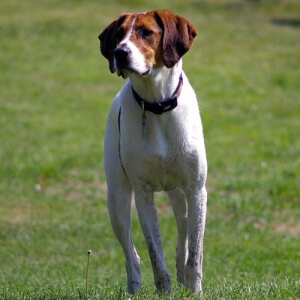
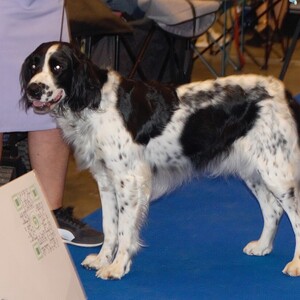
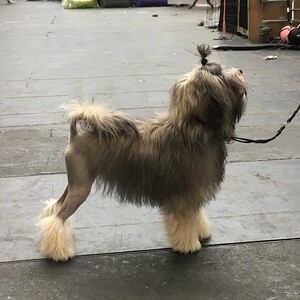
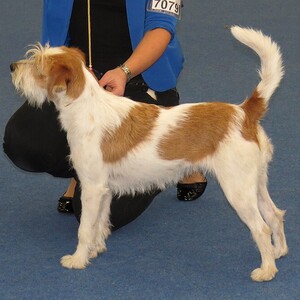
Kromfohrländer. · Томасина / Wikimedia Commons, CC BY-SA 3.0. Cropped and resized.
The Kromfohrländer is a medium-sized German companion dog, white with brown markings, with either a rough coat and beard or a smooth coat. It is one of the newest German breeds, created after the Second World War. The standard describes it as adaptable, docile, lively, a little reserved with strangers and with little hunting instinct.
Quick facts
| Common name | Kromfohrländer (Kromi) |
| Scientific name | Canis lupus familiaris |
| Country of origin | Germany |
| Official recognition | FCI, definitively since 28 November 1955 (group 9, companion and toy dogs; standard no. 192); AKC, in the Foundation Stock Service since 2012 |
| Lifespan | 13–15 years, according to the AKC |
| Size (males) | 38–46 cm at the withers; 11–16 kg |
| Size (females) | 38–46 cm at the withers; 9–14 kg |
| Coat type | Rough, with a beard, or smooth, without a beard |
| Common colours | White with markings from light brown to very dark brown |
| Energy level | High |
| Suited to an apartment? | Yes, with daily exercise |
| Temperament | Adaptable, docile, cheerful, very attached to its owner |
| Tendency to aggression | Low |
| Good with children | Good, according to the AKC |
| Good with other animals | Average |
| Genetic predispositions | Hyperkeratosis, von Willebrand disease, autoimmune problems |
- Primary category:Dog breeds
- Explore this animal's categories:
History and origin
The FCI standard says it is one of the newest German breeds and has been internationally recognised since 1955. The first breeder, Ilse Schleifenbaum, lived near Siegen, close to the area called “krom Fohr” (“crooked furrow”), from which the breed takes its name. Its ancestors are the Wire Fox Terrier and the Grand Griffon Vendéen.
Wikipedia says that in 1945 a young dog brought from France by American soldiers got lost near Hilchenbach. Ilse Schleifenbaum took him in and named him Peter. A chance mating with Fiffi, a neighbour's Fox Terrier-type bitch, produced puppies that looked very much alike, and the breed started from them.
How the breed developed
- 1945 – The dog Peter comes to Ilse Schleifenbaum, near Siegen.
- After 1945 – The first generations of the breed are born from Peter and Fiffi.
- 28 November 1955 – The FCI recognises the breed.
- 12 October 1998 – The current FCI standard is published.
Breed rating
| Feature | Stars |
|---|---|
| Training and intelligence | ★★★★☆ |
| Easy to train | ★★★★☆ |
| Intelligence | ★★★★☆ |
| Independence | ★★☆☆☆ |
| Stubbornness | ★★★☆☆ |
| Behaviour and temperament | ★★★★★ |
| Affectionate with family | ★★★★★ |
| Friendly with children | ★★★★☆ |
| Good with other dogs | ★★★☆☆ |
| Good with cats and other animals | ★★★☆☆ |
| Loyalty | ★★★★★ |
| Tendency to be aggressive | ★☆☆☆☆ |
| Tendency to bark | ★★★☆☆ |
| Needs and care | ★★★☆☆ |
| Shedding | ★★☆☆☆ |
| Needs frequent grooming | ★★☆☆☆ |
| Activity and lifestyle | ★★★★☆ |
| Energy level | ★★★★☆ |
| Daily exercise needs | ★★★☆☆ |
| Suited to apartment life | ★★★★☆ |
| Health and longevity | ★★★★☆ |
| Life expectancy | ★★★★★ |
| Predisposition to genetic diseases | ★★★☆☆ |
| Working abilities and uses | ★★★☆☆ |
| Good guard dog | ★★★☆☆ |
| Good companion dog | ★★★★★ |
Indicative rating: 5 stars means the highest level. It is based on the ratings the American Kennel Club gives the breed and on the FCI standard.
Physical characteristics
The standard describes it as a medium-sized dog, with a body slightly longer than its height, in two coat varieties: rough and smooth. The AKC says it is very intelligent, funny and agile, and that it likes to climb and jump.
General appearance
The rough-haired variety has a dense coat with a beard; on the withers and back the hair is at most 7 cm long, and around 3 cm on the sides. The smooth variety has no beard. The skull is slightly rounded, with a well-defined stop.
| Feature | Kromfohrländer |
|---|---|
| Size | Medium |
| Height at the withers | 38–46 cm |
| Weight | males: 11–16 kg; females: 9–14 kg |
| Coat | Rough with a beard, or smooth |
| Base colour | White |
| Proportions | Slightly longer than tall |
The base colour is white, with markings from light brown and reddish to very dark brown, as larger patches or a saddle. On the head, the brown markings on the cheeks, above the eyes and on the ears are divided as symmetrically as possible by a white blaze.
Training and socialisation
The standard describes it as an adaptable, docile and lively companion dog, a little reserved with strangers and with little hunting instinct. Aggression and shyness are undesirable.
The AKC says it is very intuitive and learns easily from an early age, but activities that require more independence, such as competitive agility, can be a challenge, because the breed is sensitive. Patience is needed.
Tips for effective training
- Be patient. It is a sensitive dog.
- Use rewards. It learns easily from an early age.
- Try tricks. The AKC says it excels at tricks and agility.
- Do not leave it alone for long. It wants to be by its person's side all the time.
Activity needs and lifestyle
The AKC says that, although it wants to be by its person's side all the time, it needs regular exercise outdoors. It loves to fetch a ball, and long walks in nature are its favourite. It is not a dog for dog parks.
| Activity | How often | Why it matters |
|---|---|---|
| Long walks in nature | daily | Its favourite activity |
| Ball games | daily | It loves to fetch |
| Tricks or agility | weekly | Intelligence and agility |
Tips for a balanced life
- It can also live in an apartment.
- Frisbee only after the age of 3, according to the AKC.
- Spend plenty of time with it.
Care and health
Coat and skin care
The AKC says that, for a tidy look, the coat should be hand-stripped or groomed regularly, but not clipped or shaved. The dogs have little or no odour, and dirt falls off the coat. The nails should be trimmed regularly.
Common health problems
The AKC says the breed is extremely rare, with a very small gene pool. DNA tests exist for some diseases, so breeders can avoid producing affected puppies:
| Condition | Description | Common symptoms |
|---|---|---|
| Hyperkeratosis | The skin of the paw pads thickens and cracks | Cracked, painful paws, limping |
| Von Willebrand disease | An inherited blood-clotting disorder | Bleeding that is hard to stop |
| Autoimmune problems | The body attacks its own tissues | Varied signs, depending on the organ affected |
Other care
- Check the paw pads.
- Trim the nails regularly.
- Ask the breeder for the parents' DNA tests.
Diet and nutrition
The AKC says it can be a picky eater, so it needs good-quality food that supports its activity. It does not usually overeat.
Tips for a healthy diet
The table gives a starting estimate, calculated with the formula from the Merck Veterinary Manual. The first two calorie columns show the calories per day for a healthy adult dog. The last column shows what this means in dry food with 3,500–4,000 kcal per kilogram.
| Dog's weight | Calories per day (neutered) | Calories per day (not neutered) | Dry food per day (approximate) |
|---|---|---|---|
| 9 kg | 580 kcal | 650 kcal | 140–190 g |
| 12 kg | 720 kcal | 810 kcal | 180–230 g |
| 16 kg | 900 kcal | 1,010 kcal | 220–290 g |
- Give it its food in two meals a day.
- If it refuses its food, do not change it too often.
- A dog is at the right weight when you can feel its ribs under the coat without pressing hard.
Foods to avoid
Some human foods are dangerous for dogs: chocolate, coffee, grapes and raisins, onions, garlic, xylitol (a sweetener used in chewing gum), macadamia nuts and alcohol.
Reproduction and development
Physical and emotional maturity
In dogs, sexual maturity usually comes between 6 and 12 months. Most breeds become adults at around 13–15 months.
Mating and pregnancy
Pregnancy lasts about 63 days, counted from ovulation. Mating a female on her first heat is not recommended. The FCI standard requires that only healthy dogs of typical breed appearance are used for breeding.
Caring for the puppies
In dogs, a litter has 5–6 puppies on average, and the number rises with the size of the breed. Socialisation starts in the first weeks: gentle handling, everyday noises and new people.
Interesting facts
- Named after a crooked furrow. “Krom Fohr” means “crooked furrow”.
- Peter and Fiffi. The breed started from a lost dog and a neighbour's bitch.
- Naturally clean. The AKC says dirt simply falls off its coat.
- It does not run away. The AKC says it is very attached and does not roam.
- Sometimes very long-lived. The AKC says it often lives a long time, even 17–18 years.
Frequently asked questions
Where does the name come from?
From the area called “krom Fohr” (“crooked furrow”), near Siegen.
How big does it get?
It measures 38–46 cm; males weigh 11–16 kg, females 9–14 kg.
Is it good with children?
The AKC says it is good with children and with the family.
How long does it live?
The AKC gives 13–15 years, but some dogs reach 17–18 years.