DobermannCharacteristics, history, training and care
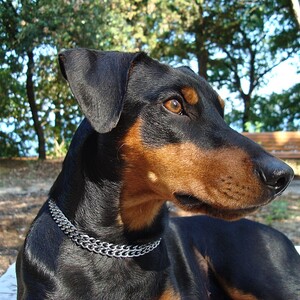
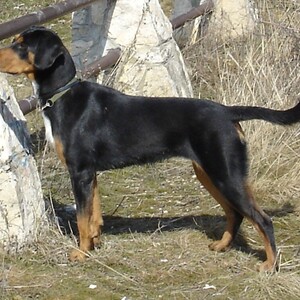
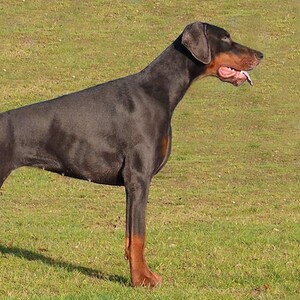
Dobermann. · J-J.J / Wikimedia Commons, CC BY-SA 3.0. Cropped and resized.
The Dobermann is a large, muscular, fast and elegant German dog. It bears the name of its creator, Friedrich Louis Dobermann, who bred it in the 1870s as a guard and house dog. It is friendly and calm, very devoted to its family, easy to train, brave and self-confident.
Quick facts
| Common name | Dobermann (Doberman Pinscher) |
| Scientific name | Canis lupus familiaris |
| Country of origin | Germany (Thuringia) |
| Official recognition | FCI, definitively since 1955 (group 2, pinscher type, with working trial; standard no. 143); also recognised by the AKC |
| Lifespan | 10–12 years, according to the AKC; a 2024 British study found 11.2 years |
| Size (males) | 68–72 cm at the withers; about 40–45 kg |
| Size (females) | 63–68 cm at the withers; about 32–35 kg |
| Coat type | Short, harsh, dense, close-lying, no undercoat |
| Common colours | Black or brown, with rust-red markings |
| Energy level | Very high |
| Suited to an apartment? | It can adapt, if it gets a great deal of exercise |
| Temperament | Friendly, calm, devoted, brave, self-confident |
| Tendency to aggression | Low with the family; very protective |
| Good with children | Very good, with socialisation |
| Good with other animals | Average |
| Genetic predispositions | Dilated cardiomyopathy, von Willebrand disease, hip dysplasia, bloat, retinal atrophy |
- Primary category:Dog breeds
- Explore this animal's categories:
History and origin
The FCI standard says the Dobermann is the only German breed that bears the name of its creator, Friedrich Louis Dobermann (1834–1894). He was a tax collector, manager of a knacker's yard and part-time dogcatcher, so he could choose the sharpest dogs from among the strays.
The “butcher's dogs”, an early type of Rottweiler, played an important part, crossed with a black-and-tan shepherd dog from Thuringia. From this mix, in the 1870s Dobermann obtained alert and very protective dogs. They were used so often by the police that they were nicknamed the “gendarme dog”, and at the beginning of the 20th century the breed was officially recognised as a police dog.
How the breed developed
- 2 January 1834 – Friedrich Louis Dobermann is born.
- 1870s – Dobermann creates the breed in Apolda, Thuringia.
- Early 20th century – The breed is officially recognised as a police dog.
- 1955 – The FCI recognises the breed.
- 13 November 2015 – The current FCI standard is published; the ears and tail remain natural.
Breed rating
| Feature | Stars |
|---|---|
| Training and intelligence | ★★★★★ |
| Easy to train | ★★★★★ |
| Intelligence | ★★★★★ |
| Independence | ★★★☆☆ |
| Stubbornness | ★★★☆☆ |
| Behaviour and temperament | ★★★★★ |
| Affectionate with family | ★★★★★ |
| Friendly with children | ★★★★★ |
| Good with other dogs | ★★★☆☆ |
| Good with cats and other animals | ★★★☆☆ |
| Loyalty | ★★★★★ |
| Tendency to be aggressive | ★★★☆☆ |
| Tendency to bark | ★★★☆☆ |
| Needs and care | ★★★★☆ |
| Shedding | ★★★★☆ |
| Needs frequent grooming | ★☆☆☆☆ |
| Activity and lifestyle | ★★★★☆ |
| Energy level | ★★★★★ |
| Daily exercise needs | ★★★★★ |
| Suited to apartment life | ★★★☆☆ |
| Health and longevity | ★★★★☆ |
| Life expectancy | ★★★☆☆ |
| Predisposition to genetic diseases | ★★★★☆ |
| Working abilities and uses | ★★★★★ |
| Good guard dog | ★★★★★ |
| Good companion dog | ★★★★☆ |
Indicative rating: 5 stars means the highest level. It is based on the ratings the American Kennel Club gives the breed and on the FCI standard.
Physical characteristics
The Dobermann is a medium to large, strong and muscular dog with an almost square body. The lines of the body are elegant, and its proud bearing shows temperament and determination.
General appearance
The head is shaped like a long wedge. The medium-sized, oval eyes are dark. The current FCI standard requires the ears and tail to remain natural: the ears hang close to the cheeks, and the tail is carried high and slightly curved.
| Feature | Dobermann |
|---|---|
| Size | Large |
| Height at the withers | males: 68–72 cm; females: 63–68 cm |
| Weight | males: about 40–45 kg; females: 32–35 kg |
| Coat | Short, harsh, no undercoat |
| Eyes | Oval, dark |
| Ears and tail | Natural, uncropped and undocked |
The FCI accepts two varieties: black with rust-red markings and brown with rust-red markings. The markings appear on the muzzle, cheeks, above the eyes, on the throat, as two patches on the chest, on the legs and under the tail. White markings disqualify. The AKC also accepts blue and fawn (Isabella) with rust.
Training and socialisation
The standard describes a friendly and calm dog, very devoted to its family, easy to train and fond of work. Self-confidence, courage and adaptability are required.
The AKC says Dobermanns are very intelligent, learn easily and react quickly. However, they are very powerful and can become pushy and hard to control if they are not raised properly. Puppy socialisation and obedience classes are a must.
Tips for effective training
- Start socialising it as a puppy. The AKC says this is absolutely essential.
- Go to puppy classes. Especially if it is your first Dobermann.
- Give it a job. Obedience, tracking or agility.
- Be consistent. Such a powerful dog needs clear rules.
Activity needs and lifestyle
The AKC calls it an energetic athlete that needs plenty of exercise and free play. Long daily walks and a large, fenced area where it can run are vital for it.
| Activity | How often | Why it matters |
|---|---|---|
| Long walks or hikes | daily | Very high energy |
| Free running in a fenced area | daily | Vital for its health |
| Obedience, tracking or agility | several times a week | An active mind |
Tips for a balanced life
- In winter, the short coat with no undercoat gives it little protection, so it may need a coat.
- The yard must be well fenced.
- It suits an active family.
Care and health
Coat and skin care
The AKC says it is an easy breed to groom: a daily going-over with a short-bristled brush or a grooming mitt keeps the coat shiny. It does not need frequent baths. The nails should be trimmed at least monthly, and the ears wiped every few days.
Common health problems
The AKC says Dobermanns are generally healthy, but the breed has some genetic predispositions:
| Condition | Description | Common symptoms |
|---|---|---|
| Dilated cardiomyopathy | The heart enlarges and pumps more and more weakly | Tiredness, coughing, fainting, laboured breathing |
| Von Willebrand disease | An inherited blood-clotting disorder | Prolonged bleeding after injuries or operations |
| Hip dysplasia | The hip joint forms incorrectly and, over time, arthritis develops | Limping, difficulty getting up or jumping, hip pain |
| Gastric dilatation-volvulus (bloat) | The stomach fills with gas and may twist; this is a veterinary emergency | Swollen belly, trying to vomit without success, drooling, restlessness |
| Progressive retinal atrophy | An inherited disease that gradually destroys the retina | Sees less and less well at night, then in the daytime too |
Other care
- Have its heart checked, as recommended by your vet.
- Brush its teeth regularly.
- Trim the nails at least once a month.
Diet and nutrition
The AKC says excellent food throughout its life is essential for a Dobermann. Too many treats lead to obesity.
Tips for a healthy diet
The table gives a starting estimate, calculated with the formula from the Merck Veterinary Manual. The first two calorie columns show the calories per day for a healthy adult dog. The last column shows what this means in dry food with 3,500–4,000 kcal per kilogram.
| Dog's weight | Calories per day (neutered) | Calories per day (not neutered) | Dry food per day (approximate) |
|---|---|---|---|
| 32 kg | 1,510 kcal | 1,700 kcal | 380–490 g |
| 38 kg | 1,710 kcal | 1,930 kcal | 430–550 g |
| 45 kg | 1,950 kcal | 2,190 kcal | 490–630 g |
- Split the food into two meals a day to reduce the risk of bloat.
- Do not let it run right after a meal.
- A dog is at the right weight when you can feel its ribs without pressing hard.
Foods to avoid
Some human foods are dangerous for dogs: chocolate, coffee, grapes and raisins, onions, garlic, xylitol (a sweetener used in chewing gum), macadamia nuts and alcohol.
Reproduction and development
Physical and emotional maturity
In dogs, sexual maturity usually comes between 6 and 12 months, but in large breeds it can be delayed until about two years. The body also reaches its adult form later than in small breeds.
Mating and pregnancy
Pregnancy lasts about 63 days, counted from ovulation. Mating a female on her first heat is not recommended. The FCI standard requires that only healthy dogs of typical breed appearance are used for breeding.
Caring for the puppies
In large breeds, a litter has around 7 puppies on average. Socialisation starts in the first weeks: gentle handling, everyday noises and new people.
Interesting facts
- Named after its creator. The FCI standard says it is the only German breed that bears its creator's name.
- The “gendarme dog”. It was used so often by the police that it earned this nickname.
- A Rottweiler ancestor. The “butcher's dogs”, an early type of Rottweiler, contributed to the breed.
- Natural ears. The FCI standard requires the ears and tail to be left uncut.
- No undercoat. The standard does not allow a visible undercoat.
Frequently asked questions
Where does the name Dobermann come from?
From Friedrich Louis Dobermann, who created the breed in the 1870s in Thuringia.
How big does it get?
Males measure 68–72 cm and weigh 40–45 kg; females measure 63–68 cm and weigh 32–35 kg.
Is it a family dog?
Yes. The standard describes it as friendly, calm and very devoted to its family, provided it is socialised and trained.
What diseases does it have?
Dilated cardiomyopathy, von Willebrand disease, hip dysplasia and bloat can occur.
How long does it live?
The AKC gives 10–12 years.