Border TerrierCharacteristics, history, training and care
The Border Terrier is a small, wiry-coated working terrier associated with the border region of England and Scotland. It is active and inquisitive, and needs exercise, training and safe management around small animals.
Quick facts
| Common name | Border Terrier |
| Scientific name | Canis lupus familiaris |
| Country of origin | United Kingdom (England - Scotland) |
| Official Recognition | Recognized by AKC in 1930 |
| Typical lifespan | About 12-15 years |
| Dimensions (Male) | About 25-30 cm / 5.9-7.1 kg |
| Dimensions (Female) | About 25-28 cm / 5.1-6.4 kg |
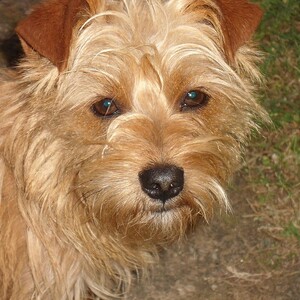
| Coat type | Harsh, dense, wiry, with an undercoat |
| Common colours | Red, grizzle and tan, blue and tan, wheaten |
| Energy Level | High |
| Suitable for an apartment? | Depends on exercise, training, health and the individual dog |
| Temperament | Playful, intelligent, friendly |
| Behaviour towards unfamiliar people and dogs | Individual behaviour varies; socialisation, training and management matter |
| Compatibility with children | Depends on the individual; adult supervision and suitable handling are essential |
| Compatibility with other animals | Depends on socialisation, prey drive and the animals involved |
| Health considerations | Canine epileptoid cramping syndrome, hip dysplasia, patellar luxation, dental problems |
- Primary category:Dog breeds
- Explore this animal's categories:
History and Origin
The Border Terrier is an old British working terrier, used since at least the 18th century to control foxes and other pests on farms in the Cheviot Hills, on the border between England and Scotland.
Evolution of the breed
- Origins in the Border country - It was bred to hunt foxes and vermin and to be fast, agile and tough.
- Running with foxhounds - It had long enough legs to keep up with hunters on horseback and foxhounds, and was small enough to follow a fox into its den.
- Official recognition - The Kennel Club in Britain recognised the Border Terrier in 1920 and the American Kennel Club (AKC) in 1930.
Breed Evaluation
The Border Terrier is a small but tough and intelligent dog, well suited to active families and people who love the outdoors. These are general editorial ratings, not measured scores; individual dogs vary.
| Characteristic | Stars |
|---|---|
| Training and Intelligence | ★★★★☆ |
| Easy to train | ★★★★☆ |
| Intelligence | ★★★★★ |
| Level of independence | ★★★★☆ |
| Level of stubbornness | ★★★★☆ |
| Behavior and Temperament | ★★★★☆ |
| Affectionate with family | ★★★★★ |
| Friendly with children | ★★★★★ |
| Compatible with other dogs | ★★★☆☆ |
| Compatible with cats and other animals | ★★★☆☆ |
| Degree of loyalty | ★★★★★ |
| Tendency to be aggressive | ★★☆☆☆ |
| Tendency to bark | ★★★☆☆ |
| Needs and Care | ★★★☆☆ |
| Shedding level | ★★★☆☆ |
| Requires frequent care | ★★★☆☆ |
| Activity and Lifestyle | ★★★★★ |
| Energy level | ★★★★★ |
| Daily exercise requirement | ★★★★★ |
| Suitable for apartment living | ★★★☆☆ |
| Health and Longevity | ★★★★☆ |
| Life expectancy | ★★★★★ |
| Predisposition to genetic diseases | ★★★☆☆ |
| Work and Utility Features | ★★★★★ |
| Good hunting dog | ★★★★★ |
| Good companion dog | ★★★★☆ |
Physical Characteristics
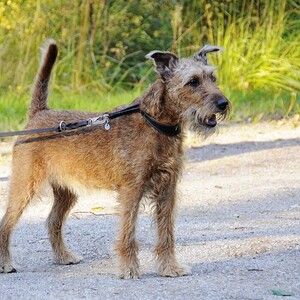
The Border Terrier is a compact, athletic and sturdy little dog, built for hard work over rough ground.
General appearance
- A small but muscular body, narrow enough to follow a fox underground.
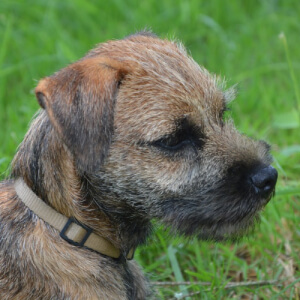
- A harsh, dense, wiry coat with a softer undercoat that protects it from the weather and thick vegetation.
- A distinctive "otter-like" head with a short, strong muzzle and small, V-shaped, folded ears.
- A fairly short, thick tail, carried happily but not curled over the back.
| Characteristic | Border Terrier |
|---|---|
| Size | Small (about 25-30 cm at the shoulder) |
| Weight | About 5-7 kg |
| Coat | Harsh, dense, wiry |
| Muzzle | Short and strong |
| Shedding tendency | Low to moderate |
| Build | Light but tough |
The Border Terrier is a sturdy, versatile dog, excellent for active families and people who love hiking.
Training and Socialization
The Border Terrier is clever and willing, but also independent, so training needs consistency and patience.
Tips for effective training
- Start early - The Border Terrier has a strong hunting instinct and should be trained from an early age.
- Positive methods - It responds best to rewards, praise and motivation, but can become stubborn with harsh corrections.
- Recall practice - Its strong hunting instinct means it can be distracted by scents and small animals, so it must learn to come when called.
- Wide socialisation - It should get used to other dogs, people and small animals to prevent conflicts.
- Lead training - Because it may chase small animals, it should learn to walk nicely on a lead.
The Border Terrier is clever and playful, but it needs regular training and good socialisation to manage its natural hunting instincts.
Activity and Lifestyle Needs
The Border Terrier is an energetic dog that needs daily exercise to stay healthy and balanced.
| Activity | Recommended duration |
|---|---|
| Daily walks | About 45-60 min |
| Obedience training | About 10-15 min |
| Interactive games | About 20-30 min |
| Dog sports (agility, earthdog, flyball) | A few times a week |
Recommendations for a balanced lifestyle
- Can live in an apartment - if it gets enough daily exercise.
- Loves to dig - It helps to have a special digging area in the garden, and fences should be checked for escape routes.
- Hunting instinct - It should be supervised around cats and small pets.
- Affectionate but independent - It is very attached to its family, but should also learn to stay alone for short periods.
The Border Terrier is a lively dog that adapts well to most homes, as long as it gets enough physical and mental exercise.
Care and Health
The Border Terrier is a hardy breed, but it needs proper coat care and regular veterinary checks.
Fur and skin care
- Weekly brushing - The wiry coat should be brushed about once a week to remove dirt and dead hair.
- Hand-stripping - The coat is usually hand-stripped about twice a year to keep its natural harsh texture; clipping makes it softer.
- Baths only when needed - The coat sheds dirt well, so it should be washed only when very dirty.
Common health problems
| Condition | Description | Common symptoms |
|---|---|---|
| Canine epileptoid cramping syndrome (CECS) | A disorder seen in the breed, linked to gluten sensitivity in some dogs | Episodes of trembling, cramping and difficulty walking |
| Hip dysplasia and patellar luxation | Joint problems that can affect mobility | Limping, difficulty walking |
| Dental problems | Tartar and gum disease | Bad breath, inflamed gums |
Other aspects of care
- Regular veterinary checks - Help monitor the joints, teeth and general health.
- Ear and eye checks - These should be checked weekly for signs of infection.
- Balanced diet - The Border Terrier can gain weight easily if overfed.
The Border Terrier is a hardy breed, but it needs regular care of its coat, teeth and joints.
Diet and Nutrition
The Border Terrier needs a balanced diet that supports its activity without extra calories.
Recommendations for a healthy diet
Choose a complete, balanced diet suited to age, size and health. Plan home-prepared diets and supplements with a qualified veterinarian; raw pet food can carry harmful bacteria.
| Food type | Daily Amount (Adults) | Frequency |
|---|---|---|
| Premium dry food | Individual amount; follow a complete diet’s guidance and veterinary advice | 2 meals/day |
| Home cooked food | Individual amount; follow complete-food guidance and veterinary advice | 2 meals/day |
| Raw food: bacterial contamination is a concern | Individual amount; follow complete-food guidance and veterinary advice | 2 meals/day |
Forbidden foods
Chocolate, grapes and raisins, onions and xylitol - toxic to dogs. ; Cooked bones - can splinter and cause intestinal blockage. ; Fatty and fried foods - can upset digestion and cause pancreatitis. ; Overfeeding - can lead to extra weight, which affects the joints and activity.
The Border Terrier should be fed according to its activity level, avoiding unhealthy food and too much food.
Reproduction and Development
Breeding requires veterinary planning, suitable health screening and care for the mother and puppies. Pregnancy and birth can involve complications.
Physical and emotional maturity
- Physical maturity: The Border Terrier reaches adult size at about 12 months, but continues to fill out until about 18 months.
- Emotional maturity: It stays energetic and playful, but usually becomes calmer at about 2 years.
Mating and Gestation
- Breeding decisions require veterinary assessment of maturity, health and suitable screening; reaching a fixed age does not establish that breeding is appropriate.
- Duration of gestation: Approximately 58-68 days, usually about 63 days.
- Average number of puppies: Usually about 3-6 puppies.
Puppy care
- The first 3 weeks: Puppies depend completely on their mother for warmth and milk.
- Between 4-8 weeks: They begin to explore and play with littermates and people; early socialisation is important for a balanced temperament.
- Moving to a new home: When puppies go to their new homes, training should start right away, as Border Terriers learn quickly.
Good food and a stimulating environment are essential for healthy growth.
Curiosities and Interesting Facts
- A brave hunting dog - The Border Terrier was bred to hunt foxes and rodents and has a strong hunting instinct.
- A weather-proof coat - Its harsh, dense coat protects it from cold, rain and wind in the hills.
- An "otter head" - Its typical head shape is often compared to an otter's.
- A famous owner - Tennis champion Andy Murray has kept Border Terriers.
- Long legs for a terrier - Its legs are long enough to keep up with horses and foxhounds on a hunt.
- An alert watchdog - It is not usually noisy, but barks to announce visitors or anything unusual.
- A keen digger - Its history as an earth dog gives it a natural love of digging.
The Dog in Popular Culture
The Border Terrier is one of Britain's most popular terriers, loved for its friendly, easy-going nature.
Importance in modern culture
- "There's Something About Mary" (1998) - The scruffy dog Puffy in this comedy film is a Border Terrier.
- A family dog - Although it was bred for hunting, the Border Terrier has become a popular family companion thanks to its affectionate, friendly nature.
- Therapy dogs - Some Border Terriers work as therapy dogs thanks to their calm, loyal personality.