American BullyCharacteristics, history, training and care
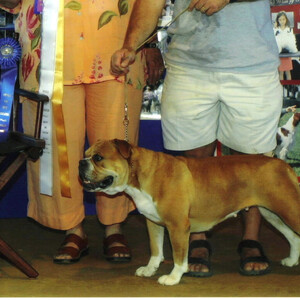
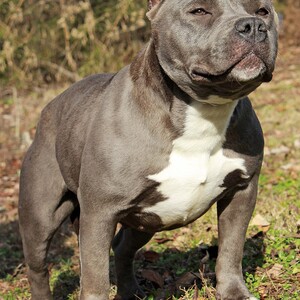
American Bully. · Rock City Kennels / Wikimedia Commons, CC BY 2.0. Cropped and resized.
The American Bully is a modern companion breed created in the United States from the American Pit Bull Terrier, with a compact, very muscular body, heavy bone and a massive head. According to Wikipedia, it was standardised in 2004 by the American Bully Kennel Club (ABKC) and recognised in 2013 by the United Kennel Club (UKC), but it is not recognised by the FCI, the AKC or the British Kennel Club. Its behaviour depends heavily on upbringing and training.
Quick facts
| Common name | American Bully |
| Scientific name | Canis lupus familiaris |
| Country of origin | United States |
| Official recognition | Not recognised by the FCI, AKC or Kennel Club; recognised by the ABKC (2004) and the UKC (2013) |
| Lifespan | No reliable data for the breed; Wikipedia says there is little health information |
| Size (males) | Standard 43–51 cm; Pocket 36–43 cm; XL 53–58 cm (Wikipedia) |
| Size (females) | Standard 41–48 cm; Pocket 33–41 cm; XL 48–56 cm (Wikipedia) |
| Coat type | Short and smooth |
| Common colours | Various |
| Energy level | Medium |
| Suited to an apartment? | Only with plenty of exercise and serious training |
| Temperament | Depends heavily on upbringing and training |
| Tendency to aggression | Can be dangerous if badly raised or trained |
| Good with children | Only with close supervision |
| Good with other animals | Variable |
| Genetic predispositions | Congenital ichthyosis, hip dysplasia (especially in the XL) |
- Primary category:Dog breeds
- Explore this animal's categories:
History and origin
According to Wikipedia, the American Pit Bull Terrier was the foundation breed of the American Bully. The shorter, bulkier lines that came out of these crosses led to a new companion breed, standardised in 2004 by the American Bully Kennel Club. The Classic variety shows its Pit Bull and American Staffordshire Terrier origins most clearly.
On 15 July 2013 the breed was recognised by the United Kennel Club. Wikipedia notes that, because of its size, strength and involvement in serious attacks, several countries restrict it by law; in the United Kingdom, the XL variety was banned under the Dangerous Dogs Act, after it was responsible for half of all deaths caused by dogs between 2021 and 2023.
How the breed developed
- 2004 – Standardised by the American Bully Kennel Club.
- 15 July 2013 – Recognised by the United Kennel Club.
- After 2023 – The XL variety is banned in the United Kingdom.
Breed rating
| Feature | Stars |
|---|---|
| Training and intelligence | ★★★☆☆ |
| Easy to train | ★★★★☆ |
| Intelligence | ★★☆☆☆ |
| Independence | ★★☆☆☆ |
| Stubbornness | ★★★☆☆ |
| Behaviour and temperament | ★★★☆☆ |
| Affectionate with family | ★★★☆☆ |
| Friendly with children | ★★☆☆☆ |
| Good with other dogs | ★★★★☆ |
| Good with cats and other animals | ★☆☆☆☆ |
| Loyalty | ★★★☆☆ |
| Tendency to be aggressive | ★★★☆☆ |
| Tendency to bark | ★★☆☆☆ |
| Needs and care | ★★★☆☆ |
| Shedding | ★★★☆☆ |
| Needs frequent grooming | ★★☆☆☆ |
| Activity and lifestyle | ★★☆☆☆ |
| Energy level | ★★★☆☆ |
| Daily exercise needs | ★★★☆☆ |
| Suited to apartment life | ★★★★☆ |
| Health and longevity | ★★★☆☆ |
| Life expectancy | ★★★☆☆ |
| Predisposition to genetic diseases | ★★★☆☆ |
| Working abilities and uses | ★★☆☆☆ |
| Good companion dog | ★★★☆☆ |
| Good companion dog | ★★★☆☆ |
Indicative rating: 5 stars means the highest level. The breed is not recognised by the FCI or the AKC; the rating is based on the ABKC/UKC standards described by Wikipedia and on the risks that have been reported.
Physical characteristics
According to Wikipedia, the standard describes a dog that gives “the impression of great strength for its size”: a compact, bulky, muscular body, heavy bone and a massive head. The ABKC recognises four varieties by height: Standard, Pocket, XL and Classic; the UKC recognises only one size.
General appearance
The coat is short and smooth. The “Micro” and “XXL” types, bred outside the standard, are not officially recognised.
| Feature | American Bully |
|---|---|
| Size | Medium (in four varieties) |
| Height at the withers | 33–58 cm, depending on the variety |
| Coat | Short, smooth |
| Body | Compact, very muscular |
| Head | Massive |
| Type | Bull-type companion dog |
The short coat comes in a variety of colours.
Training and socialisation
According to Wikipedia, breeders say temperament depends on upbringing and training; many dogs are very close to their family at home and do well in sports such as weight pulling. The standards discourage aggression towards people, but breeders acknowledge that these dogs can be very dangerous if they are badly raised or trained.
It needs an experienced owner, early socialisation and consistent, serious training from puppyhood.
Tips for effective training
- Check the law. The breed is restricted in some countries.
- Socialise it early. With people and with dogs.
- Be consistent and firm. It is very strong.
- Supervise children. Always.
Activity needs and lifestyle
It needs daily walks and activities that use its strength in a controlled way. According to Wikipedia, many do well in sports such as weight pulling and flirt pole.
| Activity | How often | Why it matters |
|---|---|---|
| Walks on the lead | daily | Fitness |
| Controlled play | daily | Energy |
| Training | several times a week | Discipline |
Tips for a balanced life
- Not suitable for beginners.
- Keep it out of great heat.
- Always keep it on the lead in public.
Care and health
Coat and skin care
Brush the short coat once a week with a grooming mitt or a soft brush. Check the skin folds and nails regularly.
Common health problems
According to Wikipedia, as it is a new breed, there is little health information. Known problems include:
| Condition | Description | Common symptoms |
|---|---|---|
| Congenital ichthyosis | A skin disease similar to the one seen in the American Bulldog | Scaly, dry skin |
| Hip dysplasia | The British Veterinary Association says mild dysplasia is part of the XL standard | Limping, stiffness |
Other care
- Keep it at the right weight.
- Avoid exertion in hot weather.
- Go for yearly check-ups.
Diet and nutrition
A muscular dog needs good-quality food, but not too much of it: extra kilos put strain on its joints.
Tips for a healthy diet
The table gives a starting estimate, calculated with the formula from the Merck Veterinary Manual. The first two calorie columns show the calories per day for a healthy adult dog. The last column shows what this means in dry food with 3,500–4,000 kcal per kilogram.
| Dog's weight | Calories per day (neutered) | Calories per day (not neutered) | Dry food per day (approximate) |
|---|---|---|---|
| 20 kg | 1,060 kcal | 1,190 kcal | 260–340 g |
| 30 kg | 1,440 kcal | 1,620 kcal | 360–460 g |
| 45 kg | 1,950 kcal | 2,190 kcal | 490–630 g |
- Split the food into two meals a day.
- Treats count towards the daily portion.
- A dog is at the right weight when you can feel its ribs without pressing hard.
Foods to avoid
Some human foods are dangerous for dogs: chocolate, coffee, grapes and raisins, onions, garlic, xylitol (a sweetener used in chewing gum), macadamia nuts and alcohol.
Reproduction and development
Physical and emotional maturity
In dogs, sexual maturity usually comes between 6 and 12 months. Most breeds become adults at around 13–15 months.
Mating and pregnancy
Pregnancy lasts about 63 days, counted from ovulation. Mating a female on her first heat is not recommended. Only healthy dogs of typical breed appearance should be used for breeding.
Caring for the puppies
In dogs, a litter has 5–6 puppies on average, and the number rises with the size of the breed. Socialisation starts in the first weeks: gentle handling, everyday noises and new people.
Interesting facts
- A very new breed. It was only standardised in 2004.
- Four varieties. Pocket, Standard, Classic and XL.
- From the Pit Bull. The American Pit Bull Terrier is its foundation breed.
- Not recognised by the FCI. Neither the AKC nor the Kennel Club recognises it either.
- Banned in the UK. The XL variety is banned in the United Kingdom.
Frequently asked questions
Is it recognised by the FCI?
No; only by the ABKC and the UKC.
What do XL and Pocket mean?
They are height varieties recognised by the ABKC.
Is it dangerous?
It can be, if it is badly raised or trained; it is restricted in some countries.
Is it good for beginners?
No; it needs an experienced owner.