Elephant sealMirounga — habitat, diet and reproduction
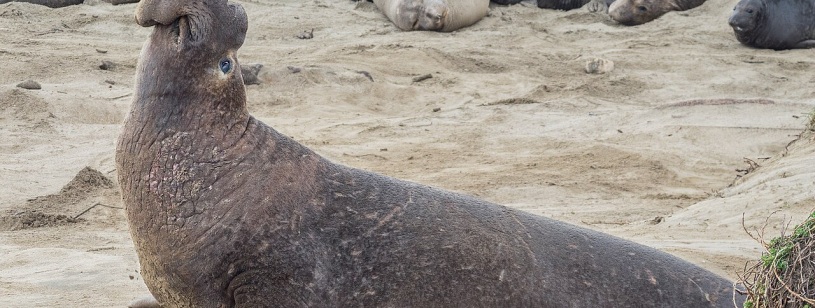
Male elephant seal (Mirounga) on a beach next to pups. · Rhododendrites / CC BY-SA 4.0 (https://creativecommons.org/licenses/by-sa/4.0). Cropped and resized.
Elephant seals are the largest seals in the world. Males can weigh about three tonnes and have an inflatable, trunk-like nose that gives them their name. They spend months at sea diving to enormous depths and come ashore only to breed and moult.
Quick facts
| Common name | Elephant seal |
| Scientific name | Mirounga (two species: northern and southern) |
| Lifespan | About 20 years |
| Length | Southern males up to about 5 m; females 2.5–3 m |
| Weight | Southern males usually about 3,000 kg; females about 400–900 kg |
| Diet | Carnivore: squid, fish, small sharks, rays |
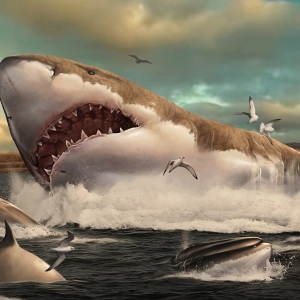
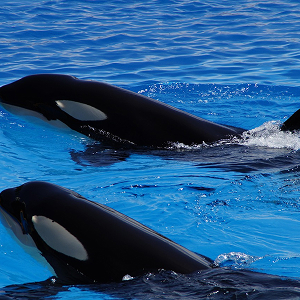
| Predators | Orcas and great white sharks |
| Conservation status | Least Concern (LC) |
| Distribution | North-east Pacific (northern species) and Southern Ocean (southern species) |
| Habitat | Open ocean; beaches and islands for breeding |
| Family | Phocidae |
| Diving | Deeper than 1,500 m |
- Primary category:Mammals
- Explore this animal's categories:
Interesting facts
- The southern elephant seal is the largest member of the order Carnivora.
- It can dive deeper than 1,500 m and stay underwater for almost two hours.
- Males do not eat at all while defending their beach, sometimes for three months.
- The northern species had fallen to a few dozen or hundred animals by the late nineteenth century.
Characteristics
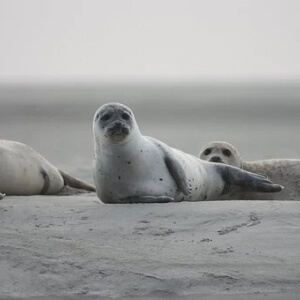
Elephant seals have a massive body covered by a thick layer of blubber. Their limbs are flippers, and on land they move clumsily, hauling themselves on their bellies.
Adult males are several times larger than females. They have a long nose that inflates when they roar and thickened neck skin that acts as a shield in fights. Females and young lack the trunk.
Behaviour
Elephant seals spend most of the year at sea alone, diving almost continuously day and night with only minutes at the surface between dives.
On breeding beaches, powerful males called beachmasters defend large groups of females. They fight violently, rearing up and slamming chests and teeth together.
Habitat and distribution
The northern elephant seal lives in the north-east Pacific and breeds on islands and beaches of California and Mexico. The southern elephant seal lives in the Southern Ocean, with large colonies on South Georgia, the Kerguelen Islands and Argentina’s Valdés Peninsula.
Diet and feeding
Elephant seals hunt in deep, dark water, eating mainly squid and fish, plus small sharks and rays.
They probably locate prey with sensitive whiskers and large eyes adapted to dim light. During their months at sea they rebuild the fat lost on land.
Reproduction and life cycle
Females arrive on the beach in winter and give birth to a single pup a few days later. The pup drinks very rich milk and triples or quadruples its weight in about a month.
Then the mother abandons it and returns to the ocean. The pup stays alone on the beach for several weeks, learns to swim in shallow water and then heads out to sea.
Name and history
The scientific name Mirounga comes from a name used by Aboriginal Australians for this seal. The common name comes from the male’s trunk-like nose.
In the nineteenth century, elephant seals were heavily hunted for blubber oil. The northern species was nearly exterminated and recovered after protection.
Conservation and threats
Both species are assessed as Least Concern. The northern elephant seal now numbers over 200,000, although all descend from the small group left after hunting, reducing genetic diversity.
Current threats include fishing nets, marine litter and ocean changes affecting their food.
Frequently asked questions
How much does an elephant seal weigh?
Southern elephant seal males usually weigh about 3 tonnes; females 400–900 kg.
Why is it called an elephant seal?
Because males have a large, inflatable nose resembling a short trunk.
How deep can it dive?
Deeper than 1,500 metres, and a dive can last almost two hours.
Where do elephant seals live?
The northern species in the north-east Pacific, the southern species in the Southern Ocean.