Minke whaleInteresting facts and information
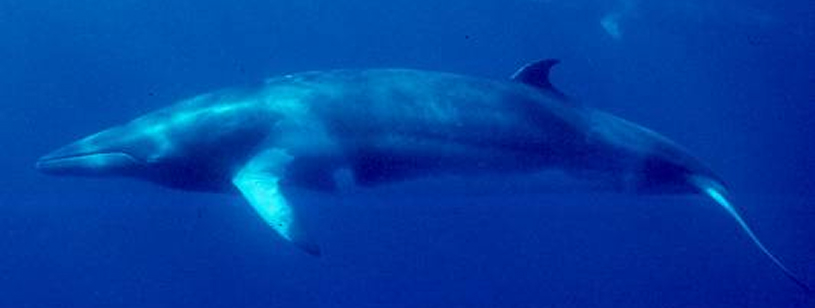
The common minke whale (Balaenoptera acutorostrata) is a relatively small baleen whale. It is a rorqual, related to blue and humpback whales, and can occur in coastal and offshore waters.
Common minke whales occur across many temperate, polar and tropical waters. Seasonal movements differ between populations; some migrate long distances and others are more resident.
Common minke whales face threats including entanglement, vessel strikes, ocean noise, climate change and whaling. The species is different from the Antarctic minke whale (Balaenoptera bonaerensis).
Quick facts
| Common name | Minke whale |
| Scientific name | Balaenoptera acutorostrata |
| Typical lifespan | Up to about 50 years |
| Length | About 7-10 metres (females are larger than males) |
| Weight | About 5-10 tonnes |
| Diet type | Carnivorous (krill, small fish, other small crustaceans) |
| Main predators | Killer whales; humans (whaling) |
| Conservation status | Least Concern (IUCN, 2018); the Antarctic minke whale is Near Threatened |
| Distribution | Oceans worldwide, especially temperate and polar waters |
| Living environment | Coastal and open ocean waters |
- Primary category:Mammals
- Explore this animal's categories:
Interesting facts
- Swimming – Minke whales can move quickly, but no “fastest baleen whale” record is claimed here.
- Curiosity – Some minke whales approach vessels, particularly stationary ones; this is not behaviour unique to the species.
- Vocalisations – Minke whales make several sounds, including calls known as “boings” in some populations.
- Whaling history – Smaller size initially made minke whales less attractive to whalers, but later commercial hunting affected some stocks.
- Diving – Dive length varies; common minke whales may remain submerged for several minutes.
Records and remarkable features
- The smallest rorqual - The minke whale is the smallest member of the rorqual family (Balaenopteridae), reaching only about a third of the length of a blue whale.
- Quick and agile - Minke whales can reach about 30 km/h or more in short bursts.
- The most hunted whale today - Minke whales are still hunted commercially by Norway, Japan and Iceland.
- One of the most widespread whales - They live in polar, temperate and tropical waters around the world.
Physical characteristics and adaptations
The common minke whale (Balaenoptera acutorostrata) is a small, slender baleen whale with a pointed head and a streamlined body built for speed.
Key physical adaptations
- A slim, streamlined body - Reduces drag and allows fast swimming.
- Distinctive colours - Dark grey to black on the back and white on the belly; in the Northern Hemisphere, each flipper has a bright white band.
- Short baleen - About 230-360 short, yellowish-white baleen plates on each side of the upper jaw filter food from the water.
- A pointed snout - Its narrow, triangular head gives it its scientific name, "sharp snout".
- A tall dorsal fin - Curved and set about two-thirds of the way along the back.
- Quick breathing - Minke whales often make short dives, but can stay underwater for up to about 20 minutes.
What does the minke whale look like?
| Characteristic | Details |
|---|---|
| Colour | Dark grey to black on the back, white on the belly |
| Length | About 7-10 m |
| Weight | About 5-10 tonnes |
| Baleen | About 230-360 short, yellowish-white plates on each side |
| Flippers | Narrow and pointed, often with a white band |
| Dorsal fin | Tall and curved, set far back on the body |
Habits and behaviour
Minke whales are usually seen alone or in pairs, although larger groups may gather in rich feeding areas.
Daily life
- Mostly alone - Minke whales usually travel alone or in twos and threes.
- Inquisitive - Some minke whales approach boats, especially when the boats are still.
- Seasonal movements - Some populations migrate between feeding areas in cold waters and breeding areas in warmer waters, while others stay in the same region.
- Inconspicuous - Their blow is small and hard to see, and they often surface briefly before diving again.
Specific behaviors
- Lunge feeding - They swim through shoals of fish or krill with their mouths wide open, then close their jaws and push the water out through the baleen.
- Approaching boats - In some places, such as the Great Barrier Reef, dwarf minke whales regularly come close to swimmers and boats.
- Breaching - Minke whales sometimes leap out of the water.
Survival strategies
- Predators – Killer whales prey on minke whales; speed and manoeuvrability can help with escape.
- Flexible feeding - They change their diet depending on what prey is available.
- Faster breeding - Minke whales can breed more often than larger whales, which helps their populations recover.
Habitat and geographic distribution
The common minke whale lives in all the world's oceans, especially in temperate and polar waters, but also in the tropics.
Distribution context
| Region | Population information | Habitat examples |
|---|---|---|
| North Atlantic | Common; one of the most numerous whales in the region | Waters off Norway, Iceland, Greenland, Scotland and Canada |
| North Pacific | Widespread; some populations depleted | Waters off Japan, Korea, Alaska and the west coast of North America |
| Southern Hemisphere | The dwarf minke whale, a form of the common minke | Waters off Australia, South Africa and South America |
| Southern Ocean | Home of the Antarctic minke whale, a separate species | Cold, krill-rich waters near the ice |
Habitat types
- Coastal waters - Minke whales often come close to shore, especially in summer.
- Open ocean - They also live far offshore.
- Rich feeding areas - They gather where currents bring together krill and shoals of small fish.
Environmental change
- Climate change - Changes in the distribution of fish and krill may affect where minke whales feed.
- Ship traffic - Minke whales are sometimes hit by ships.
- Whaling - Norway, Japan and Iceland still hunt minke whales.
- Noise - Underwater noise from ships, sonar and industry may disturb their feeding and communication.
Diet and feeding
The minke whale is an opportunistic feeder that eats krill, small fish and other small animals, depending on where it lives and the season.
What does the minke whale eat?
| Food group | Examples |
|---|---|
| Krill and zooplankton | Krill (Euphausia, Thysanoessa), copepods (Calanus finmarchicus) |
| Small fish | Herring, sand eels, capelin, mackerel, young cod |
| Other small animals | Amphipods and other small crustaceans |
Feeding methods
- Lunge feeding - The minke whale opens its mouth wide, takes in a large amount of water and prey, then pushes the water out through its baleen.
- Hunting fish - Minke whales are fast and agile and can chase shoals of fish.
- Using seabirds - In some places, minke whales feed under flocks of seabirds that are also attacking shoals of fish.
- Building reserves - In the feeding season, they eat a lot and build up blubber for leaner times.
Reproduction and life cycle
The minke whale breeds more often than larger whales, which helps keep its populations stable.
Breeding season
- Breeding usually takes place in winter, in warmer waters, but it has rarely been observed.
- Males make a variety of calls, which may help attract females.
- Little is known about their courtship.
Developmental stages
| Stage | Duration | Characteristics |
|---|---|---|
| Gestation | About 10 months | The female gives birth to a single calf |
| Newborn calf | About 2.4-2.8 m long | Weighs about 450 kg |
| Nursing | About 4-6 months | Grows quickly on fatty milk |
| Independence | After weaning | Calves start to feed themselves |
| Sexual maturity | About 6-8 years | Earlier than in larger whales |
Survival strategies
- Fatty milk helps calves grow fast in their first months.
- Mother and calf stay together for several months, which helps protect the calf from killer whales.
- Females can give birth every 1-2 years, faster than many larger whales.
Name and history
Origin of the name
- The name "minke" is said to come from a Norwegian whaler called Meincke, who mistook one of these small whales for a blue whale; other whalers began calling small whales "Meincke's whales" as a joke.
- The scientific name Balaenoptera acutorostrata means "winged whale with a sharp snout", referring to its pointed head.
Taxonomic classification
| Classification | Name |
|---|---|
| Kingdom | Animalia |
| Phylum | Chordata |
| Class | Mammalia |
| Order | Artiodactyla (cetaceans) |
| Family | Balaenopteridae |
| Genus | Balaenoptera |
| Species | Balaenoptera acutorostrata |
Evolution and fossils
- Minke whales belong to the rorqual family, together with blue whales, fin whales and humpbacks.
- Baleen whales evolved from toothed ancestors more than 30 million years ago.
- The common minke whale and the Antarctic minke whale are closely related but are now considered separate species.
Cultural significance and mythology
The minke whale has a long history with the coastal peoples of the North Atlantic and North Pacific and is today one of the most watched whales in the world.
- Whaling traditions - Minke whales have been hunted for centuries by coastal communities in Norway, Iceland, Greenland and Japan.
- Whale-watching - In places such as Scotland, Iceland and Canada, minke whales are among the whales most often seen on whale-watching trips.
- Swimming with whales - On the Great Barrier Reef, tourists can swim with curious dwarf minke whales under strict rules.
Conservation status and threats
The common minke whale is not threatened and remains one of the most numerous whales, but it still faces whaling, entanglement and other human pressures.
Main pressures
- Whaling - Norway, Japan and Iceland still hunt minke whales commercially.
- Ship strikes - Minke whales are sometimes hit by ships in busy waters.
- Noise - Sonar and industrial noise can disturb their behaviour.
- Climate change - Changes in their prey may force them to change where they feed.
- Entanglement - Minke whales often become tangled in fishing nets and ropes, which can kill them.
Current population
- There are probably several hundred thousand common minke whales in the world.
- The common minke whale is listed as Least Concern by the IUCN, while the Antarctic minke whale, a separate species, is listed as Near Threatened.
Protection efforts
| Measure | Organization / Action |
|---|---|
| Limits on whaling | International Whaling Commission moratorium on commercial whaling since 1986 (not followed by all countries) |
| Research and monitoring | Surveys and photo-identification by scientists and conservation groups |
| Marine protected areas | Protected areas in the Atlantic, Pacific and Southern Oceans |
| Safer seas | Rules to reduce ship strikes and entanglement in fishing gear |
Minke whale in popular culture
Although less famous than the blue whale or the humpback, the minke whale is popular with whale-watchers because of its curiosity.
Minke whale as symbol
- Curiosity - The minke whale is known as one of the most curious whales, often approaching boats.
- Whale conservation - Because it is still hunted, the minke whale is at the centre of international debates about whaling.