King Charles SpanielCharacteristics, history, training and care
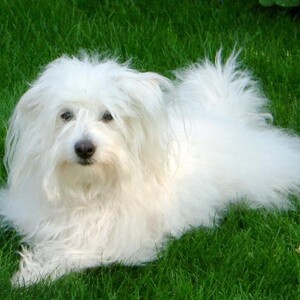
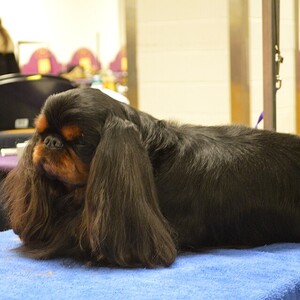
King Charles Spaniel. · Pets Adviser from Brooklyn, USA / Wikimedia Commons, CC BY 2.0. Cropped and resized.
The King Charles Spaniel is a small companion spaniel with a large, domed head, a short muzzle and a long, silky coat. It is a close relative of the Cavalier King Charles Spaniel and takes its name from King Charles II of England. The FCI standard describes it as happy, intelligent, reserved, gentle and affectionate.
Quick facts
| Common name | King Charles Spaniel (English Toy Spaniel) |
| Scientific name | Canis lupus familiaris |
| Country of origin | United Kingdom |
| Official recognition | FCI, definitively since 3 January 1955 (group 9, English toy spaniels; standard no. 128); the AKC recognises it as the English Toy Spaniel |
| Lifespan | 10–12 years, according to the AKC |
| Size (males) | about 23–25 cm at the withers, according to the AKC; 3.6–6.3 kg |
| Size (females) | about 23–25 cm at the withers, according to the AKC; 3.6–6.3 kg |
| Coat type | Long, silky, straight or slightly wavy |
| Common colours | Black and tan, tricolour, Blenheim (red and white), Ruby (red) |
| Energy level | Moderate |
| Suited to an apartment? | Yes |
| Temperament | Happy, intelligent, reserved, gentle, affectionate |
| Tendency to aggression | Very low |
| Good with children | Very good, according to the AKC |
| Good with other animals | Very good with other dogs, according to the AKC |
| Genetic predispositions | Eye disease, heart disease, luxating patella |
- Primary category:Dog breeds
- Explore this animal's categories:
History and origin
Wikipedia says the first small spaniels, probably originating in East Asia, appeared in Europe in the 16th century. They were linked to the English royal household from the time of Queen Mary I (1553–1558), and the name comes from King Charles II (1660–1685), who kept many small dogs.
In 1903 the Kennel Club united four breeds of small spaniels under a single name: Blenheim, Ruby, Prince Charles and King Charles; each contributed one of today's four colours. The FCI standard calls it an obvious relative of the Cavalier King Charles Spaniel.
How the breed developed
- 16th century – Small spaniels appear in Europe.
- 1553–1558 – They are linked to the court of Queen Mary I.
- 1660–1685 – King Charles II makes them famous.
- 1903 – Four breeds are united under the name King Charles Spaniel.
- 3 January 1955 – The FCI recognises the breed.
Breed rating
| Feature | Stars |
|---|---|
| Training and intelligence | ★★★☆☆ |
| Easy to train | ★★★☆☆ |
| Intelligence | ★★★★☆ |
| Independence | ★★☆☆☆ |
| Stubbornness | ★★★☆☆ |
| Behaviour and temperament | ★★★★★ |
| Affectionate with family | ★★★★★ |
| Friendly with children | ★★★★★ |
| Good with other dogs | ★★★★★ |
| Good with cats and other animals | ★★★★☆ |
| Loyalty | ★★★★★ |
| Tendency to be aggressive | ★☆☆☆☆ |
| Tendency to bark | ★★☆☆☆ |
| Needs and care | ★★★☆☆ |
| Shedding | ★★★☆☆ |
| Needs frequent grooming | ★★★☆☆ |
| Activity and lifestyle | ★★★☆☆ |
| Energy level | ★★★☆☆ |
| Daily exercise needs | ★★★☆☆ |
| Suited to apartment life | ★★★★★ |
| Health and longevity | ★★★★☆ |
| Life expectancy | ★★★★☆ |
| Predisposition to genetic diseases | ★★★☆☆ |
| Working abilities and uses | ★★★☆☆ |
| Good guard dog | ★★★☆☆ |
| Good companion dog | ★★★★★ |
Indicative rating: 5 stars means the highest level. It is based on the ratings the American Kennel Club gives the breed and on the FCI standard.
Physical characteristics
The AKC describes it as a small, square, snub-nosed dog weighing no more than 6.3 kg. The large, domed head, with long, profuse ears, dark eyes and full cheeks, is its best-known feature.
General appearance
The skull is large in relation to the body and well domed. The nose is black, short and turned up, and the muzzle is square, broad and deep. The coat is long, silky and straight, with profuse feathering on the legs, ears and tail.
| Feature | King Charles Spaniel |
|---|---|
| Size | Small |
| Height at the withers | about 23–25 cm (AKC) |
| Weight | 3.6–6.3 kg |
| Coat | Long, silky |
| Head | Large, domed |
| Nose | Short, turned up |
The AKC says there are four colour varieties, each with its own name: Blenheim (red and white), King Charles (black and tan), Prince Charles (white, black and tan) and Ruby (solid red).
Training and socialisation
The AKC says that “Charlie”, as it is also called, is calm, cheerful and devoted to its owners. It is forgiving and very clean. Although it is mainly a companion, it has kept some of the traits of its hunting ancestors.
It is intelligent but can be stubborn, so training requires patience and rewards.
Tips for effective training
- Use rewards. It can be stubborn.
- Be gentle. It is a sensitive dog.
- Walk it on the lead. The AKC recommends daily walks on the lead.
- Protect it from the heat. Its short muzzle makes it sensitive to high temperatures.
Activity needs and lifestyle
The AKC says it is moderately active: outdoors it is alert, playful and energetic, while at home it is calm and dignified. It is an excellent companion for city dwellers in small flats who can walk it on the lead every day.
| Activity | How often | Why it matters |
|---|---|---|
| Walks on the lead | daily | Exercise and socialisation |
| Indoor play | daily | Keeps it active |
| Trips to the park | several times a week | Exploring |
Tips for a balanced life
- It suits an apartment very well.
- In summer, avoid the hottest hours.
- Do not leave it alone for long.
Care and health
Coat and skin care
The AKC says the long, wavy, silky coat must be brushed at least twice a week with a pin brush or a soft bristle brush. A metal comb helps with knots that are starting to form.
Common health problems
The AKC says the breed is generally healthy, but breeders screen their dogs for:
| Condition | Description | Common symptoms |
|---|---|---|
| Eye disease | Hereditary eye conditions | Watery eyes, red eyes, poor vision |
| Heart disease | Heart conditions | Tires quickly, coughs, breathes with difficulty |
| Patellar luxation | The kneecap slips out of place | Suddenly holds a hind leg up for a few steps, then uses it again |
| Brachycephalic syndrome | The airways are narrowed by the short muzzle | Noisy breathing, tires quickly, copes poorly with heat |
Other care
- Clean the eyes and facial folds every day.
- Check the long ears every week.
- Brush its teeth often.
Diet and nutrition
The AKC recommends food suited to small breeds. Some dogs gain weight easily, so calories and weight must be watched.
Tips for a healthy diet
The table gives a starting estimate, calculated with the formula from the Merck Veterinary Manual. The first two calorie columns show the calories per day for a healthy adult dog. The last column shows what this means in dry food with 3,500–4,000 kcal per kilogram.
| Dog's weight | Calories per day (neutered) | Calories per day (not neutered) | Dry food per day (approximate) |
|---|---|---|---|
| 3.6 kg | 290 kcal | 330 kcal | 72–94 g |
| 5 kg | 370 kcal | 420 kcal | 92–120 g |
| 6.3 kg | 450 kcal | 500 kcal | 110–140 g |
- Give its food in two small meals a day.
- Treats count towards the daily portion.
- Choose small kibble suited to small breeds.
Foods to avoid
Some human foods are dangerous for dogs: chocolate, coffee, grapes and raisins, onions, garlic, xylitol (a sweetener used in chewing gum), macadamia nuts and alcohol.
Reproduction and development
Physical and emotional maturity
In dogs, sexual maturity usually comes between 6 and 12 months. Small breeds become adults faster than large ones, usually at around one year.
Mating and pregnancy
Pregnancy lasts about 63 days, counted from ovulation. Mating a female on her first heat is not recommended. The FCI standard requires that only healthy dogs of typical breed appearance are used for breeding.
Caring for the puppies
In small breeds, a litter has 3–4 puppies on average. The puppies are very small and fragile in the first weeks, so they must be kept warm and handled with care. Socialisation starts early: gentle handling, everyday noises and new people.
Interesting facts
- Four colours, four names. Blenheim, King Charles, Prince Charles and Ruby.
- Named after a king. The name comes from King Charles II of England.
- A relative of the Cavalier. The standard calls it an obvious relative of the Cavalier King Charles Spaniel.
- A little hunter. The AKC says the breed would make a good small hunting spaniel.
- “Charlie”. That is what it is sometimes called, according to the AKC.
Frequently asked questions
How does it differ from the Cavalier King Charles?
The King Charles is smaller, with a domed head and a shorter muzzle; they are related but separate breeds.
How much does it weigh?
The FCI standard gives 3.6–6.3 kg.
Is it suited to an apartment?
Yes, the AKC recommends it for small flats.
How long does it live?
The AKC gives 10–12 years.