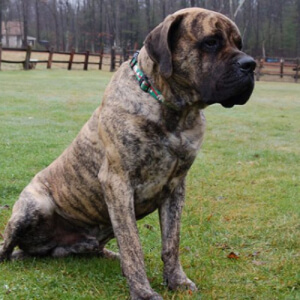
American MastiffCharacteristics, history, training and care
The American Mastiff is a giant molosser-type dog created in the USA by Fredericka Wagner at the Flying W Farms kennel. It comes from crossing an English Mastiff with an Anatolian Shepherd Dog. It is a young breed, recognised only by the American Continental Kennel Club, since 2000.
Quick facts
| Common name | American Mastiff |
| Scientific name | Canis lupus familiaris |
| Country of origin | United States |
| Official recognition | Continental Kennel Club (USA), since 2000; not recognised by the FCI or the AKC |
| Lifespan | No published data for the breed; very large breeds usually live shorter lives than small ones |
| Size (males) | 81–91 cm at the withers; 73–91 kg |
| Size (females) | 71–86 cm at the withers; 64–82 kg |
| Coat type | Short, like the English Mastiff's |
| Common colours | No published data; it resembles the English Mastiff |
| Energy level | Low to medium |
| Suited to an apartment? | Yes, with a daily walk (Spanish Wikipedia) |
| Temperament | Calm, devoted to its family, protective |
| Tendency to aggression | Low; protective if the family is threatened |
| Good with children | Good, under supervision, because of its size |
| Good with other animals | No published data |
| Genetic predispositions | No specific diseases known; as with giant breeds, dysplasia and bloat |
- Primary category:Dog breeds
- Explore this animal's categories:
History and origin
The Spanish Wikipedia says the breed was created by Fredericka Wagner at the Flying W Farms kennel in the USA. She crossed an English Mastiff with an Anatolian Shepherd Dog. The aim, according to older descriptions of the breed, was a dog like the English Mastiff but one that drools less.
In 2000, the Continental Kennel Club recognised it as a purebred breed. Some critics regard it as merely a variety of the English Mastiff or a cross.
How the breed developed
- Beginnings – Fredericka Wagner creates the breed at Flying W Farms.
- 2000 – Recognition by the Continental Kennel Club.
- Today – A rare, young breed with few breeders.
Breed rating
| Feature | Stars |
|---|---|
| Training and intelligence | ★★★☆☆ |
| Easy to train | ★★★☆☆ |
| Intelligence | ★★★☆☆ |
| Independence | ★★★☆☆ |
| Stubbornness | ★★★☆☆ |
| Behaviour and temperament | ★★★☆☆ |
| Affectionate with family | ★★★★★ |
| Friendly with children | ★★★★☆ |
| Good with other dogs | ★★★☆☆ |
| Good with cats and other animals | ★★★☆☆ |
| Loyalty | ★★★★★ |
| Tendency to be aggressive | ★★☆☆☆ |
| Tendency to bark | ★★☆☆☆ |
| Needs and care | ★★☆☆☆ |
| Shedding | ★★★☆☆ |
| Needs frequent grooming | ★☆☆☆☆ |
| Activity and lifestyle | ★★☆☆☆ |
| Energy level | ★★☆☆☆ |
| Daily exercise needs | ★★☆☆☆ |
| Suited to apartment life | ★★★☆☆ |
| Health and longevity | ★★★☆☆ |
| Life expectancy | ★★☆☆☆ |
| Predisposition to genetic diseases | ★★★☆☆ |
| Working abilities and uses | ★★★★☆ |
| Good guard dog | ★★★★☆ |
| Good companion dog | ★★★★☆ |
Indicative rating: 5 stars means the highest level. The breed has no FCI standard and no AKC profile, and sources are scarce; the rating is only indicative and is based on the published descriptions of the breed.
Physical characteristics
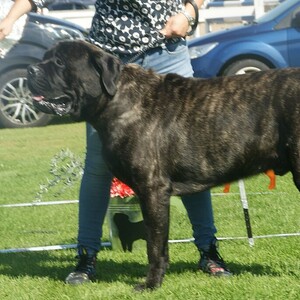
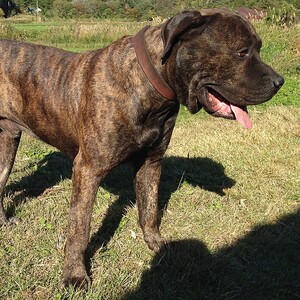
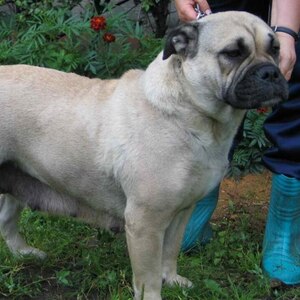
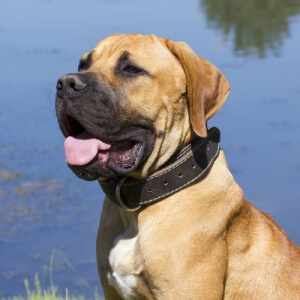
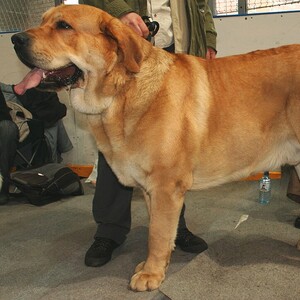
It is a giant molosser-type dog, that is, a massive dog with a large head and a short muzzle. It looks very much like the English Mastiff. Females measure 71–86 cm at the withers and males 81–91 cm.
General appearance
Females weigh 64–82 kg and males 73–91 kg. At this size, the dog needs space in the house and in the car. An adult can pull hard on the lead, so teaching it to walk to heel is very important.
| Feature | American Mastiff |
|---|---|
| Size | Giant |
| Height at the withers | males: 81–91 cm; females: 71–86 cm |
| Weight | males: 73–91 kg; females: 64–82 kg |
| Type | Molosser |
| Coat | Short, like the English Mastiff's |
Training and socialisation
Older descriptions of the breed present it as gentle with children, devoted to its family and calm, generally not aggressive unless the family is threatened. A dog this big must still be trained from an early age, while it can still be controlled easily.
Use rewards and clear rules. Socialisation with new people, dogs and places helps it stay calm as an adult.
Tips for effective training
- Start in puppyhood. It grows a great deal in a year.
- Teach it to walk on the lead. An adult weighs as much as a person.
- Use rewards. It responds well to gentleness.
- Socialise it early. It will stay calm with new people.
Activity needs and lifestyle
The Spanish Wikipedia says it copes well in a flat if it gets a walk or a short run every day. A small yard is also enough for it. Giant-breed puppies must not be overworked: no jumping and no long runs until they have finished growing.
| Activity | How often | Why it matters |
|---|---|---|
| Walk | daily | Keeps it fit |
| Short run | daily, for adults | Uses up energy |
| Obedience exercises | daily, a few minutes | Keeps it under control |
Tips for a balanced life
- Enough space in the house.
- Moderate exercise for puppies.
- A car big enough to carry it.
Care and health
Coat and skin care
The short coat should be brushed once a week with a rubber brush. Bathe it rarely, only when it gets dirty.
Common health problems
There are no published health studies on the breed. As with any giant dog, it is worth watching for:
| Condition | Description | Common symptoms |
|---|---|---|
| Hip dysplasia | The hip joint forms incorrectly and, over time, arthritis develops | Limping, difficulty getting up or jumping, hip pain |
| Elbow dysplasia | The elbow joint develops incorrectly and arthritis appears | Limping on the front legs, especially after exercise |
| Gastric dilatation-volvulus (bloat) | The stomach fills with gas and may twist; this is a veterinary emergency | Swollen belly, trying to vomit without success, drooling, restlessness |
Other care
- Ask to see the parents' hip and elbow tests.
- Do not let it run after a meal.
- Go for yearly check-ups.
Diet and nutrition
A giant dog eats a lot, but needs fewer calories per kilogram than a small dog. Excess weight puts a lot of strain on its joints.
Tips for a healthy diet
The table gives a starting estimate, calculated with the formula from the Merck Veterinary Manual. The first two calorie columns show the calories per day for a healthy adult dog. The last column shows what this means in dry food with 3,500–4,000 kcal per kilogram.
| Dog's weight | Calories per day (neutered) | Calories per day (not neutered) | Dry food per day (approximate) |
|---|---|---|---|
| 64 kg | 2,530 kcal | 2,850 kcal | 630–810 g |
| 77 kg | 2,910 kcal | 3,280 kcal | 730–940 g |
| 91 kg | 3,300 kcal | 3,710 kcal | 820–1060 g |
- Split its food into two or three meals a day.
- Puppies need special food for giant breeds.
- A dog is at the right weight when you can feel its ribs under the coat without pressing hard.
Foods to avoid
Some human foods are dangerous for dogs: chocolate, coffee, grapes and raisins, onions, garlic, xylitol (a sweetener used in chewing gum), macadamia nuts and alcohol.
Reproduction and development
Physical and emotional maturity
In dogs, sexual maturity usually comes between 6 and 12 months, but in large breeds it can be delayed until about two years. Very large breeds become adults only at around 2 years.
Mating and pregnancy
Pregnancy lasts about 63 days, counted from ovulation. Mating a female on her first heat is not recommended. Only healthy dogs of typical breed appearance should be used for breeding.
Caring for the puppies
In large breeds, a litter has around 7 puppies on average. The puppies grow very fast, so they need growth food suited to large breeds. Socialisation starts in the first weeks.
Interesting facts
- Two parent breeds. The English Mastiff and the Anatolian Shepherd Dog.
- A young breed. Recognised in 2000 by the Continental Kennel Club.
- Up to 91 kg. As much as a large adult man.
- Less drool. That was the aim of the cross.
- Created by one breeder. Fredericka Wagner, of Flying W Farms.
Frequently asked questions
Is it the same dog as the English Mastiff?
No; it comes from the English Mastiff crossed with the Anatolian Shepherd Dog.
How big does it get?
Males measure 81–91 cm and weigh 73–91 kg.
Can it live in a flat?
Yes, if it gets a daily walk, but it needs space.
Is it recognised by the FCI?
No; only by the Continental Kennel Club, in the USA.