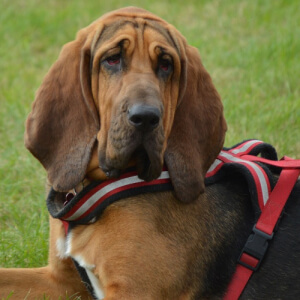
BloodhoundCharacteristics, history, training and care
The Bloodhound is a large scent hound known for following human scent trails. Its long ears and loose skin are distinctive features. It is also kept as a companion and needs exercise, training and routine care.
Quick facts
| Common name | Bloodhound |
| Scientific name | Canis lupus familiaris |
| Country of origin | Belgium, France, England |
| Official Recognition | Recognised by the American Kennel Club; the FCI calls it the Chien de Saint-Hubert |
| Typical lifespan | About 10-12 years |
| Dimensions (Male) | About 64-72 cm / 41-50 kg |
| Dimensions (Female) | About 58-66 cm / 36-45 kg |
| Coat type | Short, dense, weather-resistant |
| Common colours | Black and tan, liver and tan, red |
| Energy Level | Moderate to high |
| Suitable for an apartment? | Depends on exercise, training, health and the individual dog |
| Temperament | Gentle, independent, persevering |
| Behaviour towards unfamiliar people and dogs | Individual behaviour varies; socialisation, training and management matter |
| Compatibility with children | Depends on the individual; adult supervision and suitable handling are essential |
| Compatibility with other animals | Depends on socialisation, prey drive and the animals involved |
| Health considerations | Hip and elbow dysplasia, ear and eyelid problems, bloat |
- Primary category:Dog breeds
- Explore this animal's categories:
History and Origin
The Bloodhound is an old breed from the Middle Ages, linked with hounds bred by monks in the Ardennes and used to track game.
Evolution of the breed
- Medieval origins - The breed is linked with the St. Hubert hounds bred at the Abbey of Saint-Hubert in the Ardennes (today's Belgium); the FCI still calls it the "Chien de Saint-Hubert".
- Developed in England - Hounds of this type were taken to England, where the Bloodhound was further developed as a hunting and tracking dog.
- Tracking people - Thanks to its ability to follow old scent trails, it became one of the first dogs used by police and search teams.
- Recognition - The American Kennel Club (AKC) recognised the Bloodhound in 1885.
Breed Evaluation
The Bloodhound is a clever, gentle and very perceptive dog, excellent for tracking, search and rescue and as a companion. These are general editorial ratings, not measured scores; individual dogs vary.
| Characteristic | Stars |
|---|---|
| Training and Intelligence | ★★★★☆ |
| Easy to train | ★★★☆☆ |
| Intelligence | ★★★★★ |
| Level of independence | ★★★★☆ |
| Level of stubbornness | ★★★★☆ |
| Behavior and Temperament | ★★★★★ |
| Affectionate with family | ★★★★★ |
| Friendly with children | ★★★★★ |
| Compatible with other dogs | ★★★★★ |
| Compatible with cats and other animals | ★★★★☆ |
| Degree of loyalty | ★★★★★ |
| Tendency to be aggressive | ★☆☆☆☆ |
| Tendency to bark | ★★★★☆ |
| Needs and Care | ★★★☆☆ |
| Shedding level | ★★★☆☆ |
| Requires frequent care | ★★★☆☆ |
| Activity and Lifestyle | ★★★★☆ |
| Energy level | ★★★★☆ |
| Daily exercise requirement | ★★★★★ |
| Suitable for apartment living | ★☆☆☆☆ |
| Health and Longevity | ★★★☆☆ |
| Life expectancy | ★★★☆☆ |
| Predisposition to genetic diseases | ★★★★☆ |
| Work and Utility Features | ★★★★★ |
| It's a good dog tracking | ★★★★★ |
| He's a good family dog. | ★★★★☆ |
Physical Characteristics
The Bloodhound is a large, strong hound, built to follow trails over long distances and difficult ground.
General appearance
- A long, muscular body, built for stamina.
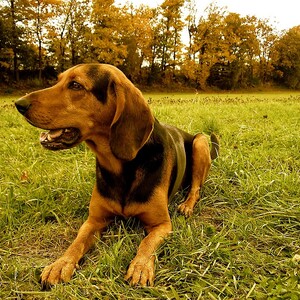
- A short, dense coat that protects it in bad weather.
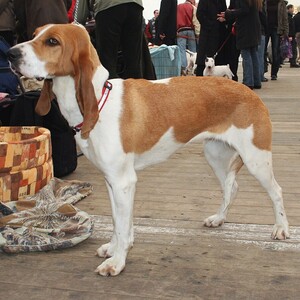
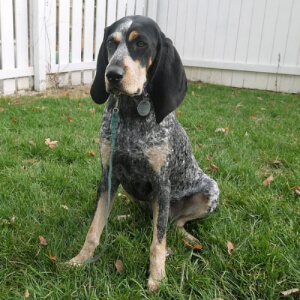
- A long, narrow head with very long, thin ears that hang in folds.
- Deep-set eyes with a gentle, serious and slightly sad expression.
- Loose skin that forms deep wrinkles on the head and neck.
| Characteristic | Bloodhound |
|---|---|
| Size | Large (about 58-72 cm at the shoulder) |
| Weight | About 36-50 kg |
| Coat | Short, dense and tough |
| Muzzle | Long and deep |
| Shedding tendency | Moderate |
| Build | Strong, heavy-boned |
The Bloodhound is a powerful, impressive dog with an exceptional nose.
Training and Socialization
The Bloodhound is intelligent but independent, which can make training a challenge. It is willing to learn, but becomes stubborn when it finds an interesting scent.
Tips for effective training
- Early socialisation - The Bloodhound should meet people, animals and different places from an early age.
- Patience and consistency - As an independent breed, it responds best to calm, structured and repeated training.
- Rewards are essential - It responds best to treats and praise.
- Managing the nose - It may ignore commands when it finds an interesting smell, so it should learn to come when called from an early age.
- Lead training - It should be kept on a lead or in secure areas, as it may follow a scent for long distances without noticing danger, such as roads.
The Bloodhound is not a dog for beginners, but with patient, fair training it becomes a loyal, balanced companion.
Activity and Lifestyle Needs
The Bloodhound is a working dog that needs daily exercise and mental stimulation, especially scent work.
| Activity | Recommended duration |
|---|---|
| Long walks | About 60-90 min |
| Tracking (mantrailing) training | About 30 min, several times a week |
| Interactive games | About 20-30 min |
| Obedience exercises | About 10-15 min/day |
Recommendations for a balanced lifestyle
- Best in a house with a large garden - It is not ideal for apartments, as it needs space to move and explore.
- Needs regular activity - Long walks and tracking games are essential.
- Weather - Its short, dense coat protects it from moderate cold, but it should be protected from extreme temperatures, especially heat.
- Can become destructive if bored - Without enough activity, it may dig or chew things.
- Drool - Bloodhounds drool a lot, so owners should keep a towel handy.
The Bloodhound is an active, curious dog that suits people who can give it plenty of activity and mental stimulation.
Care and Health
The Bloodhound is a sturdy breed, but its size, deep chest and loose skin make it prone to some health problems.
Fur and skin care
- Weekly brushing - Its short coat needs little care, but brushing removes dead hair.
- Cleaning facial wrinkles - The folds on the face should be cleaned and dried to prevent irritation and infections.
- Ear checks - The long ears are prone to infections and should be cleaned weekly.
- Baths when needed - It should be washed only when dirty, so as not to remove the skin's natural oils.
Common health problems
| Condition | Description | Common symptoms |
|---|---|---|
| Hip and elbow dysplasia | Abnormal development of the joints, common in large dogs | Limping, stiff joints |
| Ear infections and eyelid problems | Long ears trap moisture; drooping eyelids can turn in or out (entropion, ectropion) | Scratching, discharge, red or watery eyes |
| Bloat (gastric torsion) | Very common in the breed because of its deep chest; an emergency | Swollen belly, restlessness, difficulty breathing |
Other aspects of care
- Regular veterinary checks - Important for monitoring the joints, skin, eyes and ears.
- Meal planning should suit the individual dog. Feeding arrangements do not guarantee prevention of gastric dilatation and volvulus; discuss risk with a veterinarian.
- Weight control - Extra weight can make joint problems worse.
The Bloodhound needs regular care of its ears, skin and digestion, and owners should know the signs of bloat.
Diet and Nutrition
The Bloodhound needs a balanced diet with good-quality protein and controlled calories to avoid obesity.
Recommendations for a healthy diet
Choose a complete, balanced diet suited to age, size and health. Plan home-prepared diets and supplements with a qualified veterinarian; raw pet food can carry harmful bacteria.
| Food type | Daily Amount (Adults) | Frequency |
|---|---|---|
| Premium dry food | Individual amount; follow a complete diet’s guidance and veterinary advice | 2 meals/day |
| Home cooked food | Individual amount; follow a complete diet’s guidance and veterinary advice | 2 meals/day |
| Raw food: bacterial contamination is a concern | Individual amount; follow complete-food guidance and veterinary advice | 2 meals/day |
Forbidden foods
Chocolate, grapes and raisins, onions and xylitol - toxic to dogs. / Cooked bones - can splinter and cause intestinal blockage. / Fatty and processed foods - can cause digestive problems. / Large meals and hard exercise right after eating - increase the risk of bloat.
The Bloodhound should be fed according to its activity, avoiding overfeeding and digestive problems.
Reproduction and Development
Breeding requires veterinary planning, suitable health screening and care for the mother and puppies. Pregnancy and birth can involve complications.
Physical and emotional maturity
- Physical maturity: It grows quickly in the first year, but is not fully mature until about 2-3 years.
- Emotional maturity: Although friendly and sociable, it can stay playful and stubborn until about 2-3 years.
Mating and Gestation
- Breeding decisions require veterinary assessment of maturity, health and suitable screening; reaching a fixed age does not establish that breeding is appropriate.
- Duration of gestation: Approximately 58-68 days, usually about 63 days.
- Average number of puppies: Usually about 6-10 puppies.
Puppy care
- The first 3 weeks: Puppies depend completely on their mother for warmth and milk.
- Between 4-8 weeks: They begin to explore and play with littermates and people; early socialisation helps prevent shyness.
- Moving to a new home: When puppies go to their new homes, basic training and socialisation should continue.
The Bloodhound matures slowly, and good food and a stimulating environment are essential for healthy growth.
Curiosities and Interesting Facts
- A canine detective - In the past, trails followed by Bloodhounds have been accepted as evidence in some American courts.
- Old trails - Bloodhounds can follow trails that are several days old.
- An amazing nose - It has one of the best senses of smell of any dog, with hundreds of millions of scent receptors.
- The name - "Blood" probably refers to its pure, carefully kept bloodlines, or to its use in following the blood trail of wounded game.
- A famous tracker - In the early 1900s, a Kentucky Bloodhound named Nick Carter was credited with helping to catch hundreds of criminals.
- Gentle - Despite its serious look, the Bloodhound is usually gentle, affectionate and very attached to its family.
- Long-distance tracking - It can follow a trail for many kilometres.
The Dog in Popular Culture
With its droopy face and famous nose, the Bloodhound is one of the best-known hounds in films and cartoons.
Bloodhound in Media and History
- "Lady and the Tramp" (1955) - Trusty, the old dog who has lost his sense of smell, is a Bloodhound.
- "The Beverly Hillbillies" - Duke, the family dog in this American TV series, was a Bloodhound.
- Search and rescue - In the USA and Europe, Bloodhounds are used to find missing people and to track wounded game.
Importance in modern culture
- Mantrailing - The Bloodhound is one of the best dogs for mantrailing, a sport and working discipline in which dogs follow a person's scent.