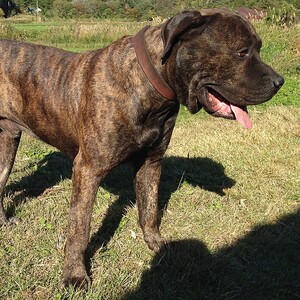
BoerboelCharacteristics, history, training and care
The Boerboel is a large South African mastiff-type dog with a history of farm guarding. Responsible breeding, early socialisation, consistent training and careful management matter; size and breed alone do not predict an individual’s behaviour.
Quick facts
| Common name | Boerboel |
| Scientific name | Canis lupus familiaris |
| Country of origin | South Africa |
| Official Recognition | Recognised by AKC in 2015 |
| Typical lifespan | About 9-11 years |
| Dimensions (Male) | About 64-70 cm / 65-90 kg |
| Dimensions (Female) | About 59-65 cm / 50-75 kg |
| Coat type | Short, dense, glossy |
| Common colours | Fawn, red, brown, brindle, often with a black mask |
| Energy Level | Moderate |
| Suitable for an apartment? | Depends on exercise, training, health and the individual dog |
| Temperament | Protective, intelligent, affectionate with family |
| Behaviour towards unfamiliar people and dogs | Individual behaviour varies; socialisation, training and management matter |
| Compatibility with children | Depends on the individual; adult supervision and suitable handling are essential |
| Compatibility with other animals | Depends on socialisation, prey drive and the animals involved |
| Health considerations | Hip and elbow dysplasia, bloat, heart problems |
- Primary category:Dog breeds
- Explore this animal's categories:
History and Origin
The Boerboel is a South African mastiff-type breed, developed by farmers to guard their farms against predators and intruders.
Evolution of the breed
- Origins from the 17th century - It descends from large dogs brought to southern Africa by Dutch, German and French Huguenot settlers; Jan van Riebeeck, founder of Cape Town, is said to have brought a "bullenbijter" in 1652.
- Bred for work - Farmers kept the strongest, bravest and toughest dogs to protect farms from leopards, hyenas and other dangers.
- European influences - Mastiffs and Bullmastiffs brought later also contributed to its large, powerful build.
- Recognition - Breeders began organising and recording the breed in the 1980s, and in 2015 the American Kennel Club recognised the Boerboel in its Working Group.
Breed Evaluation
The Boerboel is a strong, loyal and protective dog, suited only to people with experience of large, powerful guardian dogs. These are general editorial ratings, not measured scores; individual dogs vary.
| Characteristic | Stars |
|---|---|
| Training and Intelligence | ★★★★☆ |
| Easy to train | ★★★★☆ |
| Intelligence | ★★★★★ |
| Level of independence | ★★★★☆ |
| Level of stubbornness | ★★★★☆ |
| Behavior and Temperament | ★★★★☆ |
| Affectionate with family | ★★★★★ |
| Friendly with children | ★★★★★ |
| Compatible with other dogs | ★★★☆☆ |
| Compatible with cats and other animals | ★★☆☆☆ |
| Degree of loyalty | ★★★★★ |
| Tendency to be aggressive | ★★★★☆ |
| Tendency to bark | ★★★☆☆ |
| Needs and Care | ★★★☆☆ |
| Shedding level | ★★★☆☆ |
| Requires frequent care | ★★☆☆☆ |
| Activity and Lifestyle | ★★★★☆ |
| Energy level | ★★★★☆ |
| Daily exercise requirement | ★★★★☆ |
| Suitable for apartment living | ★☆☆☆☆ |
| Health and Longevity | ★★★☆☆ |
| Life expectancy | ★★★☆☆ |
| Predisposition to genetic diseases | ★★★★☆ |
| Work and Utility Features | ★★★★★ |
| Good guard dog | ★★★★★ |
| Good companion dog | ★★★★☆ |
Physical Characteristics
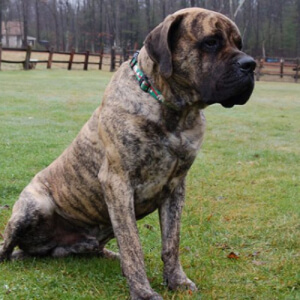
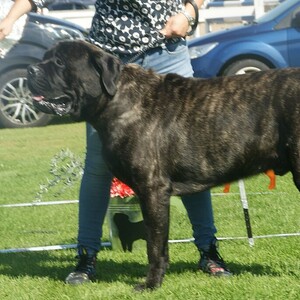
The Boerboel is an impressive dog with a large frame and strong muscles, built for strength and stamina.
General appearance
- A muscular, well-proportioned body with a confident posture.
- A short, dense, shiny coat.
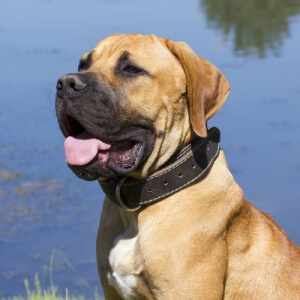
- A large, broad, square head with a powerful muzzle, often with a black mask.
- Brown eyes, in a shade that matches the coat, with an alert expression.
- Strong jaws - Bite strength depends on the individual and measurement.
| Characteristic | Boerboel |
|---|---|
| Size | Large (about 59-70 cm at the shoulder) |
| Weight | About 50-90 kg |
| Coat | Short, dense, shiny |
| Muzzle | Broad and strong |
| Shedding tendency | Moderate |
| Build | Heavy and solid, but agile |
The Boerboel is a muscular, imposing dog that combines strength with surprising agility.
Training and Socialization
The Boerboel is intelligent and loyal, but also strong-willed and protective, so early training and socialisation are essential.
Tips for effective training
- Early socialisation - As a guardian, it must meet people, other animals and different situations from an early age to avoid over-protective or territorial behaviour.
- Firm but positive training - It responds to clear, consistent commands, but should be trained with rewards and respect, not harsh corrections.
- Steady obedience training - Commands such as "wait", "come", "leave it" and "go to your place" are essential for managing such a strong dog.
- Accepting visitors - It can become over-protective, so it should learn to accept visitors and other animals calmly.
- Lead training - Because of its great strength, it must learn early not to pull on the lead.
The Boerboel is not recommended for beginners, but with good training and socialisation it can be an excellent guardian and a devoted companion.
Activity and Lifestyle Needs
The Boerboel is a powerful dog that needs regular exercise and mental stimulation to prevent boredom.
| Activity | Recommended duration |
|---|---|
| Daily walks | About 45-60 min |
| Obedience training | About 15-20 min |
| Interactive games | About 20-30 min |
| Mental exercises (scent games, tricks) | Several times a week |
Recommendations for a balanced lifestyle
- Not suited to apartment life - The Boerboel needs a large, securely fenced garden.
- Needs regular exercise - Even though it is calm indoors, it needs daily activity.
- Likes a job - As a natural guardian, it is happiest when it feels it has a role in the family.
- Needs a confident owner - It respects calm, consistent leadership; without clear rules it may become territorial.
- Supervision with strangers - Even when well socialised, its protective instincts mean it should be supervised around new people.
The Boerboel does best in a home with clear rules and daily exercise.
Care and Health
The Boerboel is a sturdy breed, but its joints, heart and digestion need careful monitoring.
Fur and skin care
- Weekly brushing - The short coat needs little care, but brushing removes dead hair and spreads the skin's natural oils.
- Occasional baths - Baths are needed only when necessary.
- Skin folds - Some dogs have looser skin on the face, which should be kept clean to prevent infections.
Common health problems
| Condition | Description | Common symptoms |
|---|---|---|
| Hip and elbow dysplasia | Common joint problems in large dogs | Limping, stiff joints |
| Bloat (gastric torsion) | Higher risk in large, deep-chested dogs | Swollen belly, difficulty breathing |
| Heart problems | Such as dilated cardiomyopathy | Tiredness, weakness, difficulty breathing |
Other aspects of care
- Regular veterinary checks - Essential for monitoring the joints and heart.
- Meal planning should suit the individual dog. Feeding arrangements do not guarantee prevention of gastric dilatation and volvulus; discuss risk with a veterinarian.
- Weight control - The Boerboel should be kept lean to avoid strain on its joints.
The Boerboel is generally healthy, but it should be monitored for the joint and digestive problems common in large dogs.
Diet and Nutrition
The Boerboel needs a balanced diet with good-quality protein and controlled calories to maintain its muscles and avoid obesity.
Recommendations for a healthy diet
Choose a complete, balanced diet suited to age, size and health. Plan home-prepared diets and supplements with a qualified veterinarian; raw pet food can carry harmful bacteria.
| Food type | Daily Amount (Adults) | Frequency |
|---|---|---|
| Premium dry food | Individual amount; follow complete-food guidance and veterinary advice | 2 meals/day |
| Home cooked food | Individual amount; follow complete-food guidance and veterinary advice | 2 meals/day |
| Raw food: bacterial contamination is a concern | Individual amount; follow complete-food guidance and veterinary advice | 2 meals/day |
Forbidden foods
Chocolate, grapes and raisins, onions and xylitol - toxic to dogs. / Cooked bones - can splinter and cause intestinal blockage. / Fatty and processed foods - can cause digestive problems. / Large meals and hard exercise right after eating - increase the risk of bloat.
The Boerboel should be fed according to its activity, with food for large-breed puppies while growing, avoiding overfeeding.
Reproduction and Development
Breeding requires veterinary planning, suitable health screening and care for the mother and puppies. Pregnancy and birth can involve complications.
Physical and emotional maturity
- Physical maturity: The Boerboel grows fast in its first year, but is not fully mature until about 2-3 years.
- Emotional maturity: It matures slowly in behaviour and may stay playful and puppy-like until about 2 years.
Mating and Gestation
- Breeding decisions require veterinary assessment of maturity, health and suitable screening; reaching a fixed age does not establish that breeding is appropriate.
- Duration of gestation: Approximately 58-68 days, usually about 63 days.
- Average number of puppies: Usually about 6-10 puppies.
Puppy care
- The first 3 weeks: Puppies depend completely on their mother for warmth and milk.
- Between 4-8 weeks: They begin to play and explore, and contact with people is essential for a balanced temperament.
- Moving to a new home: When puppies go to their new homes, training and socialisation should start right away.
The Boerboel matures slowly, and good food and early socialisation are essential for a balanced, healthy dog.
Curiosities and Interesting Facts
- Bite strength depends on the individual and measurement.
- A natural guardian - The Boerboel's protective instinct is natural and strong, so training should focus on control rather than encouraging guarding.
- Tough history - For centuries, it lived and worked on South African farms in a harsh climate with dangerous wildlife.
- Restricted in some countries - Because of its size and strength, the Boerboel is banned or restricted in some countries, such as Denmark.
- The name - "Boerboel" comes from Afrikaans and means "farmer's dog".
- Devoted to its family - Although powerful and intimidating, it is often very affectionate and gentle with its own family.
- A farm protector - In the past, it was used to protect South African farms from large predators such as leopards and hyenas.
The Dog in Popular Culture
The Boerboel is best known in South Africa, where it is part of rural farming life.
Boerboel in media and culture
- A farm guardian - In rural South Africa, the Boerboel is still valued by farmers to protect land and livestock.
Importance in modern culture
- Bite strength depends on the individual and measurement.
- A growing international breed - Since its recognition by the AKC in 2015, the Boerboel has become better known outside Africa.