CanarySerinus canaria — domestic and wild canaries
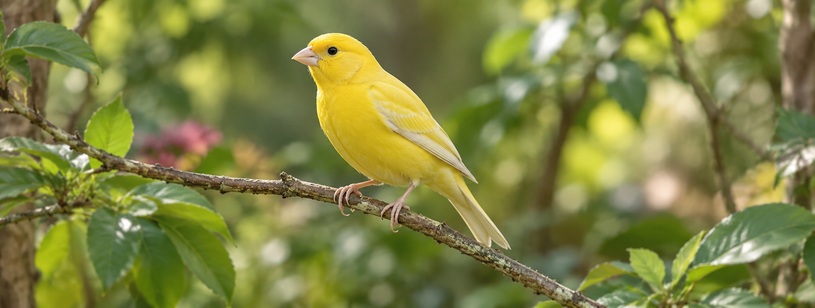
The canary is a small bird valued for its song and the many colours developed through selective breeding. Domestic canaries descend from Serinus canaria, a species native to the Canary Islands, Madeira and the Azores.
Males generally produce more elaborate songs than females. Canaries need flight space, varied food, clean water and rest. The familiar yellow pet is a domestic variety; wild canaries are generally greenish with dark streaks.
Quick facts
| Common name | Canary |
| Scientific name | Serinus canaria |
| Typical lifespan | A broad 5–15-year range according to WWF; health and husbandry matter |
| Length | Wild birds around 13 cm; domestic varieties differ, with a broad 10–20 cm range in the WWF guide |
| Weight | Around 12–30 g in the WWF guide; varies between forms and individuals |
| Diet type | Mainly seeds, buds and other plant material; insects as a secondary food |
| Conservation status | Least Concern (LC) |
| Geographical distribution | Canary Islands, Madeira and the Azores, in the region known as Macaronesia |
| Habitat | Land with trees and shrubs, woodland edges, orchards and gardens. |
| Domestic canary | The form bred and selected by people for song, colour or appearance |
| Wild plumage | Greenish with dark streaks and more prominent yellow areas in males |
| Domestic colours | Yellow, white, reddish-orange, green and combinations, depending on variety |
| Activity | Daytime |
| Social life | Wild birds can form flocks; captive compatibility needs separate assessment |
| Nest | Cup-shaped, usually in a tree or shrub |
| Eggs | Usually 3–5 in wild birds; captive clutch sizes can vary |
| Incubation | Around 13–14 days |
| Leaving the nest | Around 2–3 weeks; this does not mean immediate independence |
- Primary category:Birds
- Explore this animal's categories:
Interesting facts
- Wild canaries are not uniformly yellow. They have greenish plumage and dark streaks; familiar pet colours result from selection.
- Song varies between individuals. Males generally sing more elaborately, but some females also sing.
- Canaries have been selected for different traits. Breeding lines focus on song, colour or body and feather characteristics.
- A seed husk is not an intact seed. Empty shells left in the bowl may make it look as though food remains.
- Moulting can affect singing. Silence alone does not establish sex or illness.
- They have a place in mining history. Canaries once warned of toxic gases, a dangerous role for the birds.
Characteristics
What does a canary look like?
It has a small body, a short conical bill, slender legs and a narrow tail. The bill is suited to handling and opening seeds. It lacks the curved bill of parrots such as the budgerigar.
The wild canary is around 13 cm long. Its back and flanks show fine dark streaks. Males generally have more obvious yellow on the face and breast than females.
Yellow canaries and other domestic varieties
Captive varieties include yellow, white, greenish, reddish-orange and mixed-coloured birds. Selection has also produced differences in size, body posture, crests and feather form.
| Variety group | Selected characteristics |
|---|---|
| Song canaries | Selected for song characteristics; the German Roller is one example |
| Colour canaries | Selected for plumage colour and pattern |
| Type canaries | Selected for body and feather traits; the Gloster is one example |
These groups describe breeding aims, not separate species. A yellow canary cannot always be assigned to a particular breed from a photograph.
Male or female?
Song provides clues but is not a reliable test in every situation. Age, season, moult and health influence singing. Wild plumage differences do not automatically apply to domestic varieties.
When reliable identification matters, consult a veterinarian experienced with birds and use a laboratory test if needed. A quiet bird should not automatically be labelled female.
Habits and behaviour
Song and communication
Song plays a role in communication and breeding. Canaries also make short calls distinct from longer melodic sequences. Males are known for elaborate songs, and some domestic lines have been selected for this feature.
A newly arrived bird may need time to settle before singing. Moulting and changing day length can affect vocal activity. No method guarantees uninterrupted song.
Can canaries live together?
Wild canaries can gather in flocks, particularly after breeding. In captivity, space and individual compatibility are essential. Males may fight, especially during the breeding season.
A spacious aviary with compatible birds and several feeding places differs greatly from a small cage containing two males. Chasing, biting or preventing access to food requires safe separation.
Some canaries can be housed individually with suitable space and activities. Do not add an arbitrary companion simply to make a bird sing.
Flight, bathing and people
Canaries are active by day and need exercise. Natural perches, clear flight routes and bathing opportunities provide useful activities.
They can become accustomed to people, but many dislike being caught or stroked. Calm interaction is more appropriate than repeated handling.
Habitat and geographical distribution
Where do wild canaries live?
The species is native to the Canary Islands, Madeira and the Azores. These Atlantic archipelagos form part of Macaronesia. Domestic canaries are now kept in many countries.
Wild birds use wooded and shrubby country, woodland edges, cultivated land, orchards and gardens rather than a single habitat type. They are mainly resident, although they move locally in search of resources.
Cages and aviaries
A canary needs room to fly between perches. An enclosure chosen only for appearance, or crowded with accessories, restricts movement. A properly furnished aviary provides more flight space.
- Safe natural branches and perches with suitable surfaces and varied diameters.
- Clean food and water positioned away from droppings.
- Places to retreat and rest, away from constant disturbance.
- Protection from extreme temperatures, predators and escape in an outdoor aviary.
Clean air and rest
Smoke, aerosols and fumes from some overheated products are dangerous to birds. Kitchens are unsuitable for housing or free flight.
Canaries need a stable light–dark cycle. Artificial light late into every night can interfere with rest and seasonal rhythms.
For indoor flying, close windows and doors, switch fans off and remove hazards.
Diet and feeding
What do wild canaries eat?
Seeds, buds and other plant material make up most of the natural diet. Insects are a secondary food. The short bill helps handle seeds.
Feeding a pet canary
| Component | Role in the diet |
|---|---|
| Food appropriate for canaries | A balanced menu suited to the bird; formulated food can contribute to nutritional balance |
| Seeds | Can form part of the diet, but selective feeding from a mix does not guarantee complete nutrition |
| Safe greens and vegetables | Washed and offered in suitable quantities; remove perishable leftovers |
| Fresh water | Always available, in a container cleaned daily |
RSPCA guidance notes that canaries can benefit from good-quality pellets and suitable greens. Change diets gradually, checking that the bird is actually eating.
Remove empty husks regularly. A bowl full of shells can conceal the fact that edible seed has run out.
Changing nutritional needs
Moulting, chick growth and egg laying change nutritional demands. Do not add supplements indiscriminately to an already complete menu; discuss the plan with an avian veterinarian.
Loss of appetite or weight should not be addressed by abruptly forcing a new diet. The bird needs assessment, especially if lethargic or breathing with difficulty.
Reproduction and life cycle
Nests and eggs
Wild canaries build cup-shaped nests in trees or shrubs. Females usually lay 3–5 eggs, with incubation lasting around 13–14 days. Captive birds may lay different clutch sizes.
Day length and available resources influence breeding. Artificial light and nesting opportunities can alter these signals in pet birds.
Chick development
Chicks hatch poorly developed and depend on parental food and protection. At around 2–3 weeks, they begin to leave the nest, but first flight does not establish feeding independence.
Separate youngsters only after checking that they can feed independently. Breeding requires healthy parents, appropriate food and the ability to care for every resulting bird.
Moulting
Moult replaces old feathers with new ones. A canary may sing less during this period and needs suitable nutrition and rest, without repeated abrupt changes to lighting.
Large bare patches, wounds or declining general health should not automatically be attributed to normal moult.
How long does a canary live?
WWF gives a broad 5–15-year lifespan. Some individuals live for less time, and health, diet and husbandry affect longevity. This is neither a guarantee nor a maximum species record.
Names and history
| Classification level | Name |
|---|---|
| Class | Aves — birds |
| Order | Passeriformes — passerine birds |
| Family | Fringillidae |
Where does the name come from?
The bird’s common name is linked to the Canary Islands. Its accepted scientific name is Serinus canaria, with the authority Linnaeus, 1758. It was originally described as Fringilla canaria.
The domestic form has been selected for song, colour and appearance. Canaries are not parrots: they belong to Fringillidae, a family including other birds with bills suited to seeds.
Canaries in mines
Canaries were historically used as early warnings of toxic gases, especially carbon monoxide. Birds could show effects of exposure before people did.
The Science and Industry Museum preserves equipment designed to supply oxygen to an affected canary. This role endangered the birds; specialised instruments are used to detect gases today.
Cultural significance
“Canary in the coal mine”
The phrase canary in the coal mine comes from the historical use of these birds underground. It describes an early warning of danger, before a problem becomes obvious to everyone.
The Nottinghamshire Mining Museum explains the link between the expression and mining history.
Conservation and threats
Wild conservation status
Serinus canaria is globally classified as Least Concern (LC). This status applies to the wild species, not to each domestic variety.
SEO/BirdLife identifies threats including habitat loss, illegal trapping and predation by feral animals. Protecting island landscapes and wild populations remains important.
Pet canary health
- Unbalanced food can affect general condition and plumage.
- Polluted air and smoke can cause serious respiratory problems.
- Inadequate space and conflict can restrict movement and food access.
- Delayed veterinary assessment can postpone recognition of illness.
Birds can hide signs of disease. Lethargy, difficult breathing, poor appetite or unusual time on the cage floor need prompt veterinary attention.
Never release a pet canary outdoors. Choose a captive-bred bird of known origin and prepare its accommodation before bringing it home.
In popular culture
Tweety, the cartoon canary
Tweety is the yellow canary from the Looney Tunes world, often pursued by Sylvester the cat. Parque Warner Madrid also identifies him as a canary.
He is a stylised character. His oversized head and comic behaviour are not a representation of real canary anatomy or life.
Frequently asked questions
Is a canary a parrot?
No. Canaries belong to Fringillidae, rather than the parrot group.
Do only males sing?
Males generally produce more elaborate songs, but some females also sing. Silence alone does not establish sex.
Why has my canary stopped singing?
Settling into a new home, moult, day length and health can affect song. Lethargy, poor appetite or difficult breathing need veterinary assessment.
What does a canary eat?
Wild birds mainly eat seeds and other plant material, plus some insects. Pets need a balanced canary-appropriate menu and fresh water.
How long does a canary live?
WWF gives a broad 5–15-year range. Health and husbandry affect lifespan.
Can two males live together?
Conflict is possible, especially in small cages or during breeding. Assess space and compatibility and be ready to separate safely.
Are wild canaries yellow?
Their plumage is generally greenish with dark streaks and yellow areas. Uniform yellow is familiar in some domestic varieties.
How long do eggs take to hatch?
Around 13–14 days. Clutch size and chick development vary between individuals and conditions.
Did you know? About canaries
- Wild canaries have greenish plumage and dark streaks.
- Males generally sing more elaborately, but some females also sing.
- Domestic canaries have been selected for song, colour and appearance.
- Empty husks can conceal that edible seed has run out.