Anglo-Français de Petite VénerieCharacteristics, history, training and care
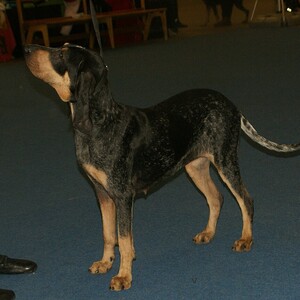
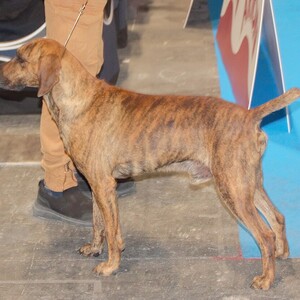
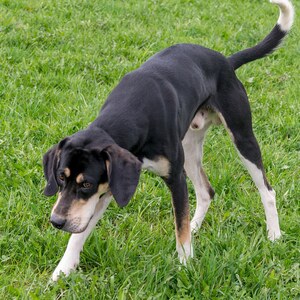
Anglo-Français de Petite Vénerie. · Self-photographed by Jwh / Wikimedia Commons, CC BY-SA 3.0 lu. Cropped and resized.
The Anglo-Français de Petite Vénerie is a medium-sized French hound, created by crossing French and English hounds. Its name does not mean it is small, but that it hunts small animals such as the hare. It usually works in a pack and is bred mainly by hunters.
Quick facts
| Common name | Anglo-Français de Petite Vénerie (medium-sized Anglo-French hound) |
| Scientific name | Canis lupus familiaris |
| Country of origin | France |
| Official recognition | FCI, definitively since 26 January 1983 (Group 6, with a working trial; standard no. 325) |
| Lifespan | No published data for the breed; medium-sized breeds usually live 10–13 years |
| Size (males) | 48–56 cm at the withers |
| Size (females) | 48–56 cm at the withers |
| Weight | The standard gives no figure |
| Coat type | Short, dense and smooth |
| Common colours | Tricolour (white, black and tan); white with black and pale tan; white and orange |
| Energy level | High |
| Suited to an apartment? | No, it is a pack dog for rural areas |
| Temperament | Active, sociable with other dogs, devoted to hunting |
| Tendency to aggression | Low |
| Good with children | Good, but it is not bred as a pet |
| Good with other animals | Very good with other dogs; strong instinct towards game |
| Genetic predispositions | No known breed-specific diseases; drop ears are more prone to infection |
- Primary category:Dog breeds
- Explore this animal's categories:
History and origin
France has a very old tradition of hunting with hounds: local types of dog are mentioned as early as the 16th century. The Anglo-French breeds were created by crossing French hounds with the English Foxhound.
The Anglo-Français de Petite Vénerie descends from the old Anglo-French hounds crossed with the Harrier, Poitevin, Petit Gascon-Saintongeois and Petit Bleu de Gascogne. It was used mainly for hunting with the gun: the pack circles the game and turns it back towards the hunter.
How the breed developed
- 16th century – The first local types of French hound are recorded.
- Until 1978 – The breed was called “Petit Anglo-Français”, being the smallest of the Anglo-French breeds.
- 26 January 1983 – The FCI recognises the breed and publishes the standard.
Breed rating
| Feature | Stars |
|---|---|
| Training and intelligence | ★★★☆☆ |
| Easy to train | ★★★☆☆ |
| Intelligence | ★★★☆☆ |
| Independence | ★★★☆☆ |
| Stubbornness | ★★★☆☆ |
| Behaviour and temperament | ★★★★☆ |
| Affectionate with family | ★★★★☆ |
| Friendly with children | ★★★★☆ |
| Good with other dogs | ★★★★★ |
| Good with cats and other animals | ★★☆☆☆ |
| Loyalty | ★★★★☆ |
| Tendency to be aggressive | ★☆☆☆☆ |
| Tendency to bark | ★★★★☆ |
| Needs and care | ★★★☆☆ |
| Shedding | ★★★☆☆ |
| Needs frequent grooming | ★★☆☆☆ |
| Activity and lifestyle | ★★★★☆ |
| Energy level | ★★★★★ |
| Daily exercise needs | ★★★★★ |
| Suited to apartment life | ★☆☆☆☆ |
| Health and longevity | ★★★★☆ |
| Life expectancy | ★★★★☆ |
| Predisposition to genetic diseases | ★★☆☆☆ |
| Working abilities and uses | ★★★★★ |
| Good pack hunting dog | ★★★★★ |
| Good companion dog | ★★★☆☆ |
Indicative rating: 5 stars means the highest level. The breed has no AKC profile, so the rating is based on the FCI standard and on its description as a pack hound.
Physical characteristics
It is a well-balanced, solid dog, but never heavy. In profile it has the typical outline of a well-built French hound.
General appearance
The large brown eyes have a gentle but lively expression. The supple ears reach almost to the tip of the nose. The tail is of medium length with dense hair, coarser towards the tip.
| Feature | Anglo-Français de Petite Vénerie |
|---|---|
| Size | Medium |
| Height at the withers | 48–56 cm (tolerance ±2 cm) |
| Coat | Short, dense and smooth |
| Eyes | Large, brown |
| Ears | Set below eye level, supple, reaching almost to the nose |
| Tail | Medium length, with dense hair |
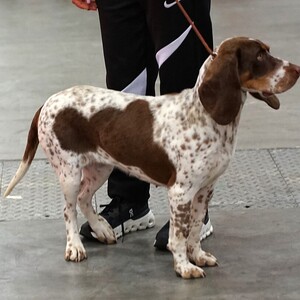
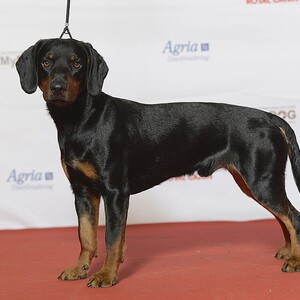
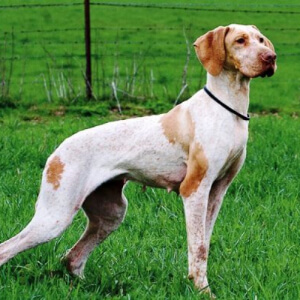
The standard accepts three varieties: tricolour (white and black with bright tan markings), white and black with pale tan markings, and white and orange bicolour, with a brown nose.
Training and socialisation
It is a pack dog, used to working with other dogs and with the hunter. It is trained mainly for hunting, not for “companion dog” obedience.
Its nose leads it: once on a trail, it focuses on the game.
Tips for effective training
- Let it work with its nose. Tracking and search games use its natural talent.
- Practise the recall. The “come” command needs a lot of practice, in safe places.
- Do not keep it alone. As a pack dog, it finds being alone hard.
- Use rewards. Praise and food keep it motivated during training.
Activity needs and lifestyle
It is an active hunting dog, usually kept in packs in the countryside. Wikipedia notes that it is not well suited to city life or to being simply a family dog.
| Activity | How often | Why it matters |
|---|---|---|
| Long walks in nature | daily | It needs a lot of exercise |
| Trail work | several times a week | Uses the instinct it was bred for |
| Time with other dogs | daily | It is a pack dog |
Tips for a balanced life
- Keep it on a lead outside safe areas.
- The fence must be high and have no gaps.
- Its melodious bay carries a long way, so think of the neighbours.
Care and health
Coat and skin care
The short, smooth coat is easy to look after. Brushing once a week with a rubber brush or a grooming mitt is enough.
Common health problems
No breed-specific health problems are documented. As with all breeds with drop ears, the area under the ear is more prone to infection, so the ears should be checked often.
Other care
- Clean the ears once a week and after hunting.
- Look for ticks after every outing in the woods.
- Check the paw pads after rough ground.
Diet and nutrition
A hunting dog needs more calories during the hunting season. For its weight, weigh it yourself: the standard gives no figure.
Tips for a healthy diet
The table gives a starting estimate, calculated with the formula from the Merck Veterinary Manual. The first two calorie columns show the calories per day for a healthy adult dog. The last column shows what this means in dry food with 3,500–4,000 kcal per kilogram.
| Dog's weight | Calories per day (neutered) | Calories per day (not neutered) | Dry food per day (approximate) |
|---|---|---|---|
| 20 kg | 1,060 kcal | 1,190 kcal | 260–340 g |
| 25 kg | 1,250 kcal | 1,410 kcal | 310–400 g |
| 30 kg | 1,440 kcal | 1,620 kcal | 360–460 g |
- Give it its food in two meals a day.
- Increase the portion on days of hard exercise.
- A dog is at the right weight when you can feel its ribs without pressing hard.
Foods to avoid
Some human foods are dangerous for dogs: chocolate, coffee, grapes and raisins, onions, garlic, xylitol (a sweetener used in chewing gum), macadamia nuts and alcohol.
Reproduction and development
Physical and emotional maturity
In dogs, sexual maturity usually comes between 6 and 12 months. Most breeds become adults at around 13–15 months.
Mating and pregnancy
Pregnancy lasts about 63 days, counted from ovulation. Mating a female on her first heat is not recommended. The FCI standard requires that only healthy dogs of typical breed appearance are used for breeding.
Caring for the puppies
In dogs, a litter has 5–6 puppies on average, and the number rises with the size of the breed. Socialisation starts in the first weeks: gentle handling, everyday noises and new people.
Interesting facts
- “Petite” does not mean small. The name “de Petite Vénerie” refers to small game, not to the size of the dog.
- It is the smallest Anglo-French hound. Before 1978 it was called “Petit Anglo-Français”, because it was the smallest of the Anglo-French hounds.
- It has a working trial. For some FCI titles it must also pass a hunting test.
- A “wheat ear” tail. Towards the tip, the tail has a few longer, coarser hairs, likened to an ear of wheat.
- It has reached America too. It is recognised by the United Kennel Club, in the scenthound group.
Frequently asked questions
What does “de Petite Vénerie” mean?
It means it is used to hunt small animals such as the hare, not that it is a small dog.
How big does it get?
It stands 48–56 cm at the withers.
Is it suited to a family?
It is a hunting dog usually kept in a pack in the countryside. It is not a good choice for the city.
What colours does it come in?
Tricolour, black and white with pale tan, or white and orange.