Blue Picardy SpanielCharacteristics, history, training and care
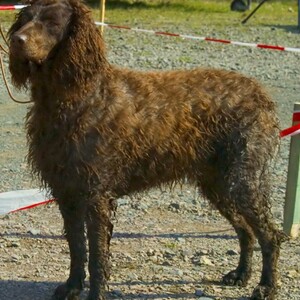
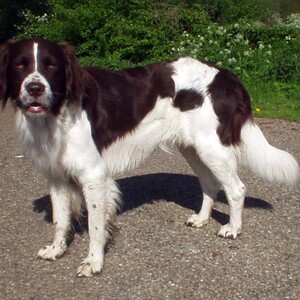
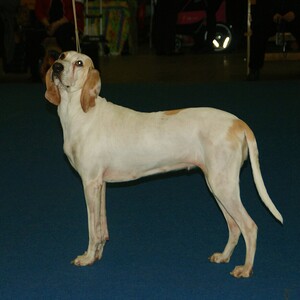
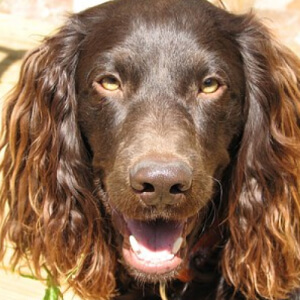
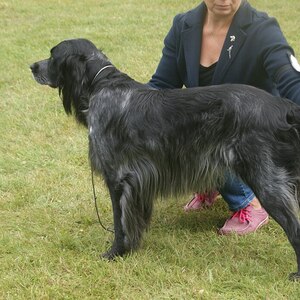
Blue Picardy Spaniel. · Canarian / Wikimedia Commons, CC BY-SA 4.0. Cropped and resized.
The Blue Picardy Spaniel is a French hunting dog with a grey and black coat that looks bluish. It specialises in hunting woodcock, but at home it is calm, playful and very gentle with children. It is easy to train, as long as it is handled gently.
Quick facts
| Common name | Blue Picardy Spaniel (in French: Épagneul bleu de Picardie) |
| Scientific name | Canis lupus familiaris |
| Country of origin | France (Picardy) |
| Official recognition | FCI, definitively since 6 December 1954 (Group 7, pointing dogs, with a working trial; standard no. 106); AKC, in the Foundation Stock Service since May 2024 |
| Lifespan | 11–12 years |
| Size (males) | 57–62 cm at the withers; about 23–25 kg |
| Size (females) | 55–60 cm at the withers; about 20–23 kg |
| Coat type | Flat or slightly wavy, with feathering on the ears, legs and tail |
| Common colours | Silver grey to grey-black flecked, with bluish tints, with or without black patches |
| Energy level | Moderate |
| Suited to an apartment? | It adapts, if it gets two active outings a day |
| Temperament | Calm, friendly, cheerful, playful |
| Tendency to aggression | Very low |
| Good with children | Very good; gentle and affectionate with them |
| Good with other animals | Very good |
| Genetic predispositions | No known breed-specific diseases; long ears are more prone to infection |
History and origin
In the 19th century, in Picardy, in northern France, writers described black or black-and-white spaniels called “épagneuls du Nord”, meaning “spaniels of the North”. The area was a paradise for wildfowl hunters.
At the end of the 19th century British hunters came here too, with their dogs. According to the AKC, because of British quarantine rules, many left their setters at farms in Picardy, and the local spaniels were crossed with English and Gordon Setters. This is how the blue spaniel came about.
How the breed developed
- 19th century – The “spaniels of the North” are described in Picardy.
- Late 19th century – The local spaniels are crossed with English and Gordon Setters.
- Early 20th century – The blue spaniel competes in a separate class.
- 1938 – The breed standard is officially registered.
- 6 December 1954 – The FCI recognises the breed.
- May 2024 – The AKC admits it to its Foundation Stock Service.
Breed rating
| Feature | Stars |
|---|---|
| Training and intelligence | ★★★★★ |
| Easy to train | ★★★★★ |
| Intelligence | ★★★★☆ |
| Independence | ★★☆☆☆ |
| Stubbornness | ★★☆☆☆ |
| Behaviour and temperament | ★★★★☆ |
| Affectionate with family | ★★★★☆ |
| Friendly with children | ★★★★★ |
| Good with other dogs | ★★★★★ |
| Good with cats and other animals | ★★★★☆ |
| Loyalty | ★★★★☆ |
| Tendency to be aggressive | ★☆☆☆☆ |
| Tendency to bark | ★★★☆☆ |
| Needs and care | ★★★☆☆ |
| Shedding | ★★★☆☆ |
| Needs frequent grooming | ★★☆☆☆ |
| Activity and lifestyle | ★★★☆☆ |
| Energy level | ★★★☆☆ |
| Daily exercise needs | ★★★☆☆ |
| Suited to apartment life | ★★★★☆ |
| Health and longevity | ★★★★☆ |
| Life expectancy | ★★★★☆ |
| Predisposition to genetic diseases | ★★☆☆☆ |
| Working abilities and uses | ★★★★★ |
| Good hunting dog (pointing) | ★★★★★ |
| Good companion dog | ★★★★★ |
Indicative rating: 5 stars means the highest level. It is based on the ratings the American Kennel Club gives the breed and on the FCI standard.
Physical characteristics
It is a fairly low-set dog for its size, well built for work, as the 1938 standard described it. It has strong, muscular legs and a long, broad muzzle.
General appearance
The thick ears, covered with silky, wavy hair, frame the head and reach the tip of the muzzle. The eyes are large and dark, with a calm expression. The tail has silky feathering and does not reach much below the hock.
| Feature | Blue Picardy Spaniel |
|---|---|
| Size | Medium to large |
| Height at the withers | males: 57–62 cm; females: 55–60 cm |
| Weight | males: about 23–25 kg; females: about 20–23 kg |
| Coat | Flat or slightly wavy, with feathering |
| Eyes | Large, dark |
| Ears | Thick, with silky wavy hair, reaching the tip of the muzzle |
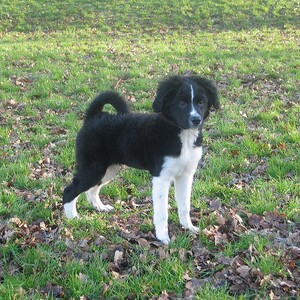
The colour is silver grey to grey-black, with small flecks that give the coat a bluish tint, with or without larger black patches. White or brown patches are not accepted. Puppies are born white with black patches, and the blue-grey colour appears gradually.
Training and socialisation
The AKC gives it top marks for trainability: it learns easily and loves to work. It responds best to a gentle, consistent approach.
Besides hunting, it does well at obedience, rally and agility.
Tips for effective training
- Be gentle. Harshness makes it shut down; praise motivates it.
- Be consistent. The same rules, every day.
- Practise the recall. It is a hunting dog and may go off after a scent.
- Try dog sports. It enjoys obedience, rally and agility.
Activity needs and lifestyle
The AKC recommends 20 minutes twice a day of brisk walking, running or fetch. The standard says a daily walk keeps it fit and helps it relax.
| Activity | How often | Why it matters |
|---|---|---|
| Brisk walk or run | twice a day, 20 minutes each | Keeps it fit |
| Game of fetch | daily | It loves it and it burns off energy |
| Training or dog sport | weekly | Uses how easily it learns |
Tips for a balanced life
- The garden must be fenced: it may go off after a scent.
- Outside the garden, keep it on the lead.
- It is calm indoors, but lets you know when a stranger arrives.
Care and health
Coat and skin care
Brush the medium-length coat once a week with a pin brush and a comb, so that it stays soft and does not mat. Bath it once a month.
Common health problems
There are no known hereditary diseases specific to the breed. The long ears must be kept clean and dry, otherwise they easily become infected.
Other care
- Clean and dry the ears after every bath or walk through water.
- Trim the nails monthly.
- Brush its teeth regularly.
Diet and nutrition
Choose a good-quality food suited to its age and activity. During the hunting season it needs more calories.
Tips for a healthy diet
The table gives a starting estimate, calculated with the formula from the Merck Veterinary Manual. The first two calorie columns show the calories per day for a healthy adult dog. The last column shows what this means in dry food with 3,500–4,000 kcal per kilogram.
| Dog's weight | Calories per day (neutered) | Calories per day (not neutered) | Dry food per day (approximate) |
|---|---|---|---|
| 20 kg | 1,060 kcal | 1,190 kcal | 260–340 g |
| 23 kg | 1,180 kcal | 1,320 kcal | 300–380 g |
| 25 kg | 1,250 kcal | 1,410 kcal | 310–400 g |
- Give it its food in two meals a day.
- Training treats count towards the daily portion.
- A dog is at the right weight when you can feel its ribs without pressing hard.
Foods to avoid
Some human foods are dangerous for dogs: chocolate, coffee, grapes and raisins, onions, garlic, xylitol (a sweetener used in chewing gum), macadamia nuts and alcohol.
Reproduction and development
Physical and emotional maturity
In dogs, sexual maturity usually comes between 6 and 12 months. Most breeds become adults at around 13–15 months.
Mating and pregnancy
Pregnancy lasts about 63 days, counted from ovulation. Mating a female on her first heat is not recommended. The FCI standard requires that only healthy dogs of typical breed appearance are used for breeding.
Caring for the puppies
In dogs, a litter has 5–6 puppies on average, and the number rises with the size of the breed. Socialisation starts in the first weeks: gentle handling, everyday noises and new people.
Interesting facts
- It is born black and white. The blue-grey colour appears gradually as it grows.
- A woodcock specialist. The standard says it is very good at hunting woodcock.
- It was a poet's companion. Lieutenant Colonel John McCrae, author of the poem “In Flanders Fields”, had a blue spaniel called Bonneau.
- It has a sister breed. The main difference from the Picardy Spaniel is the coat colour.
- Many live in Canada. Most dogs are found in France and Canada.
In popular culture
Bonneau, the dog of the First World War
The Canadian Lieutenant Colonel John McCrae, author of the famous poem “In Flanders Fields”, had a Blue Picardy Spaniel called Bonneau during the First World War, which went with him to the front.
Frequently asked questions
Is it suitable for a family with children?
Yes. The AKC says it is gentle and affectionate with children and gets on with other dogs.
How big does it get?
Males measure 57–62 cm and females 55–60 cm; they weigh about 20–25 kg.
How much exercise does it need?
20 minutes of brisk activity twice a day.
Why is it called “blue”?
Its flecked grey and black coat has a bluish tint.
How long does it live?
Its life expectancy is 11–12 years.