Bull TerrierCharacteristics, history, training and care
The Bull Terrier is a muscular dog with a distinctive, curved head profile. Individuals can be lively and strong, so appropriate socialisation, training and management are important. Breed descriptions cannot guarantee behaviour.
Quick facts
| Common name | Bull Terrier |
| Scientific name | Canis lupus familiaris |
| Country of origin | United Kingdom |
| Official Recognition | Recognised by the American Kennel Club |
| Typical lifespan | About 10-14 years |
| Dimensions (Male) | About 53-60 cm / 24-38 kg |
| Dimensions (Female) | About 50-56 cm / 22-35 kg |
| Coat type | Short, flat and glossy |
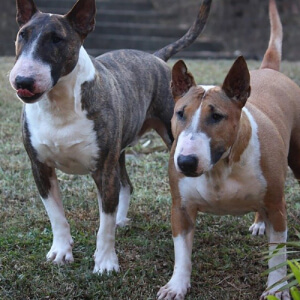
| Common colours | White (with or without head markings), or coloured: brindle, black-brindle, red, fawn, tricolour |
| Energy Level | High |
| Suitable for an apartment? | Depends on exercise, training, health and the individual dog |
| Temperament | Playful, stubborn, affectionate |
| Behaviour towards unfamiliar people and dogs | Individual behaviour varies; socialisation, training and management matter |
| Compatibility with children | Depends on the individual; adult supervision and suitable handling are essential |
| Compatibility with other animals | Depends on socialisation, prey drive and the animals involved |
| Health considerations | Deafness (especially in white dogs), skin problems, heart and kidney disease, patellar luxation |
- Primary category:Dog breeds
- Explore this animal's categories:
History and Origin
The Bull Terrier is a 19th-century English breed. Its bull-and-terrier ancestors were used for dog fighting, but the modern breed was developed as a gentleman's companion.
Evolution of the breed
- Origins in the 1800s - Its ancestors came from crosses between bulldogs and terriers, such as the now-extinct English White Terrier.
- The "White Cavalier" - In the 1860s, James Hinks of Birmingham developed an all-white, more elegant dog, which became fashionable with gentlemen.
- The egg-shaped head - Over time, breeders developed the breed's unique long, egg-shaped head; coloured Bull Terriers were added in the 20th century.
- Official recognition - The American Kennel Club (AKC) recognised the breed in 1885.
Breed Evaluation
The Bull Terrier is an energetic, intelligent and strong dog, suitable for active people and families who can give it plenty of attention. These are general editorial ratings, not measured scores; individual dogs vary.
| Characteristic | Stars |
|---|---|
| Training and Intelligence | ★★★★☆ |
| Easy to train | ★★★☆☆ |
| Intelligence | ★★★★☆ |
| Level of independence | ★★★★☆ |
| Level of stubbornness | ★★★★☆ |
| Behavior and Temperament | ★★★★★ |
| Affectionate with family | ★★★★★ |
| Friendly with children | ★★★★★ |
| Compatible with other dogs | ★★★☆☆ |
| Compatible with cats and other animals | ★★★☆☆ |
| Degree of loyalty | ★★★★★ |
| Tendency to be aggressive | ★★★☆☆ |
| Tendency to bark | ★★☆☆☆ |
| Needs and Care | ★★★☆☆ |
| Shedding level | ★★★☆☆ |
| Requires frequent care | ★★☆☆☆ |
| Activity and Lifestyle | ★★★★★ |
| Energy level | ★★★★★ |
| Daily exercise requirement | ★★★★★ |
| Suitable for apartment living | ★★★☆☆ |
| Health and Longevity | ★★★☆☆ |
| Life expectancy | ★★★★☆ |
| Predisposition to genetic diseases | ★★★☆☆ |
| Work and Utility Features | ★★★★★ |
| Good guard dog | ★★★★★ |
| Good companion dog | ★★★★★ |
Physical Characteristics
The Bull Terrier is a strong, muscular, athletic dog, famous for its egg-shaped head and its lively, brave personality.
General appearance
- A strong, rounded, muscular body.
- A short, flat, glossy coat that needs little care.
- A long, egg-shaped head with no "stop" between the forehead and the muzzle, unique among dog breeds.
- Small, thin, erect ears set close together.
- Small, dark, triangular, deep-set eyes that give a keen look.
- A short tail, thick at the base and tapering to a point, carried level.
| Characteristic | Bull Terrier |
|---|---|
| Size | Medium (about 50-60 cm at the shoulder; no fixed limits in the standard) |
| Weight | About 22-38 kg |
| Coat | Short, flat, glossy |
| Head | Long, egg-shaped |
| Shedding tendency | Moderate |
| Build | Strong and compact |
The Bull Terrier is a strong, athletic dog, suited to people with time and experience for training and socialisation.
Training and Socialization
The Bull Terrier is clever but independent and often stubborn, so training must be consistent and patient.
Tips for effective training
- Start young - The Bull Terrier should learn basic commands and house rules from about 8-10 weeks.
- Reward-based methods - Food rewards and praise work well; harsh corrections can make it stubborn or defensive.
- Early socialisation - It is very important for it to meet new people, animals and places, especially other dogs.
- Short sessions - Short daily training sessions keep its attention and prevent boredom.
- Clear rules - The Bull Terrier is strong and may test limits, so it needs a calm, consistent owner.
The Bull Terrier is not ideal for inexperienced owners, but with good training and socialisation it becomes an affectionate, devoted companion.
Activity and Lifestyle Needs
The Bull Terrier is an energetic dog that needs daily exercise and play for its physical and mental health.
| Activity | Recommended duration |
|---|---|
| Daily walks | About 60 min |
| Interactive games | About 30 min |
| Obedience training | About 10-15 min |
| Mental stimulation activities | About 15-20 min |
Recommendations for a balanced lifestyle
- Needs regular exercise - The Bull Terrier does not suit a quiet lifestyle.
- Loves games and challenges - Interactive toys and games help stimulate its intelligence.
- Does not like being alone - If left alone too long, it may become anxious or destructive, and some Bull Terriers develop compulsive habits such as tail-chasing.
- Best with a garden - It can live in an apartment, but it needs frequent outings and space to use its energy.
The Bull Terrier is an active, strong dog, suited to lively families who can give it enough physical and mental stimulation.
Care and Health
The Bull Terrier is easy to groom, but it is prone to some inherited health problems.
Fur and skin care
- Weekly brushing - The short coat needs little care, but should be brushed weekly to remove dead hair.
- Occasional baths - It needs washing only when very dirty.
- Skin checks - The Bull Terrier is prone to skin problems, especially white dogs, which can develop allergies and irritation.
Common health problems
| Condition | Description | Common symptoms |
|---|---|---|
| Deafness | More common in white Bull Terriers; puppies can be tested (BAER) | No response to sounds |
| Skin problems | Allergies and skin irritation | Itching, redness, hair loss |
| Heart and kidney disease | Inherited heart valve problems and kidney disease (hereditary nephritis) occur in the breed | Tiredness, increased thirst, weight loss |
| Patellar luxation | A slipping kneecap | Limping, skipping a step |
Other aspects of care
- Weekly ear and eye checks - To prevent infections and irritation.
- Sun protection - White Bull Terriers can get sunburned and should be protected on very sunny days.
- Weight control - With its big appetite, the Bull Terrier must be fed carefully and kept active.
The Bull Terrier is a sturdy breed, but breeding dogs should be health-tested for inherited problems.
Diet and Nutrition
The Bull Terrier needs a balanced diet with good-quality protein to maintain its muscles and energy.
Recommendations for a healthy diet
Choose a complete, balanced diet suited to age, size and health. Plan home-prepared diets and supplements with a qualified veterinarian; raw pet food can carry harmful bacteria.
| Food type | Daily Amount (Adults) | Frequency |
|---|---|---|
| Premium dry food | Individual amount; follow complete-food guidance and veterinary advice | 2 meals/day |
| Home cooked food | Individual amount; follow a complete diet’s guidance and veterinary advice | 2 meals/day |
| Raw food: bacterial contamination is a concern | Individual amount; follow a complete diet’s guidance and veterinary advice | 2 meals/day |
Forbidden foods
Chocolate, grapes and raisins, onions and xylitol - toxic to dogs. ; Cooked bones - can splinter and injure the gut. ; Fatty or fried foods - can upset digestion and cause pancreatitis. ; Overfeeding - the Bull Terrier tends to gain weight, which strains the joints and heart.
The Bull Terrier should get a balanced diet, without unhealthy food or overfeeding.
Reproduction and Development
Breeding requires veterinary planning, suitable health screening and care for the mother and puppies. Pregnancy and birth can involve complications.
Physical and emotional maturity
- Physical maturity: The Bull Terrier reaches adult size at about 12-18 months, but continues to build muscle until about 2 years.
- Emotional maturity: It stays playful and energetic, and may not be fully mature until about 3 years.
Mating and Gestation
- Breeding decisions require veterinary assessment of maturity, health and suitable screening; reaching a fixed age does not establish that breeding is appropriate.
- Duration of gestation: Approximately 58-68 days, usually about 63 days.
- Average number of puppies: Usually about 4-8 puppies.
Puppy care
- The first 3 weeks: Puppies depend completely on their mother for warmth, milk and care.
- Between 4-8 weeks: They begin to develop their personality, and early socialisation is very important to prevent fear or aggression.
- Moving to a new home: When puppies go to their new homes, training should start right away.
Early socialisation and training are essential to raise a well-mannered Bull Terrier.
Curiosities and Interesting Facts
- From fighter to gentleman's dog - Its ancestors were used in dog fights, but the modern breed was created as a companion.
- A unique head - Its long, egg-shaped head is not found in any other breed.
- Expressive and funny - Bull Terriers are known for their clownish behaviour and expressive faces.
- A "smile" - Many owners say their Bull Terrier seems to smile when happy.
- Two sizes - The Miniature Bull Terrier is a separate, smaller breed with the same look.
- A famous general's dog - General George S. Patton had a Bull Terrier called Willie.
- A loyal friend - The Bull Terrier is very loyal and affectionate with its family.
The Dog in Popular Culture
With its egg-shaped head, the Bull Terrier is one of the most recognisable dogs in advertising, films and books.
Importance in modern culture
- Bullseye - The Target department stores in the USA use a white Bull Terrier called Bullseye as their mascot.
- Literature and film - Bill Sikes's dog Bull's-eye in Charles Dickens's "Oliver Twist" is a bull-terrier-type dog, and Sid's dog Scud in "Toy Story" (1995) is a Bull Terrier.
- Advertising - In the 1980s, a Bull Terrier called Spuds MacKenzie became famous in American beer adverts.