Skye TerrierCharacteristics, history, training and care
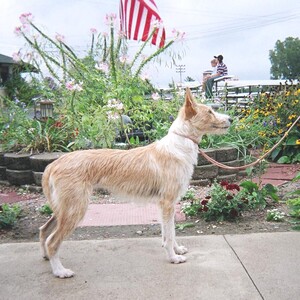
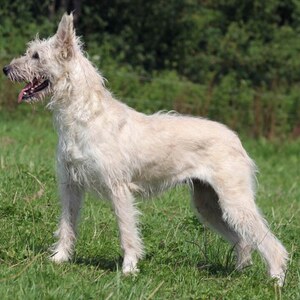
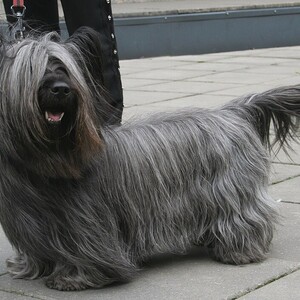
Skye Terrier. · Pleple2000 / Wikimedia Commons, CC BY-SA 3.0. Cropped and resized.
The Skye Terrier is one of the oldest Scottish breeds: a long, low, hardy terrier, twice as long as it is tall, with a long coat that covers its eyes. The FCI standard describes it as elegant and dignified, a “one-man dog”, distrustful of strangers but never vicious. Wikipedia says it is now one of the most endangered breeds in the United Kingdom.
Quick facts
| Common name | Skye Terrier |
| Scientific name | Canis lupus familiaris |
| Country of origin | United Kingdom (Scotland) |
| Official recognition | FCI, definitively since 20 October 1954 (group 3, terriers; standard no. 75); also recognised by the AKC |
| Lifespan | 12–14 years, according to the AKC |
| Size (males) | ideally 25–26 cm at the withers; 105 cm from nose to tail tip; 16–20 kg according to the AKC |
| Size (females) | slightly smaller, in the same proportions |
| Coat type | Double: short, woolly undercoat, long, hard, straight topcoat |
| Common colours | Black, dark or light grey, fawn, cream, with black points |
| Energy level | Medium |
| Suited to an apartment? | Yes |
| Temperament | Elegant, dignified, devoted to one owner, reserved with strangers |
| Tendency to aggression | Low; the standard says it is never vicious |
| Good with children | Moderate |
| Good with other animals | Moderate |
| Genetic predispositions | Intervertebral disc problems, mammary cancer, haemangiosarcoma |
- Primary category:Dog breeds
- Explore this animal's categories:
History and origin
The FCI standard says the Skye is one of the oldest Scottish breeds. It was once known as the terrier of the Western Isles and was formed from several breeds, including the prototypes of the Cairn Terrier. The AKC says it was long the companion of the nobility.
The most famous Skye was Greyfriars Bobby, who, around 1858 in Edinburgh, watched over his master's grave in Greyfriars Kirkyard until his own death. Wikipedia says only 30 puppies were born in the United Kingdom in 2005 and that the breed could disappear completely.
How the breed developed
- Centuries ago – The terrier of the Western Isles.
- Around 1858 – Greyfriars Bobby watches over his master's grave.
- 20 October 1954 – The FCI recognises the breed.
- 2005 – Only 30 puppies born in the United Kingdom.
Breed rating
| Feature | Stars |
|---|---|
| Training and intelligence | ★★★☆☆ |
| Easy to train | ★★★★★ |
| Intelligence | ★★★☆☆ |
| Independence | ★★★☆☆ |
| Stubbornness | ★★★☆☆ |
| Behaviour and temperament | ★★★☆☆ |
| Affectionate with family | ★★★☆☆ |
| Friendly with children | ★★★☆☆ |
| Good with other dogs | ★★★☆☆ |
| Good with cats and other animals | ★★★☆☆ |
| Loyalty | ★★★☆☆ |
| Tendency to be aggressive | ★★★☆☆ |
| Tendency to bark | ★★★☆☆ |
| Needs and care | ★★★☆☆ |
| Shedding | ★★★☆☆ |
| Needs frequent grooming | ★★★☆☆ |
| Activity and lifestyle | ★★★☆☆ |
| Energy level | ★★★☆☆ |
| Daily exercise needs | ★★★☆☆ |
| Suited to apartment life | ★★★☆☆ |
| Health and longevity | ★★★☆☆ |
| Life expectancy | ★★★☆☆ |
| Predisposition to genetic diseases | ★☆☆☆☆ |
| Working abilities and uses | ★★★☆☆ |
| Good companion dog | ★★★☆☆ |
| Good companion dog | ★★★☆☆ |
Indicative rating: 5 stars means the highest level. It is based on the ratings the American Kennel Club gives the breed and on the FCI standard.
Physical characteristics
The standard describes it as long, twice as long as it is tall, with an abundant coat and a gait that seems effortless, strong in quarters, body and jaws. The AKC says it is one of the most distinctive breeds in looks: long, low and level, with large feathered ears held up like bat wings, although there is also a drop-eared variety.
General appearance
The coat is double: a short, dense, soft, woolly undercoat and a long, hard, straight, flat topcoat. On the head the hair is shorter and softer and covers the forehead and eyes without blocking its sight.
| Feature | Skye Terrier |
|---|---|
| Size | Small |
| Height at the withers | ideally 25–26 cm |
| Length | 105 cm from nose to tail tip |
| Weight | 16–20 kg (AKC) |
| Coat | Long, double |
| Ears | Erect or drop |
The standard accepts black, dark or light grey, fawn and cream, all with black points. Any solid colour allowing shading of the same colour is accepted.
Training and socialisation
The standard describes it as elegant and dignified, a “one-man dog”, distrustful of strangers but never vicious. The AKC says it is very intelligent but wilful, calmer than many other terriers.
It responds well to consistent, positive training. It is sensitive to correction and withdraws if treated harshly. Like all terriers it can be stubborn, but it enjoys working with its people.
Tips for effective training
- Be positive. It withdraws if treated harshly.
- Be consistent. It is wilful.
- Socialise it early. It is reserved with strangers.
- Keep it from jumping. Its long back is sensitive.
Activity needs and lifestyle
The AKC says it has low exercise needs and is content with its owner's activity level. Even a short daily outing does it good. It enjoys play and dog sports, including agility and obedience.
| Activity | How often | Why it matters |
|---|---|---|
| Short walk | daily | Fitness |
| Play | daily | Keeps its mind busy |
| Obedience or light agility | occasionally | Bond with its owner |
Tips for a balanced life
- It can also live in an apartment.
- Puppies should not climb stairs often.
- Brush it weekly.
Care and health
Coat and skin care
The AKC says the long coat looks harder to maintain than it is: it needs weekly brushing and combing, but it is not clipped or scissored and is kept natural.
Common health problems
The AKC says that, because of its long, low body, the Skye can have disc problems, and owners should watch for signs of cancer. Watch for:
| Condition | Description | Common symptoms |
|---|---|---|
| Intervertebral disc disease | A disc between the vertebrae ruptures and presses on the spinal cord | Back or neck pain, unsteady walking on the hind legs; in severe cases, paralysis |
| Mammary cancer | Tumours of the mammary glands | Lumps on the belly |
| Haemangiosarcoma | Cancer of the blood vessels | Sudden weakness, pale gums |
Other care
- Do not let it jump down from heights.
- Puppies should not go up and down stairs often.
- Go for yearly check-ups.
Diet and nutrition
The AKC recommends good-quality food suited to its age and keeping an eye on its weight, especially for the sake of its long back.
Tips for a healthy diet
The table gives a starting estimate, calculated with the formula from the Merck Veterinary Manual. The first two calorie columns show the calories per day for a healthy adult dog. The last column shows what this means in dry food with 3,500–4,000 kcal per kilogram.
| Dog's weight | Calories per day (neutered) | Calories per day (not neutered) | Dry food per day (approximate) |
|---|---|---|---|
| 14 kg | 810 kcal | 910 kcal | 200–260 g |
| 17 kg | 940 kcal | 1,050 kcal | 240–300 g |
| 20 kg | 1,060 kcal | 1,190 kcal | 260–340 g |
- Treats count towards the daily portion.
- Split the food into two meals a day.
- A dog is at the right weight when you can feel its ribs under the coat without pressing hard.
Foods to avoid
Some human foods are dangerous for dogs: chocolate, coffee, grapes and raisins, onions, garlic, xylitol (a sweetener used in chewing gum), macadamia nuts and alcohol.
Reproduction and development
Physical and emotional maturity
In dogs, sexual maturity usually comes between 6 and 12 months. Small breeds become adults faster than large ones, usually at around one year.
Mating and pregnancy
Pregnancy lasts about 63 days, counted from ovulation. Mating a female on her first heat is not recommended. The FCI standard requires that only healthy dogs of typical breed appearance are used for breeding.
Caring for the puppies
In small breeds, a litter has 3–4 puppies on average. The puppies are very small and fragile in the first weeks, so they must be kept warm and handled with care. Socialisation starts early: gentle handling, everyday noises and new people.
Interesting facts
- Greyfriars Bobby. He watched over his master's grave for years.
- Twice as long as it is tall. That is what the standard requires.
- Ears like bat wings. The AKC compares them to bat wings.
- A threatened breed. Only 30 puppies were born in the United Kingdom in 2005.
- A dog of the nobility. The AKC says it was long the companion of the nobility.
In popular culture
Greyfriars Bobby
The FCI standard says Greyfriars Bobby watched over his master's grave in Greyfriars Kirkyard, Edinburgh, until his death; his devotion is remembered by a plaque in the street and another on the grave. Wikipedia also mentions his statue.
Frequently asked questions
Who was Greyfriars Bobby?
A Skye Terrier who watched over his master's grave in Edinburgh.
Is it a rare breed?
Yes, one of the most endangered in the United Kingdom.
Does it need clipping?
No; the coat is kept natural and brushed weekly.
How long does it live?
The AKC gives 12–14 years.