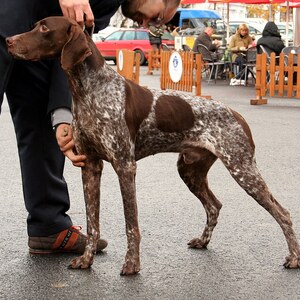
Braque Français, Pyrenees TypeCharacteristics, history, training and care
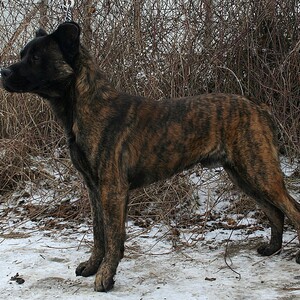
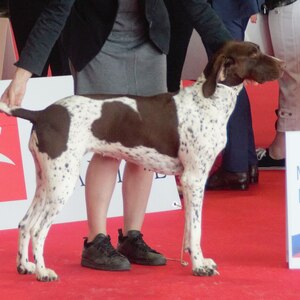
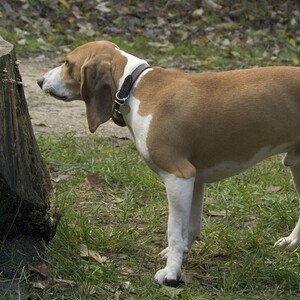
Braque Français, Pyrenees Type. · Pleple2000 / Wikimedia Commons, CC BY-SA 3.0. Cropped and resized.
The Braque Français, Pyrenees type, is the smaller, lighter variety of the French pointer, a pointing dog from the central Pyrenees. It has the same features as the Gascogne type, but in a leaner body. It is fast and versatile in the field.
Quick facts
| Common name | Braque Français, Pyrenees type (French Pointing Dog, Pyrenean type) |
| Scientific name | Canis lupus familiaris |
| Country of origin | France (south-west and central Pyrenees) |
| Official recognition | FCI, definitively since 18 January 1955 (group 7, pointing dogs, with working trial; standard no. 134) |
| Lifespan | No published data for the breed; medium and large breeds usually live 10–13 years |
| Size (males) | 51–58 cm at the withers |
| Size (females) | 49–56 cm at the withers |
| Weight | The standard gives no figure |
| Coat type | Finer and shorter than in the Gascogne type |
| Common colours | Chestnut brown; brown and white; brown and white with heavy ticking; brown with tan markings |
| Energy level | High |
| Suited to an apartment? | Not really; it needs plenty of exercise |
| Temperament | Versatile hunter; the standard asks for dogs that are neither aggressive nor timid |
| Tendency to aggression | Low |
| Good with children | No specific data |
| Good with other animals | Good with other dogs; hunting instinct towards birds |
| Genetic predispositions | No breed-specific diseases are known |
- Primary category:Dog breeds
- Explore this animal's categories:
History and origin
French pointers descend from a very old type of pointing dog, used to show the hunter where birds were hiding. Over the centuries they were taken to other countries and crossed with other breeds.
At the end of the 19th century, when people went looking for the original dogs, they found two regional varieties, kept pure in south-western France and the central Pyrenees: the larger Gascogne type and the smaller Pyrenees type. Today the FCI treats them as two separate breeds.
How the breed developed
- Centuries – French pointers spread and mix with other breeds.
- 1850 – The first breed club is founded.
- 1880 – Standards are written for both types.
- January 1955 – The FCI recognises the Gascogne type (17 January) and the Pyrenees type (18 January).
- 1 August 2023 – The current FCI standards are published.
Breed rating
| Feature | Stars |
|---|---|
| Training and intelligence | ★★★★☆ |
| Easy to train | ★★★★☆ |
| Intelligence | ★★★★☆ |
| Independence | ★★★☆☆ |
| Stubbornness | ★★★☆☆ |
| Behaviour and temperament | ★★★★☆ |
| Affectionate with family | ★★★★☆ |
| Friendly with children | ★★★★☆ |
| Good with other dogs | ★★★★☆ |
| Good with cats and other animals | ★★☆☆☆ |
| Loyalty | ★★★★☆ |
| Tendency to be aggressive | ★☆☆☆☆ |
| Tendency to bark | ★★☆☆☆ |
| Needs and care | ★★☆☆☆ |
| Shedding | ★★☆☆☆ |
| Needs frequent grooming | ★☆☆☆☆ |
| Activity and lifestyle | ★★★★☆ |
| Energy level | ★★★★★ |
| Daily exercise needs | ★★★★★ |
| Suited to apartment life | ★★☆☆☆ |
| Health and longevity | ★★★★☆ |
| Life expectancy | ★★★★☆ |
| Predisposition to genetic diseases | ★★☆☆☆ |
| Working abilities and uses | ★★★★★ |
| Good hunting dog (pointing) | ★★★★★ |
| Good companion dog | ★★★★☆ |
Indicative rating: 5 stars means the highest level. The breed has no AKC profile and the FCI standard does not describe its temperament, so the rating is only a rough guide, based on its role as a pointing dog.
Physical characteristics
It is a rustic pointing dog, not heavy, but fairly muscular. It keeps the proportions of the Gascogne type, but is smaller, lighter in build and has tighter skin.
General appearance
It has long legs, long hanging ears and a short coat. The head is usually brown. The muzzle is slightly shorter than the skull.
| Feature | Braque Français, Pyrenees Type |
|---|---|
| Size | Medium |
| Height at the withers | males: 51–58 cm; females: 49–56 cm |
| Coat | Finer and shorter than in the Gascogne type |
| Eyes | Well open, chestnut brown or dark yellow |
| Tail | Often docked; a long tail carried well, or one short from birth, is not a fault |
The accepted colours are chestnut brown, brown and white, brown and white with heavy ticking, and brown with tan markings above the eyes, on the lips and on the legs.
Training and socialisation
French pointers are not just pointing dogs but versatile hunters: they can retrieve game, flush it from cover and track it over any ground.
As with any hunting dog, training calls for patience, consistency and rewards, and the recall needs a lot of practice.
Tips for effective training
- Work with its instincts. Pointing and retrieving exercises make use of its natural qualities.
- Practise the recall. In the field, scents can lead it a long way.
- Use rewards. Praise and food help it learn.
- Socialise it early. New people, dogs and places from puppyhood.
Activity needs and lifestyle
Wikipedia describes it as a fast dog that moves quickly without sprinting. It needs plenty of exercise every day, preferably out in nature.
| Activity | How often | Why it matters |
|---|---|---|
| Long walks or running | daily | Burns off energy |
| Retrieve and search exercises | several times a week | Uses its hunting instinct |
| Hunting or dog sports | weekly | Gives it a job to do |
Tips for a balanced life
- The yard must be fenced.
- Keep it on a lead outside safe areas.
- It is best suited to hunters and active families.
Care and health
Coat and skin care
The short coat is easy to keep, with one brushing a week.
Common health problems
There are no known hereditary diseases specific to the breed. To preserve genetic diversity, the French club does not register dogs that share ancestors in the first three generations. The long ears should be checked often.
Other care
- Clean the ears once a week.
- Check for ticks after outings in the field.
- Trim the nails regularly.
Diet and nutrition
An active pointing dog needs more energy during the hunting season. Weigh it regularly, as the standard gives no weight.
Tips for a healthy diet
The table gives a starting estimate, calculated with the formula from the Merck Veterinary Manual. The first two calorie columns show the calories per day for a healthy adult dog. The last column shows what this means in dry food with 3,500–4,000 kcal per kilogram.
| Dog's weight | Calories per day (neutered) | Calories per day (not neutered) | Dry food per day (approximate) |
|---|---|---|---|
| 18 kg | 980 kcal | 1,100 kcal | 240–310 g |
| 22 kg | 1,140 kcal | 1,280 kcal | 280–370 g |
| 26 kg | 1,290 kcal | 1,450 kcal | 320–410 g |
- Give it its food in two meals a day.
- Increase the portion on days of hard exercise.
- A dog is at the right weight when you can feel its ribs without pressing hard.
Foods to avoid
Some human foods are dangerous for dogs: chocolate, coffee, grapes and raisins, onions, garlic, xylitol (a sweetener used in chewing gum), macadamia nuts and alcohol.
Reproduction and development
Physical and emotional maturity
In dogs, sexual maturity usually comes between 6 and 12 months. Most breeds become adults at around 13–15 months.
Mating and pregnancy
Pregnancy lasts about 63 days, counted from ovulation. Mating a female on her first heat is not recommended. The FCI standard requires that only healthy dogs of typical breed appearance are used for breeding.
Caring for the puppies
In dogs, a litter has 5–6 puppies on average, and the number rises with the size of the breed. Socialisation starts in the first weeks: gentle handling, everyday noises and new people.
Interesting facts
- Two breeds from one family. The Gascogne type and the Pyrenees type are two separate breeds for the FCI, but they share the same origin.
- No inbreeding. The French club refuses to register dogs that share ancestors in the first three generations.
- A very old club. The first breed club was founded in 1850.
- A “shrunken German pointer”. Wikipedia says it looks like a German Shorthaired Pointer scaled down to the size of a Brittany.
- Rare outside France. They are popular hunting dogs in France but are rarely seen in other countries.
Frequently asked questions
What is the difference between the Pyrenees type and the Gascogne type?
The Pyrenees type is smaller, lighter and faster, with a finer coat and shorter ears.
How big does it get?
Males measure 51–58 cm and females 49–56 cm at the withers.
What colours does it come in?
Chestnut brown, brown and white, brown and white with heavy ticking, or brown with tan markings.
Is it a rare breed?
It is popular in France but rare in other countries.