BrittanyCharacteristics, history, training and care
The Brittany is a compact pointing dog originating in France. It is active and was developed for hunting birds. It needs suitable exercise, training and secure opportunities to explore.
Quick facts
| Common name | Brittany |
| Scientific name | Canis lupus familiaris |
| Country of origin | France |
| Official Recognition | Recognized by FCI; recognized by AKC in 1934 |
| Typical lifespan | About 12-14 years |
| Dimensions (Male) | About 47-52 cm / 14-18 kg |
| Dimensions (Female) | About 46-51 cm / 13-16 kg |
| Coat type | Dense, flat or slightly wavy |
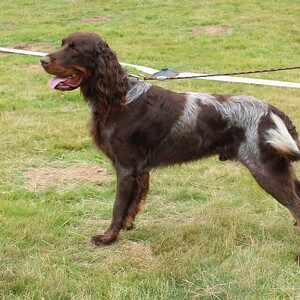
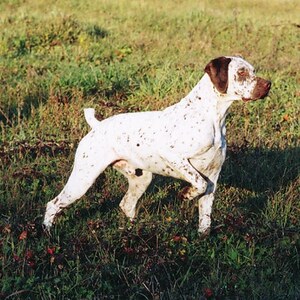
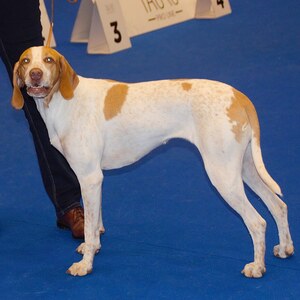
| Common colours | Orange and white, liver and white, black and white (FCI), tricolour, roan |
| Energy Level | Very high |
| Suitable for an apartment? | Depends on exercise, training, health and the individual dog |
| Temperament | Friendly, hard-working, enthusiastic |
| Behaviour towards unfamiliar people and dogs | Individual behaviour varies; socialisation, training and management matter |
| Compatibility with children | Depends on the individual; adult supervision and suitable handling are essential |
| Compatibility with other animals | Depends on socialisation, prey drive and the animals involved |
| Health considerations | Hip dysplasia, epilepsy, eye problems |
- Primary category:Dog breeds
- Explore this animal's categories:
History and Origin
The Brittany (Épagneul Breton) is a hunting dog from the Brittany region of north-western France, used for finding, pointing and retrieving game birds.
Evolution of the breed
- Early images - Dogs similar to the Brittany appear in French paintings and tapestries of the 17th and 18th centuries.
- A bird dog - The Brittany was developed to be fast and agile, to find birds, "point" them by standing still, and bring them back to the hunter.
- A recognised breed - French breeders wrote the first standard in 1907; the breed was brought to the United States in the early 1930s.
- Recognised by the AKC in 1934 - At first it was called the "Brittany Spaniel", but in 1982 the AKC dropped "Spaniel", because it hunts like a pointer.
Breed Evaluation
The Brittany is a clever, energetic and versatile dog, suitable for active families and hunters. These are general editorial ratings, not measured scores; individual dogs vary.
| Characteristic | Stars |
|---|---|
| Training and Intelligence | ★★★★★ |
| Easy to train | ★★★★★ |
| Intelligence | ★★★★★ |
| Level of independence | ★★★☆☆ |
| Level of stubbornness | ★★★☆☆ |
| Behavior and Temperament | ★★★★★ |
| Affectionate with family | ★★★★★ |
| Friendly with children | ★★★★★ |
| Compatible with other dogs | ★★★★☆ |
| Compatible with cats and other animals | ★★★☆☆ |
| Degree of loyalty | ★★★★★ |
| Tendency to be aggressive | ★☆☆☆☆ |
| Tendency to bark | ★★★☆☆ |
| Needs and Care | ★★★☆☆ |
| Shedding level | ★★★☆☆ |
| Requires frequent care | ★★★☆☆ |
| Activity and Lifestyle | ★★★★★ |
| Energy level | ★★★★★ |
| Daily exercise requirement | ★★★★★ |
| Suitable for apartment living | ★★☆☆☆ |
| Health and Longevity | ★★★★☆ |
| Life expectancy | ★★★★★ |
| Predisposition to genetic diseases | ★★★☆☆ |
| Work and Utility Features | ★★★★★ |
| Good hunting dog | ★★★★★ |
| Good companion dog | ★★★★★ |
Physical Characteristics
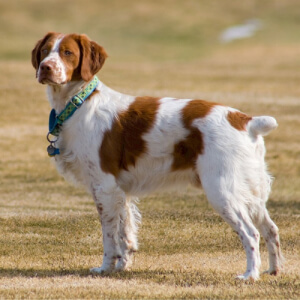
The Brittany is an athletic, compact and well-proportioned dog, built for speed and stamina.
General appearance
- A light, muscular body, about as long as it is tall.
- A dense, flat or slightly wavy coat, with light feathering on the ears and legs.
- Some dogs are born with a naturally short tail; in others the tail may be docked where this is legal, and many have a long tail.
- Fairly short, high-set, hanging ears covered with fine hair.
- Brown, amber or hazel eyes, matching the coat colour.
| Characteristic | Brittany |
|---|---|
| Size | Medium (about 44-52 cm at the shoulder) |
| Weight | About 13-18 kg |
| Coat | Dense, flat or slightly wavy |
| Muzzle | Medium length, tapering |
| Shedding tendency | Moderate |
| Build | Light but strong |
The Brittany is a fast, agile dog that can cover a lot of ground quickly, which makes it ideal for hunting and outdoor activities.
Training and Socialization
The Brittany is intelligent and eager to please, which makes it easy to train, but it needs consistent training and mental stimulation.
Tips for effective training
- Start early - The Brittany should be socialised and trained from about 8-10 weeks old.
- Positive methods - It responds best to food rewards and praise; it is sensitive and does not respond well to harshness.
- Hunting training - As a bird dog, it can learn to point, retrieve and stay focused in the field.
- Key commands - It should learn clear commands such as "come", "wait" and "fetch", especially as it may range far when hunting.
- Ongoing socialisation - Some Brittanys can be shy, so meeting people, other animals and new situations helps prevent fearfulness.
The Brittany is eager to learn, but it needs regular training and varied activities to stay balanced and happy.
Activity and Lifestyle Needs
The Brittany is one of the most energetic breeds and needs plenty of daily exercise to be healthy and happy.
| Activity | Recommended duration |
|---|---|
| Daily walks and runs | At least 60-90 min |
| Interactive games | About 30 min |
| Retrieving games | About 20-30 min |
| Obedience and field training | About 15-30 min |
Recommendations for a balanced lifestyle
- Good for active families - It suits people who love hiking, running and outdoor sports.
- Loves to run and retrieve - It is one of the fastest and most tireless bird dogs.
- Not for a quiet lifestyle - Without enough exercise, it may become destructive, hyperactive or anxious.
- A natural worker - It does well in hunting tests, field trials, agility and obedience.
The Brittany is an energetic working dog that suits active people and families who can give it plenty of physical and mental stimulation.
Care and Health
The Brittany is generally a healthy breed, but some inherited problems should be monitored.
Fur and skin care
- Brushing 1-2 times a week - The coat needs little care, but regular brushing removes dead hair and burrs.
- Occasional baths - As an active dog it often gets dirty, but it only needs washing when necessary.
- Ear checks and cleaning - Its hanging ears make it prone to ear infections.
Common health problems
| Condition | Description | Common symptoms |
|---|---|---|
| Hip dysplasia | Abnormal development of the hip joint | Difficulty walking, limping |
| Epilepsy | Seizures occur in the breed | Seizures, loss of consciousness |
| Eye problems | Including cataracts and progressive retinal atrophy | Poor vision, difficulty seeing at night |
| Ear infections | Hanging ears can trap moisture | Scratching, discharge, bad smell |
Other aspects of care
- Regular eye and ear checks - Because it is prone to eye problems and ear infections, it needs regular care.
- Weight control - Food should be matched to its activity, so it stays neither too thin nor overweight.
- Protecting young joints - Very hard exercise should be avoided while the dog is still growing.
The Brittany is a healthy, hardy breed, but it needs regular care and veterinary checks.
Diet and Nutrition
The Brittany needs a balanced diet with good-quality protein, matched to its high energy level.
Recommendations for a healthy diet
Choose a complete, balanced diet suited to age, size and health. Plan home-prepared diets and supplements with a qualified veterinarian; raw pet food can carry harmful bacteria.
| Food type | Daily Amount (Adults) | Frequency |
|---|---|---|
| Premium dry food | Individual amount; follow a complete diet’s guidance and veterinary advice | 2 meals/day |
| Home cooked food | Individual amount; follow a complete diet’s guidance and veterinary advice | 2 meals/day |
| Raw food: bacterial contamination is a concern | Individual amount; follow a complete diet’s guidance and veterinary advice | 2 meals/day |
Forbidden foods
Chocolate, grapes and raisins, onions and xylitol - toxic to dogs. ; Cooked bones - can splinter and cause intestinal blockage. ; Fatty or fried foods - can upset digestion and cause pancreatitis. ; Overfeeding - can lead to extra weight and joint problems.
The Brittany should get a balanced diet, without unhealthy food or overfeeding.
Reproduction and Development
Breeding requires veterinary planning, suitable health screening and care for the mother and puppies. Pregnancy and birth can involve complications.
Physical and emotional maturity
- Physical maturity: The Brittany reaches adult size at about 12-14 months, but continues to fill out until about 18 months.
- Emotional maturity: It can stay very playful and energetic until about 2-3 years and needs ongoing training and mental stimulation.
Mating and Gestation
- Breeding decisions require veterinary assessment of maturity, health and suitable screening; reaching a fixed age does not establish that breeding is appropriate.
- Duration of gestation: Approximately 58-68 days, usually about 63 days.
- Average number of puppies: Usually about 6-8 puppies.
Puppy care
- The first 3 weeks: Puppies depend completely on their mother for warmth and milk.
- Between 4-8 weeks: Socialisation begins; meeting different sounds, smells and places helps prevent shyness.
- Moving to a new home: When puppies go to their new homes, training should continue, as Brittanys learn very quickly.
The Brittany develops quickly, and good food, early socialisation and regular training are essential for healthy growth.
Curiosities and Interesting Facts
- An old French hunting dog - Dogs like the Brittany have been used in France for centuries.
- A pointer, not a spaniel - Although it was long called a spaniel, the Brittany points game like a pointer.
- Dual champions - The Brittany has more AKC "dual champions" (champions both in the show ring and in field trials) than any other breed.
- A water-resistant coat - Its dense coat protects it in wet vegetation, and many Brittanys enjoy swimming.
- Affectionate - Although it is a keen hunter, the Brittany loves people and is very attached to its family.
- Colours - In France, black and white Brittanys are allowed, but the American standard does not accept black.
- A smiling face - Some Brittanys pull back their lips in a "smile" when they are happy.
The Dog in Popular Culture
The Brittany is a favourite of bird hunters and active families, especially in France and the United States.
Brittany in modern media and culture
- Therapy dogs - Thanks to its gentle nature, the Brittany is sometimes used as a therapy dog.
- A companion for outdoor people - Many hikers and runners choose the Brittany because it can keep going on long trails.
Importance in modern culture
- A family dog for active people - Energetic, loyal and affectionate, the Brittany suits families who spend a lot of time outdoors.