GreyhoundCharacteristics, history, training and care
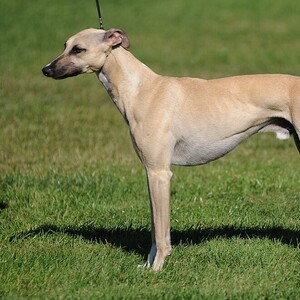
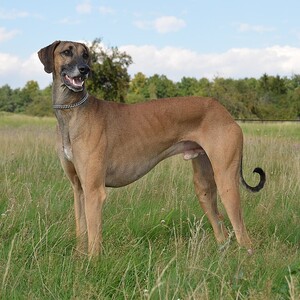
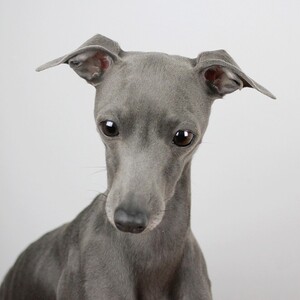
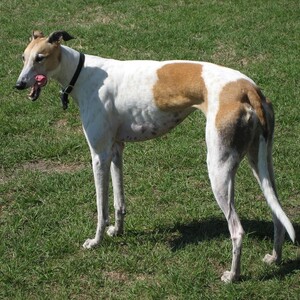
Greyhound. · Neurodoc / Wikimedia Commons, CC BY-SA 3.0. Cropped and resized.
The Greyhound is the English sighthound, a very old breed developed for hunting by sight and speed and later used for racing. The standard says that among animals only the cheetah is faster. At home, however, it is gentle, affectionate and even-tempered, and it likes to laze around all day.
Quick facts
| Common name | Greyhound (English sighthound) |
| Scientific name | Canis lupus familiaris |
| Country of origin | United Kingdom |
| Official recognition | FCI, definitively since 23 April 1955 (group 10, short-haired sighthounds; standard no. 158); also recognised by the AKC |
| Lifespan | 10–13 years, according to the AKC; a 2024 British study found 11.5 years |
| Size (males) | ideally 71–76 cm at the withers; about 29–32 kg (AKC) |
| Size (females) | ideally 68–71 cm at the withers; about 27–29 kg (AKC) |
| Coat type | Fine and close |
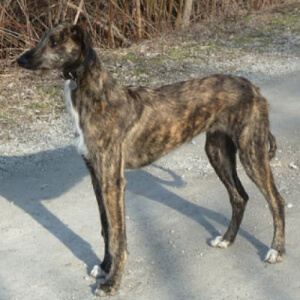
| Common colours | Black, white, red, blue, fawn, brindle, or any of these colours broken with white |
| Energy level | Low at home, very high when running |
| Suited to an apartment? | Yes, if it can run regularly in safety |
| Temperament | Intelligent, gentle, affectionate, even-tempered |
| Tendency to aggression | Very low |
| Good with children | Average |
| Good with other animals | Good with dogs; strong chasing instinct |
| Genetic predispositions | Bloat, heart disease |
- Primary category:Dog breeds
- Explore this animal's categories:
History and origin
The FCI standard says the Greyhound probably originated in the Middle East: drawings of sighthound-type dogs have been found on the walls of ancient Egyptian tombs dating back as far as 4,000 BC. Dogs of this type spread across Europe, but in Great Britain they were bred to a standard.
The coursing greyhound, which hunted live hares, was the basis of the racing Greyhound. The AKC says that in the past only aristocrats were allowed to keep Greyhounds. Wikipedia says it is the only dog mentioned by name in the Bible, in Proverbs 30.
How the breed developed
- Around 4000 BC – Sighthound-type dogs appear on the walls of Egyptian tombs.
- Middle Ages – Only aristocrats may keep Greyhounds.
- 23 April 1955 – The FCI recognises the breed.
- 8 September 2026 – the current FCI standard is published.
Breed rating
| Feature | Stars |
|---|---|
| Training and intelligence | ★★★☆☆ |
| Easy to train | ★★★☆☆ |
| Intelligence | ★★★★☆ |
| Independence | ★★★★☆ |
| Stubbornness | ★★★☆☆ |
| Behaviour and temperament | ★★★★☆ |
| Affectionate with family | ★★★★☆ |
| Friendly with children | ★★★☆☆ |
| Good with other dogs | ★★★★☆ |
| Good with cats and other animals | ★☆☆☆☆ |
| Loyalty | ★★★★☆ |
| Tendency to be aggressive | ★☆☆☆☆ |
| Tendency to bark | ★★★☆☆ |
| Needs and care | ★★★★☆ |
| Shedding | ★★☆☆☆ |
| Needs frequent grooming | ★☆☆☆☆ |
| Activity and lifestyle | ★★★★☆ |
| Energy level | ★★★★☆ |
| Daily exercise needs | ★★★★☆ |
| Suited to apartment life | ★★★★☆ |
| Health and longevity | ★★★★☆ |
| Life expectancy | ★★★★☆ |
| Predisposition to genetic diseases | ★★☆☆☆ |
| Working abilities and uses | ★★★★☆ |
| Good running dog | ★★★★☆ |
| Good companion dog | ★★★★★ |
Indicative rating: 5 stars means the highest level. It is based on the ratings the American Kennel Club gives the breed and on the FCI standard.
Physical characteristics
The standard describes it as a strongly built, upstanding dog of generous proportions, muscular power and symmetrical formation, with a long head and neck, a deep chest, slightly arched loins and powerful legs. Wikipedia says it has the flexible, “S”-shaped outline of the sighthounds.
General appearance
Its long legs, deep chest, flexible spine and slim body allow it very fast sprints. Wikipedia says that in races Greyhounds reach at least 69 km/h, with usual winning speeds of 58–61 km/h.
| Feature | Greyhound |
|---|---|
| Size | Large |
| Height at the withers | males: 71–76 cm; females: 68–71 cm |
| Weight | about 27–32 kg |
| Coat | Fine, close |
| Speed | over 69 km/h |
| Outline | “S”-shaped |
The standard accepts black, white, red, blue, fawn, brindle or any of these colours broken with white.
Training and socialisation
The standard says it has remarkable stamina and is intelligent, gentle, affectionate and even-tempered.
The AKC says training can be frustrating for anyone who does not understand a sighthound's nature. It was bred to chase game by sight, alone, making its own decisions, not at a human's command. It responds well to gentleness and rewards.
Tips for effective training
- Let it off the lead only in fenced areas. The AKC says it should only run where it is safe.
- Be gentle. It is sensitive.
- Be careful around small animals. It chases anything that runs.
- Give it a soft bed. It has little fat and prominent bones.
Activity needs and lifestyle
The AKC calls it the “cheetah of the dog world”. It is perfectly happy to laze around the house all day, but it shows astonishing speed and energy when it sees prey or a ball. It needs a regular exercise routine and chances to run at full speed in safety.
| Activity | How often | Why it matters |
|---|---|---|
| Walks on the lead | daily | Basic exercise |
| Sprint in a fenced area | several times a week | Its need for speed |
| Lure coursing | occasionally | Its chasing instinct |
Tips for a balanced life
- In winter it may need a coat, as it has little fat.
- Keep it on the lead near roads.
- It adapts well to a quiet life indoors.
Care and health
Coat and skin care
The AKC says the short, smooth coat needs very little care: regular baths and a weekly wipe with a damp cloth or a grooming mitt. The nails should be trimmed regularly and the ears checked weekly.
Common health problems
The AKC says Greyhounds are very healthy, with few major problems. Worth watching for:
| Condition | Description | Common symptoms |
|---|---|---|
| Gastric dilatation-volvulus (bloat) | The stomach fills with gas and may twist; this is a veterinary emergency | Swollen belly, trying to vomit without success, drooling, restlessness |
| Heart disease | Heart conditions | Tiredness, coughing, laboured breathing |
Other care
- Check the ears weekly.
- Trim the nails regularly.
- Brush its teeth regularly.
Diet and nutrition
The AKC says the breed usually needs somewhat more calories and protein than other dogs. The Greyhound should stay lean.
Tips for a healthy diet
The table gives a starting estimate, calculated with the formula from the Merck Veterinary Manual. The first two calorie columns show the calories per day for a healthy adult dog. The last column shows what this means in dry food with 3,500–4,000 kcal per kilogram.
| Dog's weight | Calories per day (neutered) | Calories per day (not neutered) | Dry food per day (approximate) |
|---|---|---|---|
| 27 kg | 1,330 kcal | 1,490 kcal | 330–430 g |
| 30 kg | 1,440 kcal | 1,620 kcal | 360–460 g |
| 32 kg | 1,510 kcal | 1,700 kcal | 380–490 g |
- Split the food into two meals a day to reduce the risk of bloat.
- Do not let it run right after a meal.
- In sighthounds, the ribs are easy to feel and see at the right weight.
Foods to avoid
Some human foods are dangerous for dogs: chocolate, coffee, grapes and raisins, onions, garlic, xylitol (a sweetener used in chewing gum), macadamia nuts and alcohol.
Reproduction and development
Physical and emotional maturity
In dogs, sexual maturity usually comes between 6 and 12 months, but in large breeds it can be delayed until about two years. The body also reaches its adult form later than in small breeds.
Mating and pregnancy
Pregnancy lasts about 63 days, counted from ovulation. Mating a female on her first heat is not recommended. The FCI standard requires that only healthy dogs of typical breed appearance are used for breeding.
Caring for the puppies
In large breeds, a litter has around 7 puppies on average. Socialisation starts in the first weeks: gentle handling, everyday noises and new people.
Interesting facts
- Second only to the cheetah. The standard says only the cheetah is faster.
- Mentioned in the Bible. Wikipedia says it is the only dog named in the Bible, in Proverbs 30.
- The dog of aristocrats. The AKC says that in the past only nobles could keep it.
- Lazy at home. It likes to sleep all day, even though it is very fast.
- On the walls of the pyramids. Sighthound-type dogs appear in Egyptian tombs.
In popular culture
In the Bible and in ancient Egypt
The FCI standard mentions the drawings of sighthound-type dogs on the walls of ancient Egyptian tombs. Wikipedia says the Greyhound is the only dog mentioned by name in the Bible, in Proverbs 30:29–31, among the “three things which go well”.
Frequently asked questions
How fast does a Greyhound run?
Wikipedia says it reaches at least 69 km/h in races.
How big does it get?
Males ideally measure 71–76 cm and females 68–71 cm at the withers.
Can it live in a block of flats?
Yes, if it can run regularly in safety; at home it is calm.
How long does it live?
The AKC gives 10–13 years; a 2024 British study found 11.5 years.