RabbitInteresting facts and information
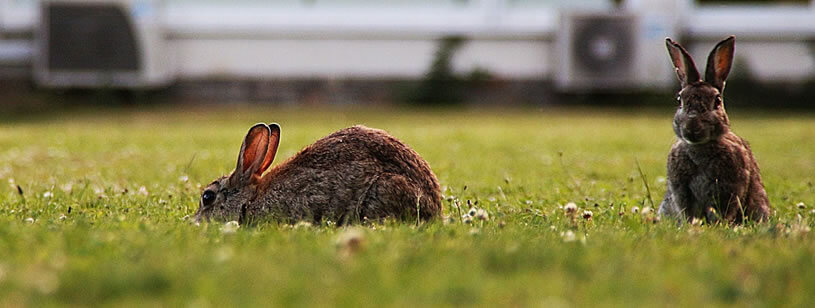
Domestic rabbits are descended from the European rabbit (Oryctolagus cuniculus). They were domesticated gradually, rather than at a single, well-dated moment. People keep them as companions and also raise them for other purposes.
There are many breeds of domestic rabbit, with different sizes, coats and ear shapes. Rabbits are lagomorphs, not rodents.
Although it is a gentle and friendly animal, the domestic rabbit keeps many of its wild instincts, such as the need to dig, to gnaw and to hide from possible predators.
Quick facts
| Common name | Domestic rabbit, house rabbit |
| Scientific name | Oryctolagus cuniculus (domestic form) |
| Typical lifespan | 7-12 years in captivity |
| Maximum speed | Varies with the rabbit's size, health and circumstances |
| Length | 30-50 cm (depending on breed) |
| Weight | 1-8 kg (depending on breed) |
| Diet type | Herbivore; grass or hay is the main food for pet rabbits, with suitable greens and a measured amount of pellets |
| Main predators | Dogs, cats, birds of prey, foxes |
| Conservation status | Not applicable (domesticated animal) |
| Distribution | Worldwide, as pets or on farms |
| Living environment | Homes, gardens and farms |
- Primary category:Mammals
- Explore this animal's categories:
Interesting facts
- Powerful hind legs – Rabbits can leap and change direction quickly when they move or escape danger.
- Ever-growing teeth – A rabbit's teeth grow throughout its life. A high-fibre diet based on grass or hay helps wear them down.
- An almost all-round view – Their eyes sit on the sides of the head, so rabbits can spot predators coming from almost any direction.
- They talk with their bodies – Foot thumping, ear position and jumps are some of the ways rabbits show how they feel.
- Rabbits cannot vomit – Their digestive system is very sensitive, so they should only be given safe foods.
- They learn familiar cues – Rabbits may recognise a familiar person's voice and learn to respond to sounds they hear often.
Records and remarkable features
Physical characteristics and adaptations
Domestic rabbits are plant-eating mammals descended from the European rabbit. Their size and appearance vary from breed to breed, while many of their behaviours, such as digging and hiding, come from their wild ancestors.
Key physical adaptations
- Compact, muscular body – Makes rabbits very agile, able to sprint quickly and make long jumps.
- Long ears (up to about 15 cm) – Help control body temperature by giving off heat. Large breeds tend to have longer ears, and dwarf breeds shorter ones.
- Wide field of view – Eyes on the sides of the head help rabbits notice movement all around them, although they still have blind spots.
- Continuously growing teeth – Grass and hay keep chewing and tooth wear normal; any suspected dental problem should be checked by a vet.
- Dense, soft fur – Protects against cold and damp. In some breeds, such as the Angora, the fur is so fine that it is spun into wool.
- Short, fluffy tail – Acts as a visual signal to other rabbits when they run.
- Strong hind legs – Allow jumps of up to about 3 metres in length and a fast escape from danger.
Some popular breeds of domestic rabbit
| Breed | Size | Features |
|---|---|---|
| English Spot | Medium (2.5-3.5 kg) | White coat with coloured spots, a "butterfly" mark on the nose and a stripe along the back |
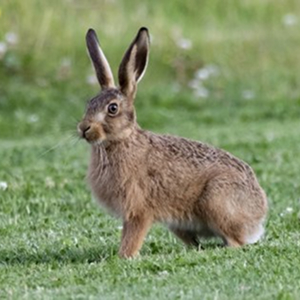
| Belgian Hare | Medium (3-4 kg) | Long, slender, hare-like body; a domestic rabbit despite its name |
| Holland Lop | Small (1-2 kg) | Drooping ears, calm temperament |
| Mini Rex | Small (about 1.5 kg) | Thick, velvety coat, playful temperament |
| English Angora | Medium (2-3 kg) | Very long wool that needs regular grooming |
Habits and behaviour
Although it is bred in captivity, the domestic rabbit keeps many of the natural behaviours of its wild ancestors, including the need to dig, to gnaw and to communicate through body language.
Daily life
- Active at dawn and dusk – Rabbits are most active in the early morning and evening, when they feed and explore.
- Varied personalities – Some rabbits are friendly and affectionate, while others are shy and more independent.
- Scent marking – Rabbits use scent glands, including glands under the chin, to mark their territory.
- They hide pain – As prey animals, rabbits do not easily show pain or stress, so health problems can be hard to spot.
Domestic rabbit body language
| Behaviour | Meaning |
|---|---|
| Thumping a hind foot | Alarm or annoyance |
| Jumping and twisting in the air | Happiness and excitement (called a "binky") |
| Lying relaxed on its side | The rabbit feels safe |
| Gentle nibbles or nudges | Curiosity or a request for attention |
| Scratching the floor or digging in the litter | Natural urge to dig; can also be a sign of boredom |
Defence techniques
- Fast zigzag running – When it feels threatened, a rabbit can run fast and change direction suddenly to escape.
- Freezing – If it spots a predator, it presses itself flat against the ground to avoid being seen.
- Screaming – In extreme danger or pain, a rabbit may scream loudly.
Habitat and geographic distribution
As a fully domesticated animal, the domestic rabbit is found all over the world, kept as a pet or raised for meat or fur.
The right living space
- Indoors – Rabbits need plenty of space, such as a large enclosure or a rabbit-safe room, with constant access to hay, hiding places and toys.
- Outdoors – Some owners build secure runs in the garden, but rabbits must be protected from predators and bad weather.
- On farms – Rabbits raised for meat or fur live in special housing and need proper care to stay healthy.
Coping with different climates
- Cold – Rabbits cope fairly well with cold if they have a dry, draught-free shelter.
- Heat – They are sensitive to heat and can suffer heatstroke at temperatures above about 30°C, so they need shade and good ventilation.
- Damp – Very humid or wet conditions can lead to skin and breathing problems.
The impact of rabbits on the environment
- An invasive species in some regions – In Australia and New Zealand, introduced European rabbits have multiplied rapidly and damaged natural ecosystems.
- Soil erosion – Large numbers of feral rabbits can damage land and farmland through grazing and burrowing.
- Harm to native wildlife – Feral rabbits compete with native animals for food and shelter and strip vegetation that other species need.
Diet and feeding
The domestic rabbit is a strict herbivore, with a digestive system specialised for high-fibre foods such as hay and grass. A balanced diet is essential for its health and helps prevent digestive and dental problems.
What does a domestic rabbit eat?
| Food group | Examples and context | How often |
|---|---|---|
| Hay (main food) | Timothy hay or meadow hay; alfalfa only for young rabbits | Unlimited, every day |
| Herbs and leafy greens | Parsley, carrot tops, rocket, some spinach | Daily, in moderate amounts |
| Vegetables | Carrots, bell peppers, cucumber | 2-3 times a week |
| Fruit | Apple, banana, watermelon, strawberries | Only occasionally, as a treat |
| Commercial pellets | High-fibre, hay-based pellets | 1-2 tablespoons a day |
| Fresh water | Clean drinking water | Always available, changed daily |
Foods to avoid
- Chocolate, coffee and tea – They are toxic to rabbits.
- Potatoes and onions – Can cause serious digestive and health problems.
- Dairy products – Rabbits cannot digest them properly.
- Bread, biscuits and processed grains – Can lead to obesity, digestive upsets and dental problems.
Digestive adaptations
- Fermentation in the caecum – Breaks down fibre and releases essential nutrients.
- Eating caecotrophs – Rabbits eat special soft droppings to digest them a second time and absorb more nutrients.
- Sensitive to sudden changes – Any change of diet should be made gradually to avoid digestive problems.
Reproduction and life cycle
Domestic rabbits are known for their remarkable ability to reproduce: they can breed quickly and often.
Breeding season
- No fixed season – Domestic rabbits can breed all year round if conditions allow.
- Induced ovulation – Females release eggs only when they mate.
Pregnancy and birth
| Feature | Details |
|---|---|
| Pregnancy | 28-32 days |
| Kits per litter | 4-12 (depending on the breed) |
| Weight at birth | About 50-80 g |
| Nursing period | 4-6 weeks |
Raising the young
- Baby rabbits, called kits, are born blind, hairless and completely dependent on their mother.
- At about 10 days old, their fur starts to grow and their eyes open.
- At about 3 weeks, the kits start eating solid food.
- At 6-8 weeks they are fully weaned and can leave their mother.
- They reach sexual maturity at 3-6 months, depending on the breed.
Survival
- In captivity, kits have a high survival rate when they are properly cared for.
- On farms, selective breeding has produced hardier breeds.
- Domestic rabbits that escape or are released into the wild survive poorly, because they are not adapted to avoid predators.
Name and history
Origin of the name
- The English word "rabbit" dates from the Middle Ages and probably comes from an Old French or Walloon word; the older English name for an adult rabbit was "coney".
- The scientific name Oryctolagus cuniculus combines Greek and Latin: Oryctolagus means "digging hare", and cuniculus is the Latin word for rabbit.
- In French, a domestic rabbit is called "lapin domestique".
Taxonomic classification
| Classification | Name |
|---|---|
| Kingdom | Animalia |
| Phylum | Chordata |
| Class | Mammalia |
| Order | Lagomorpha |
| Family | Leporidae |
| Genus | Oryctolagus |
| Species | Oryctolagus cuniculus |
| Subspecies | Oryctolagus cuniculus domesticus |
Evolution and domestication
- The ancestor of the domestic rabbit is the wild European rabbit (Oryctolagus cuniculus), native to the Iberian Peninsula and southern France.
- The Romans kept rabbits in walled enclosures called leporaria.
- In the Middle Ages, rabbits were bred in France, including in monasteries, for meat and fur.
- Between the 17th and 19th centuries, rabbits were taken to the Americas, Australia and other regions, where some populations became feral.
- During the 20th century, the domestic rabbit became a popular pet thanks to its appealing looks and gentle nature.
Cultural significance and mythology
Rabbits and hares appear in many stories and seasonal traditions. Their meaning differs between cultures, and a rabbit in a story is not necessarily a domestic rabbit.
The rabbit in myths and legends
- The Moon rabbit – Rabbits appear in several East Asian traditions about the Moon, with details that vary from story to story.
What the rabbit symbolises
- Fertility and abundance – Because rabbits breed so quickly, they are linked with plenty and prosperity.
- Luck and protection – In some cultures, a rabbit's foot is seen as a lucky charm.
- Speed and cleverness – The rabbit is a symbol of surviving through speed and cunning.
Conservation status and threats
As a domesticated animal, the domestic rabbit is not at risk of extinction. However, feral rabbit populations can harm the environment in some regions.
Conservation status
| Population | Status | Trend |
|---|---|---|
| Domestic rabbits | Not applicable | Stable |
| Feral populations (e.g. Australia, New Zealand) | Invasive species | Controlled, but still a major problem |
Main environmental problems
- Population explosions where rabbits were introduced – In Australia, rabbits released into the wild multiplied out of control and destroyed vegetation and farmland.
- Soil erosion – Burrowing and overgrazing destabilise the ground and harm local ecosystems.
- Disease – Diseases such as myxomatosis and rabbit haemorrhagic disease can pass between domestic and wild rabbits.
- Competition with native animals – Feral rabbits compete with native wildlife for food and shelter.
Management measures
- Neutering and responsible ownership – Pet rabbits should never be released into the wild.
- Control programmes – In Australia and New Zealand, authorities use rabbit-proof fencing and biological control to limit feral rabbit numbers.
- Conserving rare breeds – Some domestic rabbit breeds are carefully bred to stop them from dying out.
In popular culture
Rabbits are popular characters in books, films and cartoons, often shown as clever, funny and fast.
Film and animation
- Bugs Bunny (Warner Bros.) – One of the most famous cartoon rabbits, known for his cleverness and sarcastic humour.
- Alice in Wonderland (Disney, 1951) – The White Rabbit is a key character who stands for hurry and the passing of time.
- Watership Down (1978; 2018) – Screen adaptations of Richard Adams's novel about wild rabbits.
- Peter Rabbit (2018) – A film based on Beatrix Potter's stories about Peter Rabbit.
Books and literature
- Alice's Adventures in Wonderland (Lewis Carroll, 1865) – The White Rabbit is one of the best-known characters in literature.
- Watership Down (Richard Adams, 1972) – A powerful story about the lives and dangers of a group of rabbits.
- The Tale of Peter Rabbit (Beatrix Potter, 1902) – A children's story about a rabbit who sneaks into Mr McGregor's garden.
- The Easter Bunny – A folk tradition, especially in Europe and North America, in which a rabbit or hare brings Easter eggs.
Video games
- Rayman Raving Rabbids – A game full of crazy, funny rabbit-like creatures who cause chaos.
- Overgrowth – A game whose hero is a human-like rabbit skilled in martial arts.
- The Elder Scrolls V: Skyrim – Includes rabbits as part of the game's wildlife.
Mascots and symbols
- Brand logos – Some companies use a rabbit in their logo as a symbol of speed and energy.
- Easter traditions – The rabbit is one of the best-known symbols of Easter, linked with fertility and the return of spring.