Prague RatterCharacteristics, history, training and care
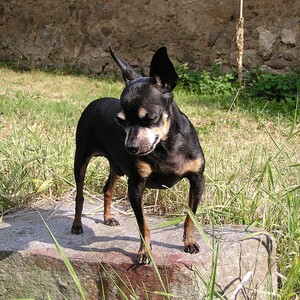
Prague Ratter. · Jenc / Wikimedia Commons, CC BY-SA 3.0. Cropped and resized.
The Prague Ratter (Pražský Krysařík) is one of the smallest dogs, only 21–23 cm tall and about 2.6 kg, elegant and quick. The name means “the ratter from Prague”. The standard describes it as gentle, curious and affectionate, a little reserved with strangers but very friendly within the family.
Quick facts
| Common name | Prague Ratter (Pražský Krysařík) |
| Scientific name | Canis lupus familiaris |
| Country of origin | Czech Republic |
| Official recognition | FCI, provisionally accepted (group 9, companion and toy dogs; standard no. 363) |
| Lifespan | No published data for the breed; small breeds usually live 12–15 years |
| Size (males) | 21–23 cm at the withers (±1 cm); ideally about 2.6 kg |
| Size (females) | 21–23 cm at the withers (±1 cm); ideally about 2.6 kg |
| Coat type | Short and glossy or moderately long, with feathering |
| Common colours | Black, brown or blue with tan; red; yellow |
| Energy level | Moderate |
| Suited to an apartment? | Yes |
| Temperament | Gentle, curious, affectionate, a little reserved with strangers |
| Tendency to aggression | Low |
| Good with children | Average; it is a very small dog |
| Good with other animals | Average |
| Genetic predispositions | No breed-specific diseases are known |
- Primary category:Dog breeds
- Explore this animal's categories:
History and origin
The FCI standard says the breed has been known since the distant past of the Czech state. Thanks to its small size, quick movement and very good sense of smell, it was used to kill rats, hence the name “Krysařík”.
This small, active dog was often seen at the feasts of the Czech kings at Prague Castle. It graced the courts of the Bohemian aristocracy and, as a royal gift, reached other European rulers and, later, ordinary people. The revival of the breed began successfully in 1980.
How the breed developed
- The distant past – A ratter in Bohemia.
- Middle Ages – At the feasts of the Czech kings, at Prague Castle.
- 1980 – The revival of the breed begins.
- 2019 – The FCI standard is published.
Breed rating
| Feature | Stars |
|---|---|
| Training and intelligence | ★★★☆☆ |
| Easy to train | ★★★☆☆ |
| Intelligence | ★★★★☆ |
| Independence | ★★★☆☆ |
| Stubbornness | ★★★☆☆ |
| Behaviour and temperament | ★★★★☆ |
| Affectionate with family | ★★★★★ |
| Friendly with children | ★★★☆☆ |
| Good with other dogs | ★★★☆☆ |
| Good with cats and other animals | ★★★☆☆ |
| Loyalty | ★★★★★ |
| Tendency to be aggressive | ★☆☆☆☆ |
| Tendency to bark | ★★★☆☆ |
| Needs and care | ★★★☆☆ |
| Shedding | ★☆☆☆☆ |
| Needs frequent grooming | ★★★★☆ |
| Activity and lifestyle | ★★★☆☆ |
| Energy level | ★★★☆☆ |
| Daily exercise needs | ★★★★★ |
| Suited to apartment life | ★★★★☆ |
| Health and longevity | ★★★☆☆ |
| Life expectancy | ★★★★☆ |
| Predisposition to genetic diseases | ★★☆☆☆ |
| Working abilities and uses | ★★★☆☆ |
| Good guard dog | ★★★☆☆ |
| Good companion dog | ★★★★★ |
Indicative rating: 5 stars means the highest level. The breed has no AKC profile, so the rating is based on the FCI standard.
Physical characteristics
It is a very small, quick dog, with good movement and a steady gait. Wikipedia says it resembles a Chihuahua or a Miniature Pinscher.
General appearance
The skull is rounded in profile, with the eyes set wide apart. There are two coat varieties: short, glossy and close-lying, or moderately long, with feathering on the ears, legs and tail.
| Feature | Prague Ratter |
|---|---|
| Size | Very small |
| Height at the withers | 21–23 cm (±1 cm) |
| Weight | ideally about 2.6 kg |
| Coat | Short or moderately long |
| Skull | Rounded |
| Movement | Quick |
The accepted colours are black, brown or blue with tan markings, including the diluted shades, as well as yellow and red, in the richest shades.
Training and socialisation
The standard describes it as gentle, curious and affectionate, with natural nobility and character. By nature it is a little reserved with strangers, but very friendly within the family.
As it is very small, it should be trained gently and with small rewards, and early socialisation helps it stay well balanced.
Tips for effective training
- Be gentle. It is a very small, sensitive dog.
- Use small rewards. Calories count at its size.
- Socialise it from puppyhood. It is a little reserved with strangers.
- Take care around small children. It can be injured easily.
Activity needs and lifestyle
It is a small, active dog that enjoys daily walks and play indoors.
| Activity | How often | Why it matters |
|---|---|---|
| Short walks | daily | Exercise |
| Indoor play | daily | Keeps it active |
| Search games | several times a week | A very good nose |
Tips for a balanced life
- It suits an apartment very well.
- In winter, dress it warmly.
- Keep it from jumping down from heights.
Care and health
Coat and skin care
The short coat should be wiped or brushed once a week; the longer coat is brushed twice a week.
Common health problems
There are no published health studies for the breed and no known breed-specific diseases. As with all very small dogs, it is worth watching for:
| Condition | Description | Common symptoms |
|---|---|---|
| Patellar luxation | The kneecap slips out of place | Suddenly holds a hind leg up for a few steps, then uses it again |
| Dental problems | The small teeth crowd together and build up tartar easily | Bad breath, red gums |
Other care
- Brush its teeth often.
- Trim the nails regularly.
- Keep it warm in winter.
Diet and nutrition
Such a small dog needs small portions, but of good-quality food suited to very small breeds.
Tips for a healthy diet
The table gives a starting estimate, calculated with the formula from the Merck Veterinary Manual. The first two calorie columns show the calories per day for a healthy adult dog. The last column shows what this means in dry food with 3,500–4,000 kcal per kilogram.
| Dog's weight | Calories per day (neutered) | Calories per day (not neutered) | Dry food per day (approximate) |
|---|---|---|---|
| 2 kg | 190 kcal | 210 kcal | 48–60 g |
| 2.6 kg | 230 kcal | 260 kcal | 58–74 g |
| 3.5 kg | 290 kcal | 320 kcal | 72–91 g |
- Feed it three small meals a day.
- Treats count towards the daily portion.
- Choose very small kibble.
Foods to avoid
Some human foods are dangerous for dogs: chocolate, coffee, grapes and raisins, onions, garlic, xylitol (a sweetener used in chewing gum), macadamia nuts and alcohol.
Reproduction and development
Physical and emotional maturity
In dogs, sexual maturity usually comes between 6 and 12 months. Small breeds become adults faster than large ones, usually at around one year.
Mating and pregnancy
Pregnancy lasts about 63 days, counted from ovulation. Mating a female on her first heat is not recommended. The FCI standard requires that only healthy dogs of typical breed appearance are used for breeding.
Caring for the puppies
In small breeds, a litter has 3–4 puppies on average. The puppies are very small and fragile in the first weeks, so they must be kept warm and handled with care. Socialisation starts early: gentle handling, everyday noises and new people.
Interesting facts
- The ratter. That is what “Krysařík” means.
- At the kings' feasts. It was seen at the feasts of the Czech kings at Prague Castle.
- A royal gift. The kings of Bohemia gave it to other European rulers.
- Very small. It is only 21–23 cm tall and weighs about 2.6 kg.
- Revived in 1980. The breed has been successfully revived since 1980.
Frequently asked questions
What does “Krysařík” mean?
Ratter, in Czech.
How big does it get?
21–23 cm and about 2.6 kg.
Is it suited to an apartment?
Yes, it is a very small dog.
Is it recognised by the FCI?
Yes, it is provisionally accepted.